
Legal in House Counsel: Roles, Duties and How to Hire
November 26, 2026 · 17 min read · Five Star Placements

Table of contents
The vendor agreement has sat in a shared drive for eleven days. Sales needs it countersigned by Friday, procurement keeps asking about an indemnity clause nobody can explain, and the outside firm that reviewed the previous version billed six hours for a document your team has seen forty times. Someone has now asked to approve a new in-house lawyer, and the justification slide has one word on it: workload.
That slide is where most legal hiring conversations go wrong. Workload is a symptom. The decision is about capacity: which work should sit with counsel, which should sit with legal operations, which should run on templates and workflow software, and which should stay with an outside firm because it's rare, specialist or high stakes. Answer that badly and you hire a lawyer to feed an inefficient system.
This guide is written for both readers in that decision. One is the executive, HR leader or general counsel deciding whether to hire. The other is the lawyer deciding whether to move in-house. It covers what the job contains, how the titles differ, how work splits between inside and outside counsel, and how to build a hiring brief or a career plan that survives contact with a budget.
Table of Contents
- What In-House Counsel Actually Do Day to Day
- Specializations and Where Each Role Fits
- In-House Counsel Versus Law Firm Practice
- Responsibilities Beyond Legal Advice
- How Companies Split Work Between Inside and Outside Counsel
- What to Define Before Hiring an In-House Counsel
- Qualifications and How to Pursue an In-House Role
What In-House Counsel Actually Do Day to Day
Think of an in-house lawyer as staff and outside counsel as a specialist contractor. Staff know the building, the politics, the product roadmap and the last three contracts signed with the same supplier. A contractor arrives with deep expertise in the narrow question, charges for every hour, and leaves once the matter closes.

The work itself moves through four recurring areas.
- Contracts. Reviewing, redlining and negotiating vendor, customer, partner and employment agreements, then tracking renewals and obligations after signature.
- Advice before the decision. Sitting with product, sales and HR while a plan is still flexible, so the legal problem is designed out instead of argued about later.
- Disputes and regulators. Handling demand letters, managing outside litigation counsel, responding to regulator inquiries and deciding when to settle.
- Policy and records. Keeping the entity list, board minutes, delegations of authority and internal policies current enough to survive an audit.
A week in the chair
Monday morning is redlines on a vendor agreement, with three comments that each need a five-minute phone call rather than an email. Mid-morning the product team wants to know whether a new feature can collect location data from customers in two countries, and they need an answer before a build decision that afternoon. The afternoon goes to a demand letter from a former supplier, which means reading the contract, calling the business owner and writing a short position memo for the chief executive.
Month end brings the executive update: two contracts signed, one dispute contained, one policy approved, and a note that the sales team keeps promising delivery dates the standard terms don't support.
Companies keep lawyers inside for three reasons. Answers arrive in hours rather than days. Routine matters stop generating outside-firm invoices. And the lawyer accumulates business knowledge that a firm would have to rebuild from scratch on every engagement. None of that is about legal brilliance. It's about proximity.
The job description, in the end, is written by the business, not by the lawyer. What a company needs from counsel varies enormously by stage and sector, which is why the titles below describe different jobs rather than seniority levels.
Specializations and Where Each Role Fits
| Role | Core work | Typical trigger | Works most with |
|---|---|---|---|
| General Counsel | Legal strategy, enterprise risk, board advice, leads the legal team | Growth, a new executive team, major disputes | CEO, board, executive team |
| Corporate Counsel | Governance, entity records, everyday commercial advice | Board meetings, new subsidiaries, routine business questions | Finance, operations, sales |
| Compliance Counsel | Regulatory programs, policies, investigations | New regulation, audits, licensing changes | Compliance, HR, internal audit |
| Intellectual Property Counsel | Patents, trademarks, licensing, infringement | New product launch, brand disputes | Product, R&D, marketing |
| M&A Counsel | Deal diligence, drafting, post-closing integration | Acquisitions, divestitures, joint ventures | Corporate development, finance, outside deal teams |
| Contracts Counsel | Templates, negotiation, vendor and customer agreements | High contract volume, procurement growth | Sales, procurement, operations |
| Tax Counsel | Tax structure, audits, tax disputes | Cross-border expansion, tax audits | Finance, tax department, outside advisers |
Read the table in two layers. The general counsel row is the frame: that person sets legal strategy, owns the department, and usually reports to the chief executive or the board. Every other row is a specialist who either reports into that function or sits alongside it. The Association of Corporate Counsel's 2025 Chief Legal Officers Survey shows why these are live hires rather than org-chart decoration: 30% of chief legal officers planned to increase the number of lawyers they hire in 2025, rising to nearly 50% among larger companies. The same survey reports that 43% expected to increase the volume of work outsourced to law firms, which tells you internal and external capacity are usually built together, not as alternatives.
The governance core
Corporate counsel work looks administrative until it isn't. Entity records, subsidiary filings, board minutes and delegations of authority are the paper trail a regulator or acquirer reads first. A company that has just opened three foreign subsidiaries needs someone who can keep that structure coherent.
Compliance counsel builds the machine rather than operating it case by case: the code of conduct, the training cycle, the monitoring plan, the investigation protocol. The trigger is almost always external, a new regulation, a licensing change or an audit finding.
Intellectual property counsel tends to arrive with the first serious product launch or the first brand dispute. Patents, trademarks and licensing all need someone who can read a claims chart and talk to engineers.
The transaction roles
M&A counsel earns their keep in diligence, where a missed liability costs more than the entire legal budget for the year. They also own post-closing integration, which is where most deal value leaks away.
Contracts counsel is the highest-volume role in the table. Templates, clause libraries, negotiation playbooks and vendor agreements. This is a capacity hire more often than a prestige hire, and it should be measured that way.
Tax counsel sits at the intersection of structure and dispute. Cross-border expansion triggers the first, and a tax authority triggers the second.
Titles stretch with company size. A fifty-person company may have one lawyer doing every row in that table badly and cheerfully. A multinational separates them and adds privacy, employment and litigation specialists on top.
Practical rule: match the title to the workload you actually have, not the one on the org chart you copied from a bigger competitor. A corporate legal department structure should follow the matter mix, and most department charts don't.
In-House Counsel Versus Law Firm Practice
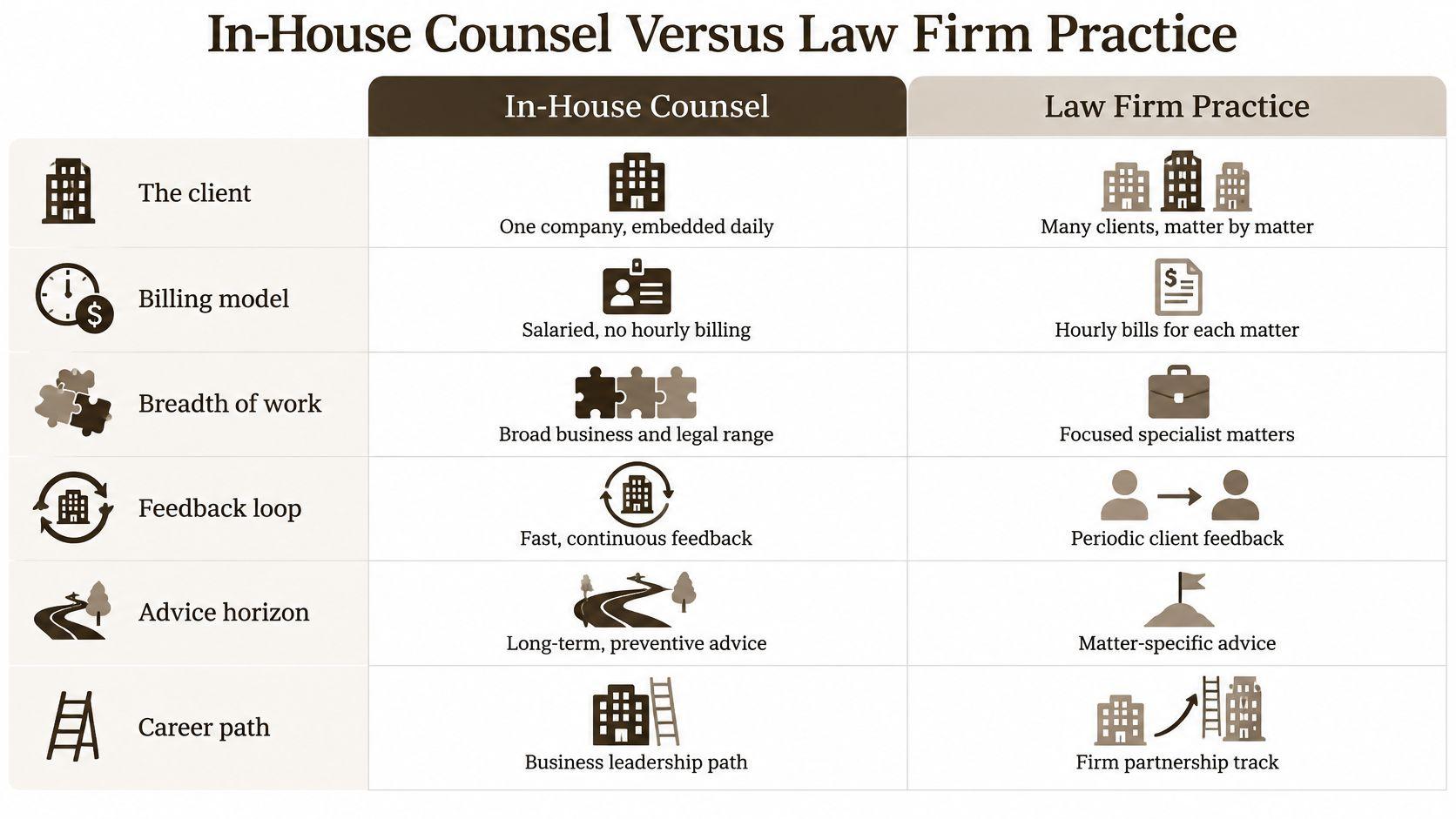
The two models differ on six things that matter to anyone choosing between them or hiring across the line.
| Criterion | In-house counsel | Law firm lawyer |
|---|---|---|
| Client | One company | Many clients |
| Billing model | Salaried | Usually billed by the hour |
| Breadth of work | Broad business exposure, narrower in some specialties | Deep in one practice area across varied matters |
| Feedback loop | Sees the results of advice for years | Rarely sees a clause after drafting it |
| Advice horizon | Ongoing advice to the same business | Advice given matter by matter |
| Career path | Moves up within the legal department or to general counsel | Progresses through firm ranks |
Start with the feedback loop, because it shapes everything else. A firm associate drafts an indemnity clause, sends it to a partner, and moves to the next file. They may never learn whether that clause was accepted, rejected, or tested in a dispute eighteen months later. The in-house lawyer negotiates the same clause, signs the contract, and manages the renewal two years later when the supplier's pricing model has changed.
Where the trade-offs land
Breadth cuts both ways. In-house lawyers see the whole business, from hiring to pricing to a factory lease, which makes them commercially fluent fast. But they often lose depth in a specialty because the volume isn't there to sustain it. A litigator who moves in-house and handles two disputes a year will not stay sharp on procedure the way a firm lawyer with twenty active matters does.
The colleagues problem is real too. A firm puts a junior lawyer in a corridor with people who have argued the same motion a hundred times. An in-house department of three may have nobody who has ever run the specific matter in front of them, which is exactly when outside counsel earns the fee.
Pay structure differs in ways that surprise people. The firm model rewards hours and origination. The in-house model rewards judgment, scope control and the ability to say no to the business without becoming the department everyone routes around.
The honest question isn't which model is better. It's which one matches how you like to work: deep, varied case work with a scoreboard, or sustained involvement in one business where you watch your own advice play out.
Responsibilities Beyond Legal Advice
Legal teams didn't ask for artificial intelligence to land on their desks, but it did. The 2025 ACC Law Department Management Benchmarking Report, published by the Association of Corporate Counsel and Major, Lindsey & Africa, found that 52% of surveyed companies had implemented artificial-intelligence tools in 2025, up from 34% the prior year. Every one of those tools arrived with a contract to review, a data-handling question, a usage policy nobody had drafted, and a business sponsor who wanted it live last month.
Three areas that now sit with counsel
The mandate keeps widening. The Association of Corporate Counsel's 2025 Law Department Management Benchmarking Report recorded a 7% increase in chief legal officer oversight of compliance and an 8% increase in risk-management oversight, with a 5% increase in ESG leadership responsibilities. In practice that means the general counsel often owns the enterprise risk register, chairs the compliance committee, and sits with the audit committee rather than briefing it.
- Governance and disclosure. Supplier codes of conduct, sustainability reporting, whistleblower channels and the board pack that ties them together.
- Operations. Legal intake, matter management, e-billing, knowledge tools, and the budget line for outside spend. Someone has to decide which software the department buys and what cycle time it should produce.
- Cyber and privacy. Coordinating with security on incident response, deciding what gets notified to a regulator, and reviewing the contracts that carry the data.
Picture a general counsel introducing an AI contract-review tool. The purchase is the easy part. They set intake rules so that only agreements above a value threshold go to the tool, define what a reviewer must still read manually, measure cycle time before and after, and write the internal usage policy that tells the business what may and may not be pasted into a public model.
None of that is legal analysis in the narrow sense. It's stakeholder management and prioritization, and those are the skills that separate a strong in-house lawyer from a strong legal technician.
How Companies Split Work Between Inside and Outside Counsel
The 2025 Legisway Benchmark published by Wolters Kluwer found that in-house teams handled 62% of their workload internally in 2025, while 8% was outsourced to law firms and 2% to alternative legal-service providers. The remainder is spread across other arrangements, but the shape is clear: most legal work already sits inside the company, and outside firms handle the tail.
That tail is where hiring decisions get made. Routine, repeating work that still goes to a firm is the strongest argument for a capacity hire. Specialist, infrequent work is the strongest argument for keeping the relationship as it is.
Running the numbers on one type of matter
Say a team sends twenty routine non-disclosure agreements a month to an outside firm. Assume three hours each at the firm's standard hourly rate. Multiply it out for a year, add the internal time spent instructing the firm and chasing status, and you have the annual cost of a workflow that a contracts counsel on salary could absorb in a fraction of their week.
The comparison isn't salary against invoice. It's salary plus benefits plus desk cost plus software against invoice plus internal instruction time plus the delay cost of waiting for external turnaround. Run both sides, and the answer usually becomes obvious, in one direction or the other.
A simple audit produces that answer:
- List last quarter's outside matters. Every instruction, including the small ones that never got a formal engagement letter.
- Group them by type. NDAs, vendor agreements, employment questions, one-off litigation, regulatory advice.
- Count the repeats. Anything appearing three or more times in a quarter is a candidate for internal handling.
- Mark what could move. Flag each group as in-house ready, needs a template, or specialist.
That list also exposes what the routine work is crowding out. Corporate lawyers average 49 hours a week, and 62% say they lack sufficient time to complete everything they would like to do, according to Juro's State of In-House 2026 report. Every hour spent supervising outsourced NDAs is an hour not spent on the acquisition, the regulator or the product launch.
What to Define Before Hiring an In-House Counsel
Under-resourcing is an operating risk, not a scheduling annoyance. The 2025 Legal Department Operations Index from Thomson Reuters reports that departments short of resources see increased workload and burnout, along with reduced capacity for proactive risk management and process improvement. The same benchmarking data puts median estimated spending at roughly $3 million on fully loaded internal staff costs and $5 million on outside counsel, which is why a single hire has to be judged against the whole cost model rather than a salary band.
Six items decide everything else, and all six are workload questions before they are hiring questions.
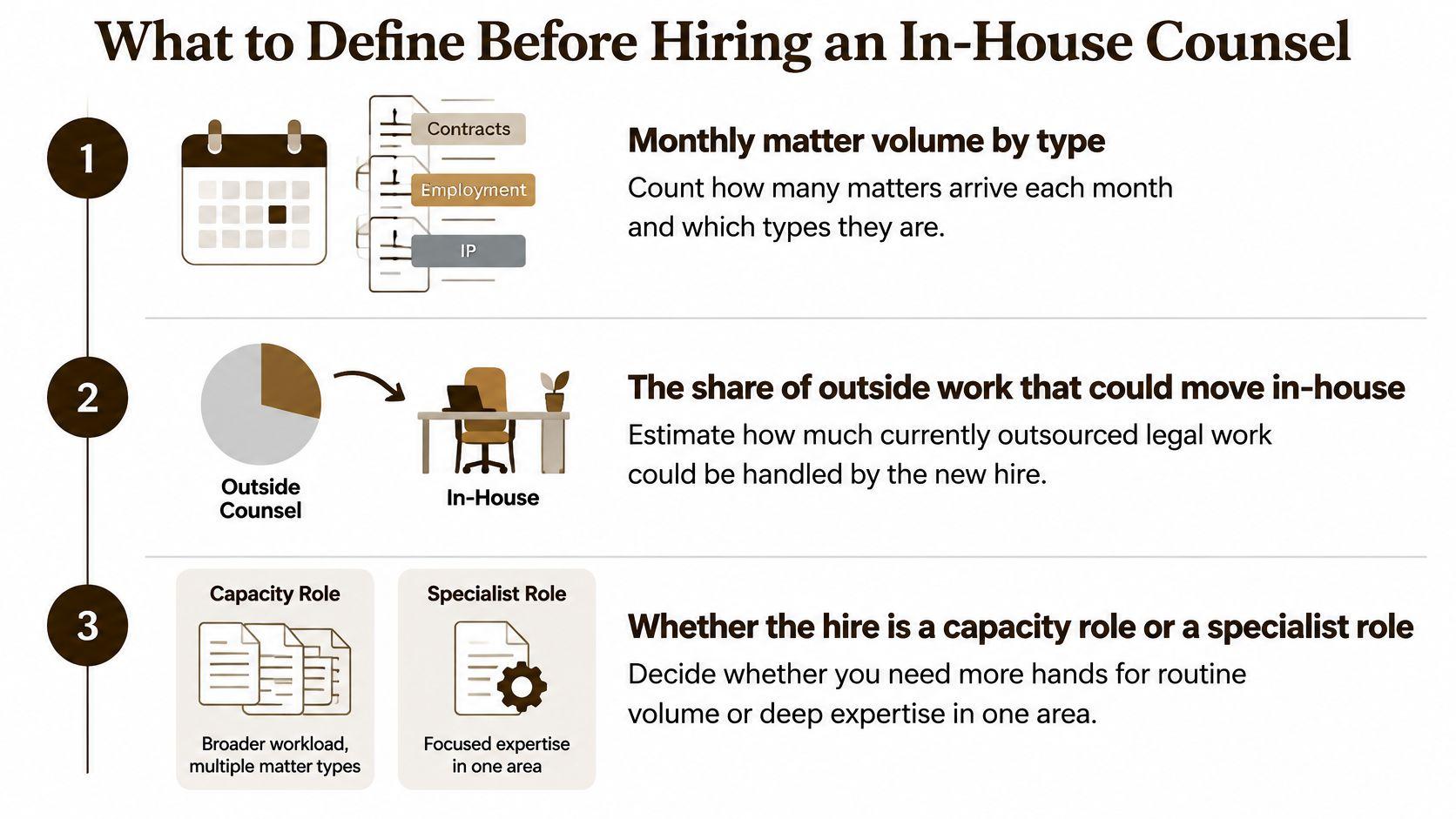
Six items to settle first
- Monthly matter volume by type. Count what arrives and what it is, not how busy everyone feels. A queue of forty NDAs a month and a queue of four share purchase agreements are both volume, but they need different people.
- The share of outside work that could move inside. Use the audit from the previous step; this number is the business case.
- Capacity or specialist. Decide which one before you write the title, because they screen differently.
- Seniority and reporting line. Does the role report to the general counsel, the chief executive or the finance lead? The answer changes who applies.
- Non-legal scope. Compliance, risk, privacy, legal operations. Write it down or it will be assigned by accident, and the person you hired to clear the contracts queue ends up running policy training instead.
- Screening criteria. Practice-ready experience, commercial judgment, and the ability to explain a risk to a sales director in one minute.
Notice what is missing from that list: the job title. Titles come last, because the same workload can justify a contracts counsel, a commercial counsel or a legal operations hire with contract automation software. The first five items tell you which.
Capacity roles and specialist roles
A capacity role exists to absorb volume and reduce outside spend. Contracts counsel, commercial counsel and generalist corporate counsel fit here. The person needs process discipline, a talent for prioritization, and the temperament to run a template library without treating every clause as a negotiation. Measure them on cycle time, matters handled and external spend avoided.
A specialist role exists to cover risk. Tax counsel, M&A counsel, privacy counsel and IP counsel fit here. Their value shows up in coverage and execution, in deals closed without a surprise and audits survived without findings. Judging a tax counsel on contract turnaround misses the point entirely.
Some work belongs to neither. High-volume, low-judgment tasks like intake triage and signature routing often sit better with operations staff or technology than with a salaried attorney. Bespoke, once-a-decade matters like a major acquisition or a bet-the-company dispute stay with outside firms no matter who you hire. The honest version of the plan assigns every recurring matter type to one of four owners: counsel, operations, technology or an outside firm. Hiring one lawyer and hoping the sorting happens on its own is how legal departments end up expensive and overwhelmed at the same time.
Build the business case in four lines: hours recovered from the business, outside spend avoided, cycle time reduced, and risk now covered internally. A headcount request written that way gets a different hearing from one that says workload.
Write the brief before you write the job description. Most bad in-house hires are a good lawyer matched to an unexamined problem.
Then vet properly. A recruiter working only in legal talks with every candidate before a client sees them, checks bar status and the matters they handled, and confirms genuine interest in this role rather than any role. That's how we work at Five Star Placements: every candidate we send has spoken with us on a call before you see them, and we vet credentials, bar status, matters handled and fit. Because we recruit exclusively for law firms and legal departments, the screening is built around legal work rather than generic hiring criteria. For a longer walkthrough, this video covers the search process from the client side.
A search brief built this way also tells a recruiter what to screen out. If the underlying problem is a contracts queue, a brilliant M&A lawyer will be bored in six months and gone in twelve. If you're structuring the hire as a general counsel search, the brief has to name the board exposure and the team the person will build, not just the years of experience.
Qualifications and How to Pursue an In-House Role
Hiring managers screen for three things. Practice-ready experience, usually several years at a firm or in another legal department. Current bar admission in the jurisdiction where the company operates. And evidence you can operate without a partner reviewing your work, which is the defining difference between firm and in-house performance.
Notice what those three screens measure. They are capacity questions. Can this person absorb a steady stream of matters without supervision, week after week, and still catch details? That is why the qualification bar shifts depending on what kind of work the role exists to carry.
Specialist roles expect a track record in the field. Nobody hires a tax counsel who has never structured a cross-border payment flow. Capacity roles expect something different: proof you can handle high volume without dropping detail, and that you've built or improved a process rather than just survived one. If the queue is contracts, the winning candidate is the one who cut turnaround time somewhere else, because the role is really about throughput. If the queue is regulatory judgment calls, the winning candidate is the one who has already made those calls and can defend them.
Compare offers on total value. In-house pay is salaried and often carries a bonus and benefits component, and the mix shifts with company size, industry and region. A higher base at a smaller company can lose to a lower base with a real bonus, better equity and a shorter commute.
The pursuit plan
- List the matter types you handle now and estimate monthly volume for each. Ten NDAs, two vendor agreements, one employment dispute. Concrete numbers, not adjectives.
- Match that mix to actual openings. Read each job posting as a workload statement: which of your matter types would you be absorbing there, and at what volume?
- Name the gap. Missing deal experience, no privacy work, no exposure to board reporting. Then close it, through a secondment, a stretch matter or a certification. A certification signals interest; a stretch matter with a result signals capacity, and capacity is what gets hired.
- Target one or two openings where the employer's needs match your demonstrated strengths. Applying broadly to every general counsel posting is aspiration-driven searching, and it mostly produces silence.
If you use a recruiter, compare at least two, ask for placement and retention records, and confirm they vet candidates before presenting them. Your application should be confidential, and no recruiter should contact your employer without your permission. Since the move into a legal department differs enough from lateral firm moves to deserve its own playbook, the guide on how to go in-house from a law firm walks through the transition from the candidate side.
One question decides the rest. Do you want sustained involvement in one business, watching your advice compound over years, or varied case work across many clients with a scoreboard at the end of the year? The first path rewards breadth, process instinct and tolerance for repetitive volume. The second rewards depth and competitive pace.
Five Star Placements recruits in-house counsel for corporate legal departments, from contracts counsel to general counsel. Because it works exclusively in legal, its recruiters read a candidate's matter mix the same way a hiring manager does, as a capacity picture rather than a resume. If you're weighing a hire or a move, bring your matter types and volumes, and the conversation starts from what the work is. Visit Five Star Placements to schedule a call.
Need help filling a legal role?
Five Star Placements partners with law firms and legal departments nationwide.
Schedule a Call