
In House Counsel Jobs Maryland: Where to Find Openings
November 8, 2026 · 14 min read · Five Star Placements

Table of contents
Seventy-four percent of general counsel identify adaptability as the most critical success skill, according to LHH's coverage of in-house legal hiring trends. For attorneys searching for in-house counsel jobs in Maryland, that changes the pitch: employers need more than a practice-area match. They need someone who can make defensible decisions, explain trade-offs to business leaders, and take ownership without waiting for perfectly organized instructions.
Table of Contents
- Maryland In-House Counsel Market Size and Pay
- Where to Find Maryland In-House Counsel Openings
- Working With Legal Recruiters and Your Network
- How to Position Your Experience for Corporate Counsel Roles
- Questions That Reveal Role Scope and Fit
- Maryland Hiring Considerations
- Build Your Maryland Shortlist This Week
Maryland In-House Counsel Market Size and Pay
Maryland has a substantial legal employment base, not a niche market. The BLS May 2022 estimates below cover lawyers across employer types and the broader legal-occupation group, not a standalone count of corporate counsel positions.
Maryland legal labor market at a glance, using the U.S. Bureau of Labor Statistics' Maryland occupational estimates:
| Measure | Value |
|---|---|
| Lawyers employed in Maryland (May 2022) | 12,950 |
| Lawyers per 1,000 jobs statewide | 4.904 |
| Location quotient | 1.03 |
| Mean lawyer hourly wage | $76.03 |
| Mean lawyer annual wage | $158,150 |
| Legal-occupation group jobs | 24,200 |
| Legal-occupation mean annual wage | $119,180 |
The lawyer employment count shows the size of the professional pool in which corporate legal departments recruit. The location quotient indicates that Maryland's share of lawyer employment was close to the national average, rather than unusually concentrated relative to its overall employment base.
The broader legal-occupation group includes paralegals, legal assistants, judges, court reporters, and other legal workers. Its wage measure isn't an appropriate substitute for an attorney compensation benchmark.
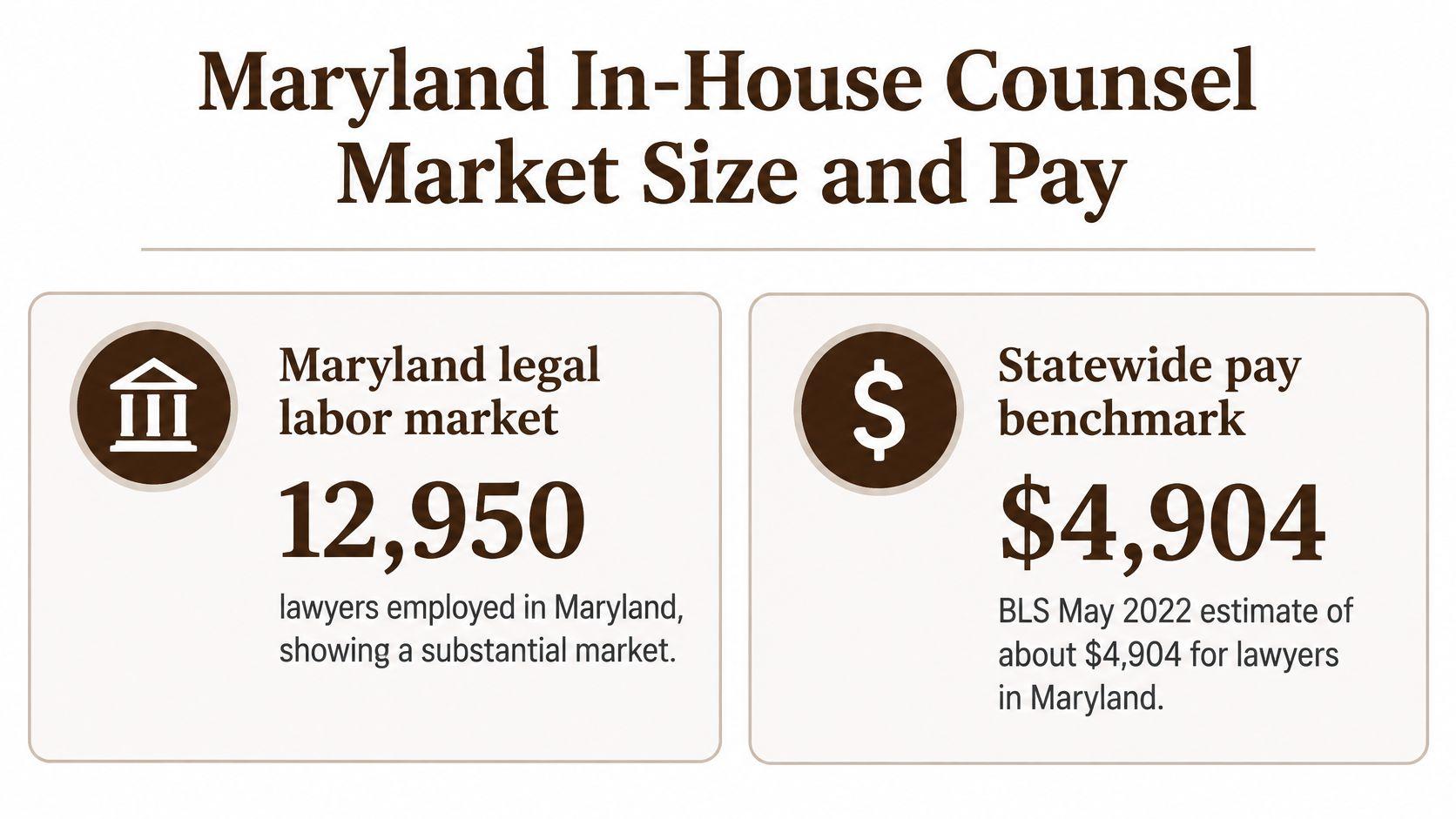
Read the infographic alongside the table: the statewide employment-density figure is lawyers per thousand jobs, not a dollar-denominated pay benchmark.
What the wage benchmark means for your search
Corporate legal departments compete with law firms, government offices, and other legal employers for licensed attorneys. Your compensation comparison should therefore account for what you're giving up, including specialization, promotion prospects, schedule flexibility, and the resources available to support your work.
A statewide mean isn't a personalized offer range. It combines lawyers with different responsibilities, seniority, and specialties, and it reflects historical wages rather than today's advertised packages. Don't assume that a corporate counsel title automatically warrants a premium or that moving in-house necessarily means accepting less.
Compare the actual package in separate components:
- Guaranteed compensation: Establish base salary before discussing discretionary incentives.
- Variable compensation: Ask how bonuses are determined and what conditions attach to equity.
- Role economics: Identify travel, availability expectations, and the cost of losing existing benefits.
- Career value: Evaluate access to executives, ownership of meaningful matters, and a credible promotion path.
Practical rule: Use the statewide lawyer mean as a question starter, not an acceptance threshold.
When a posting discloses salary, compare it with the annual mean in the table, then ask which responsibilities justify the difference. A narrow advisory position with substantial support and a broad counsel role covering several business functions shouldn't be evaluated as interchangeable jobs.
Where to Find Maryland In-House Counsel Openings
Sourcing channels for Maryland in-house counsel roles
| Channel | Best for | Effort | Watch for |
|---|---|---|---|
| Job boards filtered for in-house or corporate counsel | Volume and quick scans | Low, a brief daily review | Stale or recycled postings; check the posting date |
| Specialist legal recruiters | Senior and confidential roles | Medium, requires responsive calls | Confirm their Maryland client mix and fee structure |
| Bar association and practice section listings | Roles tied to privacy, contracts or regulatory work | Low to medium | Listings can lag behind open requisitions |
| Former colleagues and alumni networks | Roles not yet posted | High, requires regular outreach | Ask directly rather than waiting for a posting |
| Direct applications to company legal departments | Healthcare, defense, technology, financial services and life sciences | Medium, requires company research | Use the company careers page; no third-party fee |
Use these channels for different purposes rather than treating every listing as a separate opportunity. Your tracker should identify the employer and requisition, so a recruiter advertisement and a company posting don't become duplicate applications.
Turn each channel into an action
Job boards: Save searches for corporate counsel, commercial counsel, associate general counsel, and compliance counsel, then verify promising listings on the employer's careers page. Search by substantive work as well as title, because a useful contracts or privacy position may not appear under your preferred label.
Specialist recruiters: Review current legal openings and prepare a short statement of your target responsibilities, location constraints, and relevant matters. A recruiter can evaluate that brief more effectively than a request for anything in-house.
Bar and practice listings: Check the association's career resources alongside relevant committee communications. Use these channels to identify employers seeking your specialty, then confirm that the requisition remains active before investing in a customized application.
Former colleagues and alumni: Ask for an introduction to a named lawyer or department, not a general promise to keep you in mind. Give the contact a concise explanation they can forward without rewriting it.
Direct applications: Build a company list by sector and apply through the employer's careers page when there's a genuine match. Read the legal leadership biographies and business description first, so your application explains why your experience belongs in that organization.
Decide where your effort belongs
If you're changing sectors, prioritize conversations that help you understand the employer's terminology and risk priorities. If you already have closely matched substantive experience, spend more effort on targeted applications and recruiter discussions about active requirements.
Don't confuse application volume with progress. An application deserves time when you can identify the business need, demonstrate relevant ownership, and explain any material gap.
Keep adjacent positions separate from your counsel shortlist. A legal operations, contract administration, or compliance role may be attractive, but investigate whether it involves attorney responsibilities, a different promotion path, or a deliberate move away from practicing law.
Working With Legal Recruiters and Your Network
Qualify the recruiter before authorizing outreach
Ask: Which employers and legal functions does your network cover? A recruiter's concentration matters more than a broad claim of market access. Our candidate network and placement record are concentrated in boutique and midsize law firms and companies hiring in-house counsel, and we work exclusively with law firms and legal departments rather than placing non-legal roles.
Ask: What will you share, and who must approve it? Establish submission boundaries before providing sensitive information. Applications to Five Star Placements are confidential, and we won't contact your employer without your permission; with any recruiter, also clarify how introductions and references will be coordinated.
Ask: Have you worked with this company before, and how directly do you know the hiring team? Distinguish an established client relationship from someone forwarding candidates against a public advertisement. You want to understand which details the recruiter has confirmed and which remain open questions.
Ask: Who does the position report to, and which matters will the lawyer own? A useful initial conversation should distinguish advisory responsibility from final decision authority. Ask whether the lawyer will negotiate directly, supervise outside counsel, manage staff, or provide recommendations for another attorney's approval.
Use this guide to working with a recruiter to prepare your expectations before the first substantive call. Bring an accurate résumé and a clear account of what would make a move worthwhile.
A recruiter can explain an opportunity and advocate for your fit. You still need to decide whether the job solves the right career problem.
Give your network an answerable request
Ask: Who would be the most useful person for me to speak with about this department? A former colleague can answer that more easily than a broad request for job-search help. Explain the type of work you want, why their introduction is relevant, and what you'd like to learn.
Keep a simple Excel or Google Sheets tracker:
| Field | What to record |
|---|---|
| Company | Employer and legal function |
| Contact | Name, relationship, and introduction route |
| Last contact | Most recent exchange |
| Stage | Research, introduction, application, or interview |
| Next action | Specific follow-up and owner |
Ask: What should I understand before approaching the team? Use informal conversations to learn how the department interacts with finance, procurement, compliance, and operating leaders. Don't ask contacts to disclose confidential searches or internal disputes.
At Maryland bar or practice-section events, discuss substantive work before asking about openings. A thoughtful conversation about contract escalation or regulatory implementation gives another lawyer a reason to remember you beyond your availability.
How to Position Your Experience for Corporate Counsel Roles
Backgrounds mapped to employer types
| Background | Employer types that value it | Evidence to show |
|---|---|---|
| Regulatory and compliance | Healthcare, life sciences, financial services | Filed responses, audit closures, exposure figures |
| Privacy and cybersecurity | Technology, healthcare, financial services | Incident response, policy rollouts, vendor reviews |
| Commercial contracts | Technology, defense, life sciences | Turnaround time, template or playbook ownership |
| Legal operations and process | Any sector with growing legal teams | Contract templates, matter tracking, tool adoption |
| Law firm or government practice | Employers wanting broad, fast-moving judgment | Matter scope, decision authority, client-facing outcomes |
The useful connection is between your background and the employer's work, not between your current title and its advertised title. Prepare examples that show how you'd contribute inside a business team.

Maryland's legal-services industry employed 18.2 thousand people in December 2023, according to Federal Reserve economic data sourced from BLS. That industry measure describes the surrounding legal-services ecosystem, not the number of in-house counsel, but it helps explain why candidates bring varied litigation, transactional, and advisory backgrounds to corporate searches.
Translate matters into business evidence
-
Describe the full matter. Record scope, decision authority, dollar exposure, cycle time, and outcome where those details are available and disclosable. Separate what you personally decided from what the partner, agency, or client approved.
-
Lead with the problem solved. Replace a résumé summary built entirely around practice labels with a concise description of the business problems you can handle. Use an attorney résumé format that makes relevant ownership easy to locate.
-
Match the company's substantive needs. Identify the contracts, regulatory, privacy, or employment work that overlaps with the opening. Don't rename general litigation experience as specialized regulatory counseling without supporting matters.
-
Show plain-language advice. Prepare an example of explaining alternatives to a non-lawyer decision-maker. Include the recommendation, the rejected option, and the reason for the trade-off.
-
Make process work visible. Templates, escalation rules, matter tracking, and tool adoption demonstrate operational fluency. Explain your role in designing or implementing them rather than merely listing software.
For a hypothetical vendor-dispute matter, replace a task description such as handled vendor contract disputes for clients with an evidence-led statement: Led resolution of vendor disputes, assessed financial exposure, advised procurement on settlement options, and revised escalation procedures to prevent repeat issues. Add actual amounts and timing only when your records support them.
Use the video as a prompt to rehearse how you explain your professional value.
Make the transition credible
Law-firm candidates should distinguish legal analysis from client counseling. Government attorneys should explain how they exercised discretion, managed stakeholders, and implemented requirements, while respecting confidentiality and any applicable transition restrictions.
Legal operations candidates need to distinguish process leadership from legal judgment. Operational fluency strengthens a counsel application, but it doesn't replace the attorney qualifications and substantive experience the employer requires.
Questions That Reveal Role Scope and Fit
A counsel title tells you little about whether you'll own a manageable specialty or become the default contact for every unresolved legal issue. Test workload, authority, and resources before negotiating the final package.
The Association of Corporate Counsel's law department benchmarking methodology uses lawyers per US$1 billion in company revenue, calculated by dividing internal lawyer headcount by company revenue expressed in billions. It's a useful scope check, not a staffing prescription.
Calculate the ratio, then investigate
Consider a hypothetical company with US$2 billion in revenue and four internal lawyers. Its ratio is 2.0 lawyers per US$1 billion; a hypothetical department with eight lawyers at the same revenue has a ratio of 4.0.
The larger ratio indicates more internal lawyers relative to revenue. It doesn't prove that individual lawyers have heavier workloads or more specialized assignments, because outsourcing, regulatory complexity, and business structure can change the picture.
| Scope input | What it helps you test |
|---|---|
| Revenue and internal lawyer headcount | Staffing relative to business scale |
| Business units and geography | Breadth of stakeholders and jurisdictions |
| Recurring matter intake | Predictability of daily workload |
| Transactions and investigations | Exposure to episodic demand |
| Outside counsel resources | Available specialist and overflow support |
If the employer won't disclose revenue, ask for a usable range or discuss staffing against business units and matter categories instead. Mark unknown inputs rather than manufacturing a precise ratio from incomplete information.
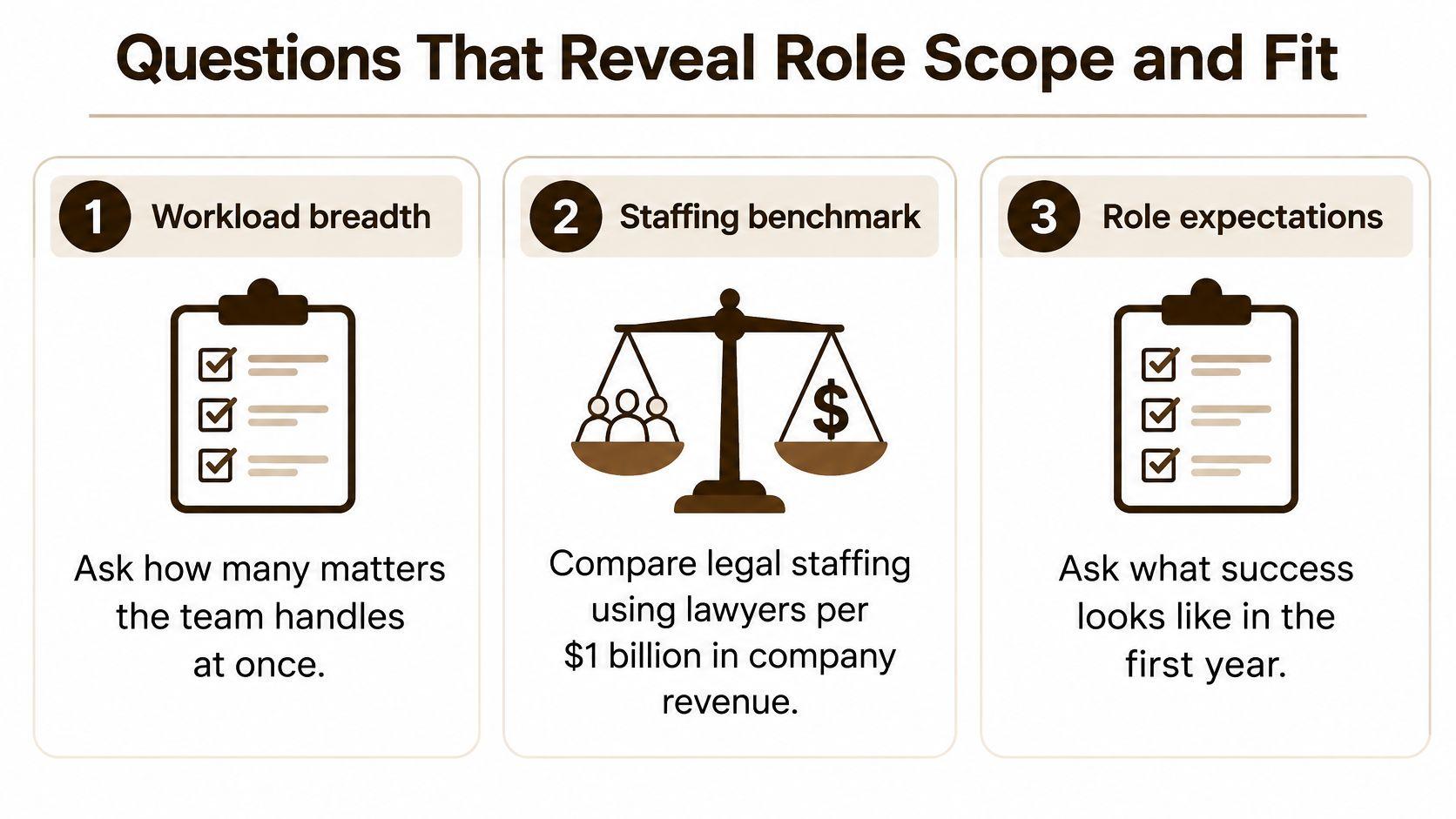
Bring an interview checklist
- Work arriving: Which matters recur, and which create sudden peaks?
- Decision rights: What can this lawyer resolve without escalation?
- Business coverage: Which functions, locations, and subsidiaries fall within the assignment?
- External support: Who authorizes outside counsel, and is the budget usable?
- Priority conflicts: Who decides when a commercial deadline competes with a compliance investigation?
- Success measures: What deliverables will the hiring manager use to evaluate performance?
Ask for concrete examples. If the manager says the priority is faster contracting, clarify whether the obstacle is lawyer capacity, incomplete intake, procurement approvals, or unresolved risk policy.
A broad role can be a strong career move when the lawyer has authority and support. Breadth without either can leave you accountable for outcomes you can't control.
Don't rely on a generic lawyer-to-employee rule. A company's employees don't reveal its transaction complexity, dispute exposure, outsourcing choices, or growth plans.
Before accepting, summarize the expected responsibilities in your own words and ask the hiring manager to confirm them. Differences between that summary and the posting deserve a conversation, not an optimistic assumption.
Maryland Hiring Considerations
Check the posting against your actual eligibility
Run these checks before investing in a specialized application. Treat ambiguity as something to resolve, not permission to assume the most favorable interpretation.
-
Confirm the work location. Distinguish an on-site Maryland position from hybrid work, a remote role open to Maryland residents, or a listing tagged to Maryland for advertising purposes. Ask where your manager and business stakeholders work, since that can affect travel and availability.
-
Read the licensing requirement precisely. Determine whether the employer requires Maryland admission or accepts admission elsewhere. A posting isn't legal authorization to practice, so verify applicable admission or registration requirements through the relevant bar authority when necessary.
-
Identify the sector-specific gap. For healthcare, defense, technology, financial services, or life sciences targets, separate required experience from preferred familiarity. Explain transferable strengths without claiming expertise you haven't developed.
-
Clarify immediate compliance ownership. Determine whether you'll advise an established compliance team or personally administer reporting, investigations, policy updates, and training. Those assignments require different preparation and support.
-
Test the handover. Ask whether you're replacing someone, joining an established function, or building the position from scratch. Find out who will explain existing matters and where institutional knowledge is documented.
Before applying: Separate an inconvenient requirement from a disqualifying one. A commute may be negotiable; professional eligibility needs a verified answer.
Record unresolved requirements in your tracker. That gives you a focused agenda for the recruiter screen and prevents repeated applications to roles that don't fit your constraints.
Build Your Maryland Shortlist This Week
A seven-day working plan
Use this as a proposed schedule, not an application quota. Finish with a small set of employers you can approach intelligently rather than a spreadsheet full of names.
-
Day one, define your targets. List Maryland employers with corporate legal departments and group them by sector. Add a sentence explaining why each company might need your strongest experience.
-
Day two, establish alerts. Set job-board searches for corporate counsel, associate general counsel, and compliance counsel. Save each target employer's careers page and record the exact requisition for active matches.
-
Day three, prepare evidence. Rewrite your strongest matters around ownership and business outcomes. Remove confidential details and flag any figures that need verification.
-
Day four, test scope. Gather available staffing and revenue information for your leading targets. Record unanswered workload questions rather than assigning a misleading fit score.
-
Day five, start a recruiter conversation. Send a concise target brief covering responsibilities, geography, and constraints. Ask which requirements appear realistic for your background.
-
Day six, request introductions. Contact former colleagues with a named employer and a specific reason for the conversation. Make the request easy to forward.
-
Day seven, choose the first approach. Select the strongest fit, tailor your résumé, and decide whether to apply directly or proceed through an authorized recruiter introduction.
Attorneys considering a move can tell us what they're looking for, and we'll contact them when a strong fit opens in our network. Keep your own target list active while that matching process runs.
Finish by writing down the single employer you'll approach directly this month, the person or application route you'll use, and your reason for choosing it.
Five Star Placements helps companies recruit in-house counsel and matches attorneys with opportunities aligned to employer requirements. Visit Five Star Placements to discuss your Maryland search, including your preferred responsibilities, location constraints, and the experience you want your next role to use.
Need help filling a legal role?
Five Star Placements partners with law firms and legal departments nationwide.
Schedule a Call