
Working with a Recruiter: A Practical Guide for Candidates
October 27, 2026 · 13 min read · Five Star Placements
Table of contents
You have two firms in your inbox and no clean way to tell which lateral move fits your book. Or you posted one counsel role, watched hundreds of résumés arrive, and still have nobody senior enough to run the work. Working with a recruiter is not a personality fit. It is a service agreement with response times, screening rules, and an exit. Treat it that way or you will spend weeks on a search that was never live.
Table of Contents
- When a Recruiter Is Worth Engaging
- How to Prepare Before Your First Recruiter Call
- Questions to Ask Before You Commit
- How the Search Runs Week by Week
- Handling Silence, Changing Scope and Ghosting
- Setting Up a Recruiter-Led Search
- Confirm the Terms and Start This Week
When a Recruiter Is Worth Engaging
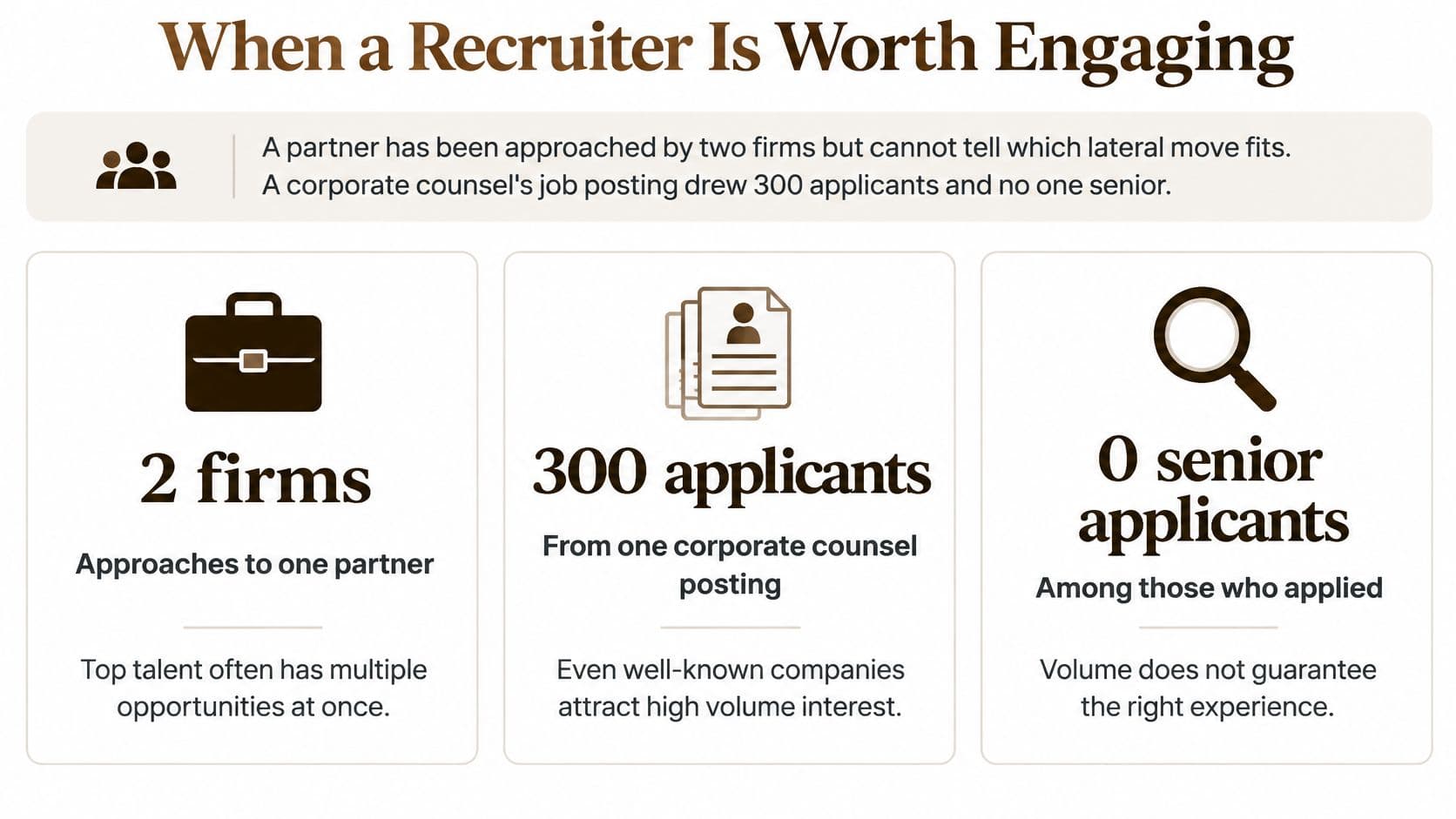
A partner weighing approaches from two firms needs a way to compare platform, compensation, and client conflicts. A corporate counsel posting that draws many applicants but no one ready to lead the practice presents a different problem. A recruiter earns a role when the search depends on access or judgment your team cannot provide internally.
| Situation | Recruiter fit | Why it matters |
|---|---|---|
| Partner or lateral move | High | Many potential partners are not applying publicly, so a recruiter can approach them confidentially |
| Specialized attorney (Tax, Immigration, Trusts and Estates) | High | A narrow talent pool makes an established recruiter network useful |
| In-house counsel or legal operations leader | High | Confidentiality and compensation discussions can shape the search |
| Paralegal or legal assistant hired in volume | Medium | Referrals and job boards may work; a recruiter can help clear a hiring backlog |
| Entry-level role with many applicants | Low | Direct applications are often a practical, low-cost route |
Recruiters are most useful when qualified candidates are unlikely to apply to a public posting. The network matters only if it reaches attorneys whose practice mix, seniority, and goals fit the role. Ask how the recruiter will identify those candidates and what they will confirm before presenting someone.
The relationship should work as a two-way service agreement. Set expectations for response times, what counts as a qualified candidate, and how the recruiter screens for AI use in application materials or screening processes. Agree on an exit rule too: if the search changes, stalls, or produces no suitable candidates, both sides should know when and how to pause or end the engagement.
If you are comparing public listings before hiring a search firm, use a focused approach to find attorney jobs. That helps distinguish roles you can pursue directly from searches that need confidential outreach or a recruiter's candidate network.
Weigh the fee against the cost of leaving the role open. SHRM's 2025 recruiting benchmarks report a median time-to-fill of about one and a half months for both executive and nonexecutive roles. During that time, matters still need coverage, client work still arrives, and colleagues may absorb the vacancy. The fit depends on whether a recruiter can reach stronger candidates or reduce the burden enough to justify the fee.
Use a recruiter when the search needs access or discretion your team lacks. For a role that a public posting can fill, handle the search directly.
How to Prepare Before Your First Recruiter Call
A first call goes badly when the recruiter has to invent your story. Fix the materials before you pick up the phone.
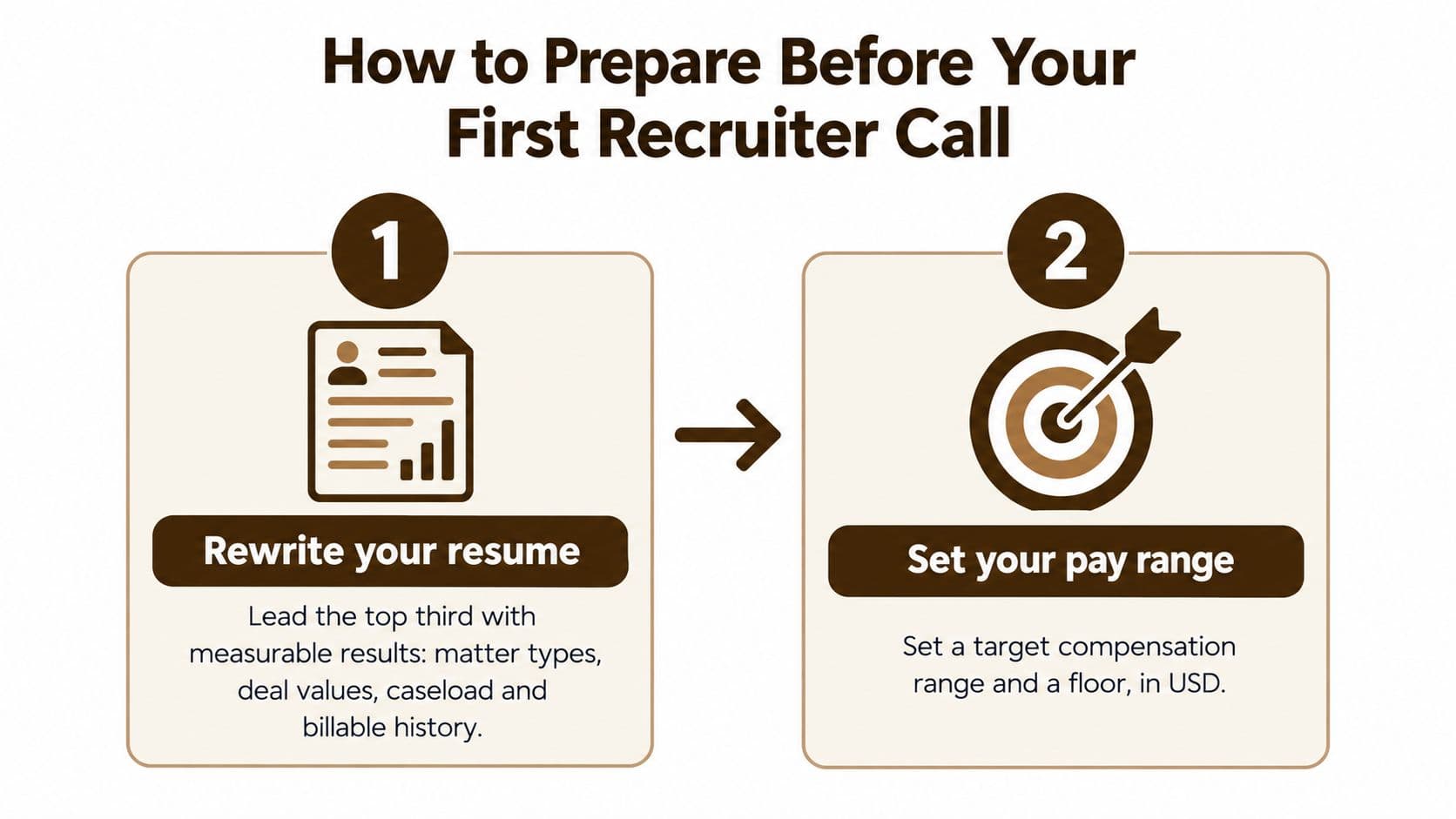
- Rewrite the top third of the résumé around results. Lead with matter types, deal values, caseload, and billable history. Duties without numbers get you sorted into the wrong practice. A clean attorney résumé format keeps that evidence above the fold.
- Set a target range and a floor. Include base, bonus structure, and any partnership or equity track, in dollars. A range with no floor invites a low opening offer you then have to unwind.
- Split must-haves from preferences. Practice area, city, remote days, and who you report to belong on the hard list. Title polish and office amenities don't.
- Write the confidentiality limits. Name the clients, matters, and current employer you won't be submitted to without written permission. If you leave this blank, a well-meaning recruiter will guess.
- Draft a 60-second pitch. Cover practice, seniority, the move you want, and why now. Rambling on the first call gets summarized badly in the submission note.
- Put bar admissions on one list. Jurisdiction, status, and any pending applications. A missing admission is the most common reason a fit candidate never gets sent.
- Confirm notice, non-solicit, and garden leave. Know the weeks you owe and what you can say to clients. Surprise restrictions kill start dates after the offer is already out.
Watch a short walk-through of how a prepared candidate sounds on that first call, then come back to your own list.
Why this order
Recruiters present candidates within days of a live brief. A missing bar date or an unstated notice period costs you a submission you could have won, because the hiring partner moves to the next name on the sheet. Do the paperwork first so the call is about fit, not cleanup.
Questions to Ask Before You Commit
Don't commit after a friendly intro. Put seven questions on the table and judge the answer, not the tone.

Is AI used to source or screen you, and will a person review your materials? A good answer names the human reviewer and the stage where that review happens. In the Dice trust-gap survey, 68% of technology professionals distrust fully AI-driven hiring, and 92% believe keyword tools can miss qualified candidates. Portable business, court experience, and writing quality don't survive a keyword filter. AI for administrative matching is fine if a person stays accountable for the judgment.
What goes to the employer, and in what order? You want the document list and the sequence. Nothing should leave the recruiter before your written consent.
Which clients and roles are you being sent to, and has your name already gone out? A good answer names each firm and the date. "A few firms in your market" is not an answer.
How are matter details, pay history, and lateral plans protected? Look for a written confidentiality commitment, not a promise to "be discreet."
What happens if an automated screen rejects you? There should be a human re-review path you can trigger. A dead end with no appeal is a reason to walk.
Is any fee charged to you, and is the model contingency or retained? The employer pays. Contingency means the firm is paid only on hire, but you should still ask whether you are represented exclusively or shopped widely.
Is the search approved and active? Ask how many interview stages remain and whether internal or competing candidates are in the mix. Dates and stage counts are the test. A vague reassurance is a warning sign.
If the recruiter can't say who reads your file, where it goes, and who pays, you don't have a search. You have a contact list.
How the Search Runs Week by Week
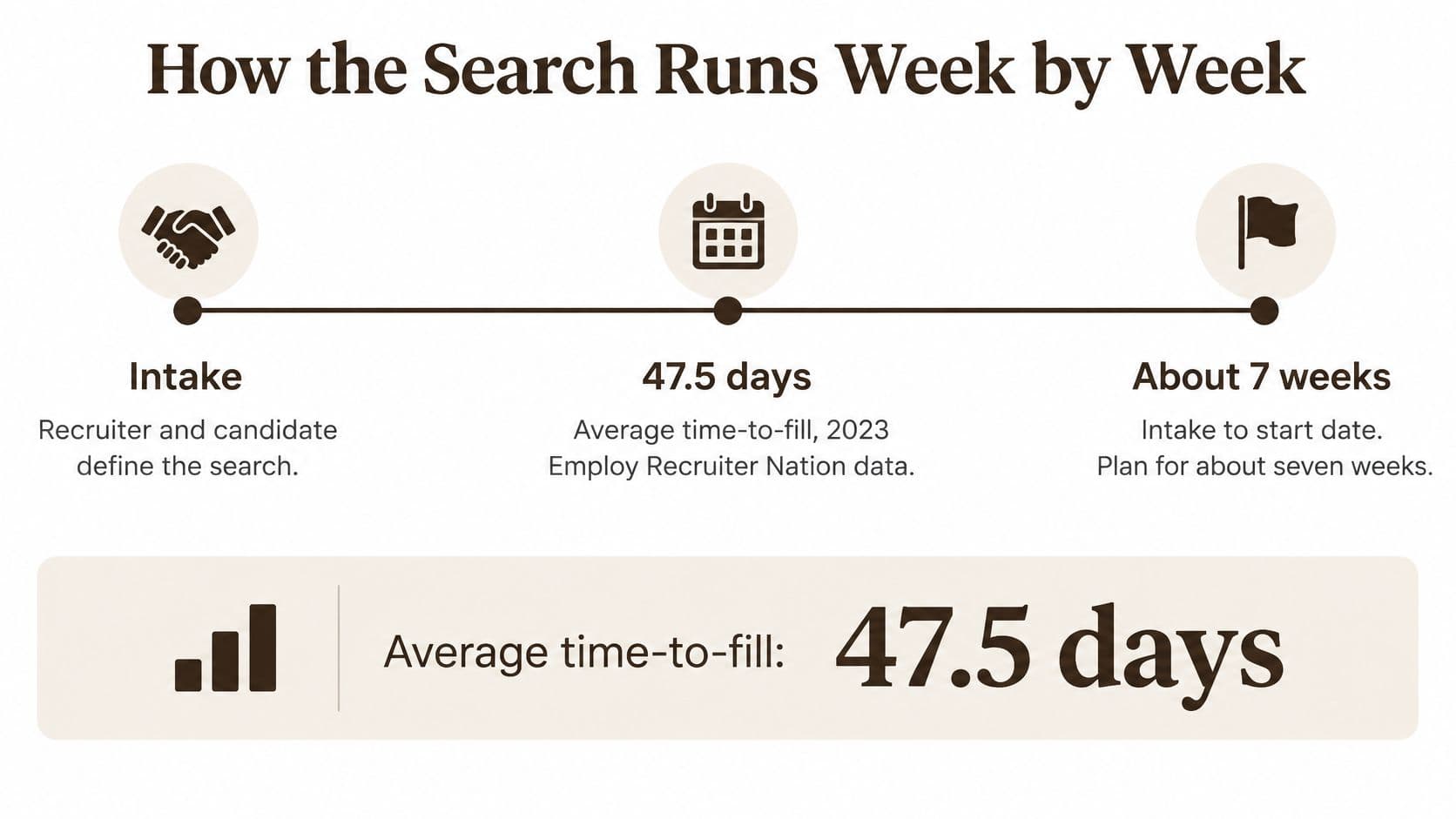
Agree on the calendar before interviews begin. In 2023, average time-to-fill for open roles reached 47.5 days, according to Employ's Recruiter Nation Survey, as reported by SHRM. Time-to-fill generally runs only until an offer is accepted, so a start date adds any notice period or garden leave on top of that figure. Senior legal searches may therefore continue beyond the time-to-fill measure.
| Stage | Typical length | Recruiter action | Your action |
|---|---|---|---|
| Intake and role brief | About 1 week | Provide a written brief, compensation range, and interview stages | Share required terms and identify decision owners |
| Sourcing and first submissions | 1 to 3 weeks | Send a fit summary with each submission, only after your permission | Confirm availability within one business day |
| Interview rounds | 2 to 4 weeks | Prepare you for each interviewer and hold a same-day debrief | Send thanks and feedback within 24 hours |
| Offer and negotiation | 3 to 10 days | Discuss compensation and confirm a decision date | Respond by the agreed date |
| Notice and start date | 2 to 8 weeks, depending on notice or garden leave | Coordinate the start and address counter-offer risk | Plan resignation timing with your current employer |
Cadence you can audit
At kickoff, record the role brief, compensation structure, interview stages and decision owners, response-time commitments, and confidentiality rules. Agree on what counts as a missed response deadline and who follows up. A weekly dashboard should show submissions, stage changes, objections, and requisitions that are aging. That gives both sides a clear view of whether the search is moving or stalled.
Communication is part of the service agreement, not a courtesy. In a U.S. market study, Daxtra found that 34% of applicants expected a response within 24 hours, while only 23% said they usually received one. The study also found that 54% had abandoned a process because of poor recruiter or employer communication. Set a response standard you can both meet: contact an active candidate within one business day after an interview, then send at least a weekly update while the search remains open. If there is no decision, give a specific next step or date rather than a vague status.
When an interview invitation arrives, respond to an interview invitation the same day with your availability and any conflict the recruiter should flag. That keeps scheduling from creating avoidable delays.
Judge the working relationship by the process as well as the outcome. A recruiter should get your permission before submitting your profile, disclose changes to pay or work arrangement, and avoid sending your name to the same firm through multiple recruiters. Track response-time compliance, withdrawals, interview attendance, and offer acceptance separately. Placements alone will not show whether the search was handled carefully.
Handling Silence, Changing Scope and Ghosting
Silence isn't a candidate problem or an employer problem. It's both. In iHire's 2025 online recruiting findings, 59.0% of job seekers called applying and hearing nothing a major challenge, while 50.7% of employers reported frustration with candidates ghosting them. In legal hiring, conflicts checks, compensation approvals, partner politics, and notice periods stretch timelines without anyone meaning to disappear. You still need a rule for when quiet becomes a closed file.
When a week passes with no news
Send one short note. Ask for the decision date and the stage now in progress. Don't send a chasing message that restates your interest. One ask, then you wait for the date they give you.
When the role moves under you
A different practice group, a lower title, or a new reporting line is a new search. Ask what changed, whether compensation moves with it, and whether the role is still approved. Continue only after those three answers are in writing. Staying in out of politeness is how people accept jobs they didn't apply for.
Delayed or disengaged
A delayed search gives you a new date and a reason, such as a conflicts memo or a partner who is in trial. A disengaged search gives you neither. After two missed dates, close the file. Don't grant a third "circling back."
Withdrawal belongs in writing:
I am withdrawing from this search because of [brief reason]. Please close my file and stop outreach to other clients.
That sentence protects the relationship better than going quiet, and it stops your name from traveling after you've left.
Hiring managers have the matching duty. Separate must-have qualifications from trainable ones before the search opens, and return disposition feedback within a set number of days. Candidates shouldn't carry your silence into the next firm.
Setting Up a Recruiter-Led Search
When a recruiter presents a candidate who looks strong on paper, the hiring team needs agreed criteria to decide whether that person fits the role. If you are the hiring partner or general counsel, build the role scorecard before the first résumé is read. Otherwise, partners may assess candidates against different expectations, and the brief can shift mid-search.
List technical requirements, deal-breakers, seniority indicators, and the behaviors the team needs. For a legal search, make the criteria specific: practice-area depth, jurisdictional experience, billable-work history, portable business, writing samples, case-management tools, and client-service behavior. Replace “strong communicator” with an observable standard, such as explaining a loss to a client in writing within 24 hours.
Ask the same job-relevant questions of every candidate. Record evidence in a situation, task, action, result format, then score it against anchors written in advance. Have interviewers score independently before the debrief. That gives the hiring team evidence to discuss, rather than letting the most senior or forceful partner set the grade.
A meta-analysis of 31 studies found interview structure was the only examined characteristic that moderated validity. The estimated true validity was 0.38, compared with an observed average of 0.27. Apply the same structure throughout the process; changing questions or scoring standards between candidates weakens the comparison.
A two-stage screen
Start with a recruiter competency screen, then move candidates to a hiring-partner or general-counsel assessment. For each advance or rejection, record a reason tied to the scorecard. The record helps explain why a recognizable résumé did not progress and gives the recruiter a consistent message to deliver.
Watch for four failure modes: an undocumented “culture fit” veto, requirements changing after interviews begin, too much weight given to a firm name, and interviewers testing different competencies before arguing from different evidence. Set who owns each stage and how quickly the recruiter and hiring team will return feedback. A process without response times can stall even when the scorecard is sound.
What to track
Shortlist volume alone says little about fit. Track pass-through rates at each stage, the interview-to-offer ratio, offer acceptance, 90-day retention, and quality of hire at six and twelve months. High pass-through paired with low retention suggests the scorecard is too soft. If almost nobody clears the first screen, revisit the brief: its requirements may not match the candidates the recruiter can find.
Confirm the Terms and Start This Week
Engage a recruiter when your situation sits in the high-fit rows and you can keep the response times you set at kickoff. If you can't commit to those times, run the search yourself through referrals and direct applications for a few weeks, then reconsider. A recruiter can't outrun a hiring team that won't decide.
- Shortlist two or three recruiters with a real record in your practice or function. A generalist who "also does legal" is a slow way to learn the market.
- Put the seven questions to each one and keep the answers in writing. Compare them side by side before you share a résumé.
- Compare fee model and exclusivity. Confirm the employer pays, that no fee falls on you, and whether the recruiter represents you alone or may submit you elsewhere.
- Sign a short engagement that locks the brief, stages, owners, response times, and confidentiality rules.
- Set a 30-day checkpoint for submissions, stage movement, and your own reply speed. If the dashboard is empty and the excuses are full, end it.
Your first action this week is to send that checklist to the shortlist. For an attorney, partner, in-house, or legal operations search, Five Star Placements (fivestarplacements.com) is a reasonable first call among firms that place those roles. Ask it, as you would any firm on the list, to confirm fee model and exclusivity in writing before you share names.
Five Star Placements runs contingency permanent searches for law firms and corporate legal departments, covering attorneys, partners, in-house counsel, legal operations leaders, and legal support staff, with screening and interview coaching tied to the role. If you want a search run against a written brief, clear response times, and a fee that lands only on a hire, start with Five Star Placements and put the same questions to them that you would put to anyone else.
Need help filling a legal role?
Five Star Placements partners with law firms and legal departments nationwide.
Schedule a Call