
How to Respond to an Interview Invitation
August 27, 2026 · 15 min read · Five Star Placements
Table of contents
You're between depositions when the interview email arrives. An associate sees it at 8:47 a.m., a paralegal notices the notification while walking into court, and a partner-track candidate reads the invitation during a client call. The first reaction is usually the same: excitement, followed by a quick attempt to reply before the day gets away.
That first reply matters more than most candidates realize. In legal hiring, the message may be read by a recruiter, a hiring partner, an HR professional, and a scheduling coordinator. They're not grading your legal analysis yet. They're noticing whether you read carefully, manage a demanding calendar, answer the actual question, and make the next step easy.
The right response is short, prompt, and operationally complete. It confirms interest, locks down the logistics, and asks precise questions when the invitation leaves out information that affects preparation. The wrong response is vague, overfamiliar, delayed, or careless with dates and time zones.
Table of Contents
- The Moment You See the Interview Email
- Why Response Speed Is Now a Hiring Signal
- Templates for Accepting an Interview Invitation
- What to Confirm Before You Hit Send
- How to Reschedule or Decline Without Burning Bridges
- Real Scenarios From Legal Hiring
- Your Quick Checklist Before Replying
The Moment You See the Interview Email
An attorney sees the invitation between depositions. A paralegal opens it while entering court. A partner-track candidate notices it during a client call. Treat the invitation as a professional task you schedule immediately, not an email to reply to later. In legal hiring, this response signals calendar discipline, panel readiness, and partner-level judgment before anyone shakes your hand.
Open the full thread, identify every copied recipient, and read the invitation twice. Legal recruiting often involves a recruiter, coordinator, hiring partner, and HR contact. Excluding one of them can create avoidable confusion.
Before drafting, answer three questions:
- What role is this? Confirm the title, office, practice group, and whether the discussion concerns a permanent position, lateral move, partner opportunity, or support role.
- What does the firm want from me? Check for writing samples, deal lists, references, conflicts information, or other preparation.
- What decision must I make now? Choose whether to accept the proposed time, request clarification, suggest another slot, or withdraw.
A same-day reply shows that you can control a demanding calendar. A response sent later in the week can raise questions about how you manage competing obligations. The invitation itself is a screening moment, so handle it with the same care as a client request.
Do not draft from a phone while walking through a courthouse unless you are sending only a brief acknowledgment. A rushed sentence, misspelled partner name, or incorrect date creates doubt before the interview begins.
Practical rule: Read the invitation as if you were reviewing a client email. Identify the request, deadlines, people involved, and missing facts before answering.
Keep the reply concise. Confirm the offered time, propose alternatives, or ask focused questions. Then proofread names, dates, time zone, attachments, and sign-off. For attorneys and paralegals managing court deadlines, client demands, deal closings, and shifting partner priorities, this is an early sample of judgment under pressure. Strong qualifications still matter most, but careless logistics can make the hiring team question how reliably you will handle theirs.
Why Response Speed Is Now a Hiring Signal
A fast reply is valuable only when it is accurate. A large 2026 benchmark analysis found that candidates reply to recruiter outreach in a median of 3.9 days, with 26% replying within 24 hours and about one-third replying within 48 hours. That outreach measure is broader than an interview invitation, so do not treat it as a precise deadline for accepting a scheduled meeting. It does support a practical rule: the first 24 to 48 hours carry the strongest response signal. (The benchmark analysis of recruiter response timing)
The same analysis found that 58.9% of candidates who eventually interview do so within a week of first contact, while 79.7% do so within two weeks. Those figures describe the period from initial contact to an eventual interview, not the time allowed to answer an invitation. The distinction matters. Reply promptly, but judge the invitation on its actual deadline, proposed schedule, and outstanding logistics.
You can preserve speed without sacrificing judgment. If you are in court, traveling, or checking a current employer's calendar, send a brief acknowledgment that confirms receipt and interest, then state when you will provide final availability. Silence creates uncertainty. A concise acknowledgment keeps the process moving without committing you to a time you cannot honor.
Scheduling remains a significant hiring obstacle. A 2026 recruitment-coordination study reported that 49.2% of companies overall and 47.9% in mid-career hiring identify scheduling from initial contact to a confirmed slot as their biggest obstacle. Companies responding within five minutes recorded a 67.5% interview booking rate, compared with 45.8% for companies taking three days or more. (The recruitment-coordination study on interview booking)
The timing rule I give candidates
Reply the same business day whenever possible. If a hearing or client emergency prevents that, acknowledge the invitation as soon as you can and complete the scheduling response within the next business day. Career guidance recommends replying in the existing thread, retaining the subject line, thanking the sender, confirming availability, proposing alternatives when needed, and including copied recipients when appropriate. (Interview invitation reply guidance and templates)
| Response timing | What it communicates | My recruiting view |
|---|---|---|
| Same business day | Interest and control | Preferred |
| Within 24 hours | Professional responsiveness | Fully acceptable |
| After several days | Competing priorities or uncertainty | Explain briefly and regain momentum |
| No acknowledgment | Avoidance or disinterest | Never acceptable |
Firms need attorneys who respond to partners, clients, opposing counsel, and internal teams without preventable delays. Your reply cannot prove that you manage a case well, but it can reveal calendar discipline, panel readiness, and partner-level judgment before anyone shakes your hand.
Templates for Accepting an Interview Invitation
Keep the original subject line and reply in the existing thread. Use the recipient's name, address the hiring partner directly when appropriate, and mention the role or practice group so the message feels deliberate rather than copied.
In-person associate interview
Subject: Re: Interview Invitation, Litigation Associate
Dear Ms. [Last Name],
Thank you for inviting me to interview for the Litigation Associate position with [Firm Name]. I'm pleased to confirm my availability for [day, date] at [time] [time zone].
I understand that the interview will take place at [office address]. Please let me know if there are parking or building-access instructions, and whether I should bring any additional materials.
I look forward to meeting with you and learning more about the litigation group.
Best regards,
[Full Name]
[Phone Number]
This works because it confirms the decision and identifies the only logistics that still need attention. Don't write “I'll be there” without confirming the date, location, and expected format.
Virtual paralegal screen
Subject: Re: Interview Invitation, Litigation Paralegal
Hello [Recruiter Name],
Thank you for the invitation to discuss the Litigation Paralegal role at [Firm Name]. I'm available on [day, date] at [time] [time zone] and would be glad to meet virtually.
Please send the video link and let me know the expected duration of the conversation. I look forward to speaking with you.
Best,
[Full Name]
[Phone Number]
A virtual reply should still sound formal. Avoid emojis, abbreviations, and casual phrases such as “Sounds great” or “Can't wait.” The platform doesn't make the process informal.
Partner-track lateral conversation
Subject: Re: Partner Opportunity, [Practice Group]
Dear [Recruiter or Partner Name],
Thank you for reaching out regarding the partner opportunity with [Firm Name]. I appreciate the invitation and would welcome an initial conversation about the practice group, client-development expectations, and the firm's plans for [market or office].
I'm available on [option one] or [option two]. Please let me know which works best, and whether the conversation will include the managing partner, practice-group chair, or another member of the leadership team.
I look forward to speaking with you.
Sincerely,
[Full Name]
[Phone Number]
For senior candidates, the reply should show thoughtful interest without negotiating the entire opportunity by email. Asking who will attend and what the conversation will cover demonstrates preparation and protects your time.
When you need flexibility
Dear [Name],
Thank you for inviting me to interview for the [Role] position. I'm very interested in continuing the conversation, but I'm unavailable at the proposed time because of a prior professional commitment.
Could we meet during one of these windows?
- [Day, date], [time range] [time zone]
- [Day, date], [time range] [time zone]
If neither works, I'm happy to review another option.
Best regards, [Full Name]
Use two concrete windows rather than “Let me know what works.” The coordinator can schedule from a real answer. Keep paragraphs short, use a formal sign-off, and name the practice group when it matters.
Subject lines that make the thread easy to find include:
- Re: Interview Invitation, [Role]
- Re: [Firm Name] Interview
- Re: [Practice Group] Conversation
- Re: Partner Opportunity
- Re: [Role] Scheduling
What to Confirm Before You Hit Send
An invitation can be polite and still be incomplete. Don't confirm blindly when the missing information affects your preparation, travel, conflicts, or ability to participate. Reply with interest and ask for the facts in the same message.
| Detail to confirm | In-person | Virtual | Phone screen | Panel interview |
|---|---|---|---|---|
| Format | Confirm office meeting and expected duration | Confirm platform, link, camera expectations, and time zone | Confirm caller, number, and duration | Confirm whether the panel meets together or separately |
| Venue details | Ask for address, reception procedure, parking, and security | Ask whether the link requires an account or special access | Confirm the number that will call and whether you should call first | Ask for the conference room or virtual meeting details |
| Interviewers | Request names and titles | Request names, titles, and roles | Identify the recruiter or attorney conducting the screen | Request each panelist's name, title, and practice area |
| Preparation | Ask about documents, writing samples, or deal lists | Confirm whether materials must be shared in advance | Ask whether you need your resume available | Ask whether each interviewer will focus on a different competency |
| Practical issues | Ask about dress expectations and accessibility accommodations | Ask about recording, screen sharing, and technical requirements | Confirm whether the call is evaluative or introductory | Ask about breaks, meal arrangements, and total duration |
Legal candidates should ask questions that improve preparation, not questions that create the impression they haven't read the invitation. “Who will attend?” is useful. “What should I know?” is lazy. If the role involves a specialized practice, knowing the panel's titles, practice areas, and bar admissions can help you prepare relevant questions and avoid obvious mismatches.
A careful response also catches details that generic career advice often misses. Confirm the time zone, especially when the firm has multiple offices. Ask whether a video interview will be recorded. For an in-office meeting, ask about parking, building access, and security procedures. If you need an accessibility accommodation, request it early and directly.
For more role-specific preparation, review these attorney interview questions to ask in 2026 before you send your reply. Your questions at the interview will be stronger when you understand the role and the people evaluating you.
A complete confirmation signals that you can manage details without turning a simple scheduling email into a project.
Before sending, place the appointment on your calendar with the time zone displayed. Add a travel buffer for in-person meetings and verify that the calendar hold matches the written confirmation. If the recruiter has copied several people, use “Reply all” when everyone needs the same information. Don't leave a decision-critical question open.
How to Reschedule or Decline Without Burning Bridges
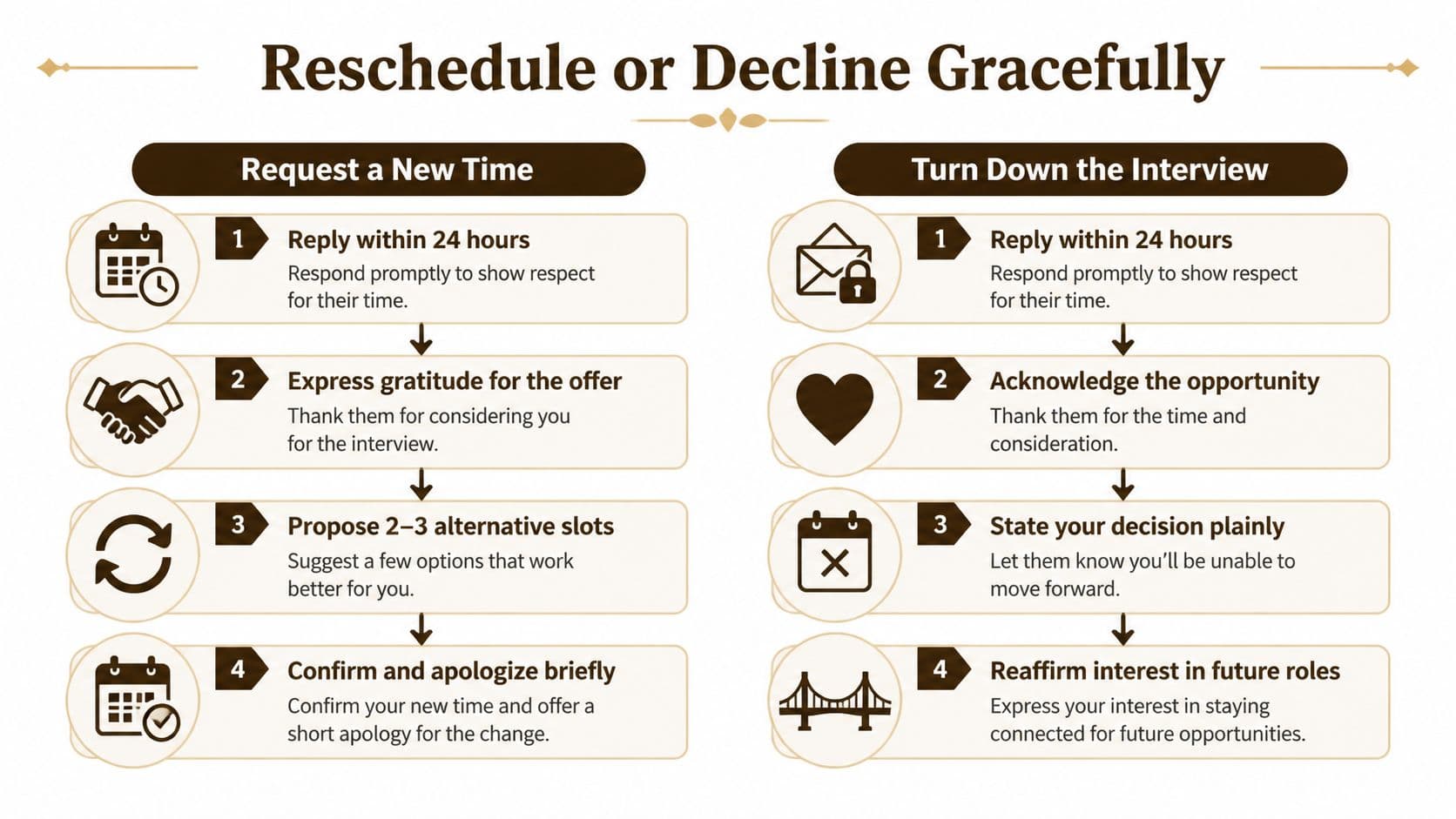
Rescheduling is acceptable. Rescheduling without alternatives is not. Reply quickly, acknowledge the opportunity, state the conflict plainly, and provide two or three specific windows. You don't need a long apology or a detailed account of your court calendar.
Use this sequence:
- Respond promptly. Don't wait until the proposed meeting is close.
- Name the conflict professionally. “I have a court appearance” is sufficient.
- Offer alternatives. Include dates, times, and the time zone.
- Confirm the new slot. Once accepted, send a brief confirmation and update your calendar.
Court appearance
Dear [Name],
Thank you for the invitation to interview for the [Role] position. I'm very interested in the opportunity, but I have a court appearance at the proposed time.
Would either [date and time] or [date and time] work for the team? I apologize for the scheduling change and appreciate your flexibility.
Best regards, [Full Name]
Client conflict
Hello [Name],
Thank you for arranging the interview. A client commitment now conflicts with [date and time], so I'm writing to ask whether we could move the conversation.
I'm available [option one], [option two], or [option three]. I remain very interested in the role and appreciate your help coordinating a new time.
Best, [Full Name]
Prior interview
You don't need to disclose that you're interviewing elsewhere unless doing so helps explain a genuine scheduling constraint. “A prior professional commitment” is enough. Never invent a court appearance or client emergency. Legal recruiting is a small community, and inaccurate explanations can damage credibility.
Declining the interview
Decline when the role, compensation framework, location, conflicts position, or practice fit clearly doesn't work. Don't accept an interview merely to avoid an uncomfortable email. A prompt, respectful refusal protects the recruiter's time and preserves your reputation.
Role fit decline
Dear [Name],
Thank you for considering me for the [Role] opportunity. After reviewing the position, I don't believe the practice focus aligns closely enough with my current direction, so I'm going to decline the interview.
I appreciate you reaching out and would welcome staying in touch about future opportunities that fit my background in [practice area].
Sincerely, [Full Name]
Compensation decline
Hello [Name],
Thank you for the invitation and for sharing information about the role. Based on the compensation framework, I don't think the opportunity is the right fit for me at this time, so I'll respectfully decline the interview.
I appreciate your consideration and would be glad to remain connected for a position with a different structure.
Best regards, [Full Name]
Competing offer
Dear [Name],
Thank you for reaching out regarding the [Role] position. I've accepted another opportunity and need to withdraw from the interview process.
I'm grateful for your consideration and hope we can reconnect if the right opportunity arises in the future.
Best, [Full Name]
Suggested subject lines include Re: Interview Invitation, Withdrawal from Process, Re: Interview Scheduling, and Re: [Role] Opportunity. Ghosting is never a strategy. It forces the recruiter to chase you, wastes the panel's preparation time, and may close doors you didn't intend to shut.
Real Scenarios From Legal Hiring
A mid-level associate received an invitation from a regional litigation firm while preparing for a deposition. She couldn't review the firm's full process immediately, but she replied within forty minutes. Her message thanked the recruiter, confirmed interest, accepted the proposed day, and asked who would participate, whether the discussion would focus on commercial litigation, and whether she should bring a writing sample.
The hiring partner saw preparation, not desperation. The associate didn't overexplain her workload or send a long biography. She made the meeting easier to organize and gave the firm useful information about how she thinks.
A paralegal handled the same moment differently. She wrote, “Yes, that works for me,” but didn't confirm the office, duration, or panel names. She arrived expecting a one-on-one conversation and found several interviewers with different responsibilities. She hadn't prepared examples relevant to the firm's practice because the invitation had not identified the panel.
The problem wasn't lack of ability. It was a failure to ask a simple question. A confirmation that leaves operational gaps can turn a promising candidate into an unprepared one.
A senior partner-track candidate declined an invitation from one firm after accepting a competing opportunity. He replied promptly, thanked the managing partner, stated that he had accepted another role, and expressed interest in staying connected. He didn't criticize the firm, disclose confidential details about the competing offer, or leave the message open to negotiation he didn't want.
That response protected the relationship. Firms remember candidates who handle a decline with discretion, particularly when the legal community overlaps across practice groups and markets.
Candidates who want to sharpen the spoken part of the process can use interview coaching for lawyers alongside a disciplined email response. The written reply and the interview itself should communicate the same qualities: judgment, preparation, clarity, and respect for other people's time.
Your Quick Checklist Before Replying
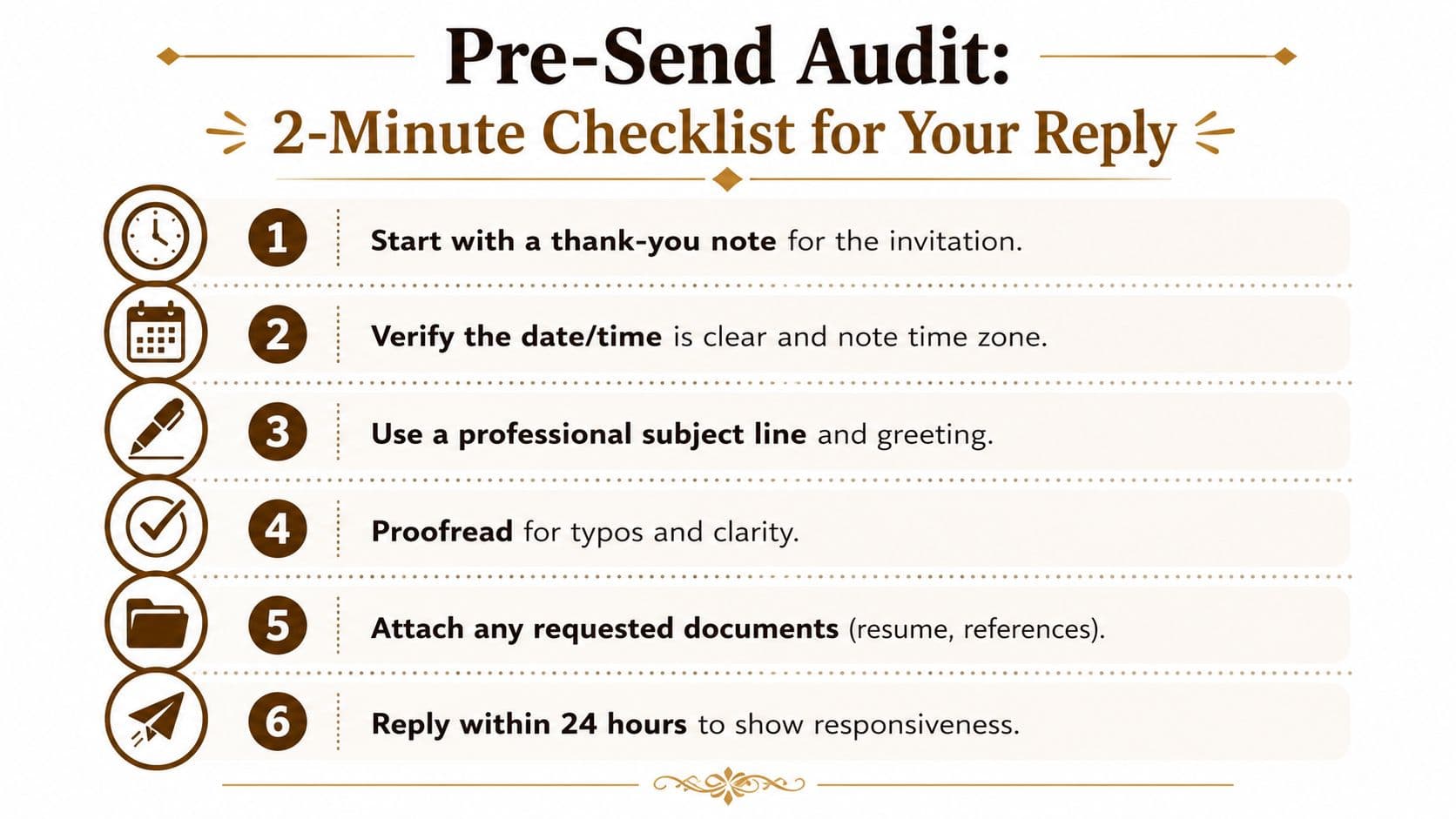
Run this audit before you press send:
- Identify the sender. Confirm the recruiter, partner, coordinator, and copied recipients.
- Name the opportunity. Verify the role, firm, office, and practice group.
- Check the timing. Confirm the date, time, and time zone.
- Confirm the format. Identify whether the interview is in person, virtual, by phone, or with a panel.
- Review the location or link. Ask about parking, access, video platform, or the calling procedure.
- Prepare two questions. Ask only what affects scheduling or preparation.
- Use the existing subject line. Don't start a new thread unless the sender asks.
- Open professionally. Use the recipient's name and thank them for the invitation.
- Make the decision clear. Accept, propose alternatives, request details, or decline.
- Read it aloud. Catch incorrect names, missing words, and ambiguous times.
- Send promptly. Same day is the standard, and within 24 hours is the outer boundary for a normal invitation.
- Calendar the commitment. Add travel time, preparation time, and the correct time zone.
For a reschedule, include the conflict briefly and give concrete alternatives. For a decline, state the decision plainly, express appreciation, and leave the relationship in good condition when appropriate. Don't use a vague “maybe later” if you know you won't proceed.
Your reply is also a small communication-skills assessment. Use the communication skills assessment as a reminder that hiring teams evaluate clarity through ordinary exchanges, not only formal interview answers.
For attorneys, the final rules are simple: never assume the time zone, never leave a logistics question open, and never send a casual reply that you wouldn't send to a client or partner. A good invitation response doesn't perform enthusiasm. It demonstrates control.
Five Star Placements provides permanent placement for attorneys, partners, in-house counsel, paralegals, and other legal professionals, along with interview coaching aligned to legal hiring processes. If you're preparing for a move or hiring for a demanding legal role, visit Five Star Placements to connect with a recruiting team that can help manage the search and the interview process.
Need help filling a legal role?
Five Star Placements partners with law firms and legal departments nationwide.
Schedule a Call