
Interview Coaching Online for Legal Careers
October 14, 2026 · 15 min read · Five Star Placements
Table of contents
86% of organizations used video interviews at some stage of recruitment in 2022, and online interview coaching is the structured preparation that helps candidates manage the technology, communicate through a camera, and deliver competency-based answers. For legal professionals, it turns experience into clear evidence instead of leaving a selective employer to interpret an improvised response.
You may be a strong attorney with excellent client judgment, a solid matter history, and the references to prove it. Yet you keep disappearing after the first virtual screen. The recruiter says the firm chose to move forward with “other candidates,” and you're left wondering whether your answers were too long, too cautious, too technical, or flat on camera.
That pattern is rarely fixed by reading another list of common interview questions. Selective legal hiring tests more than whether you can speak confidently. It tests whether you can explain judgment, ownership, outcomes, and fit under pressure, often through a screen that amplifies every pause, interruption, and vague answer.
Table of Contents
- What Online Interview Coaching Actually Is
- Why Legal Hiring Makes Coaching Worth the Investment
- How a Coaching Engagement Typically Runs
- Turning Legal Experience into Structured Answers
- Camera Presence and the Technology Routine
- Where Generic Coaching Misses the Real Risks
- How to Choose an Online Interview Coach
- A Practical Plan for This Week
What Online Interview Coaching Actually Is
An attorney can perform brilliantly in a conference room and still underperform in a video interview. The room provides natural eye contact, physical presence, and conversational rhythm. A screen removes or distorts those signals, while a recruiter may be evaluating your answer structure at the same time.
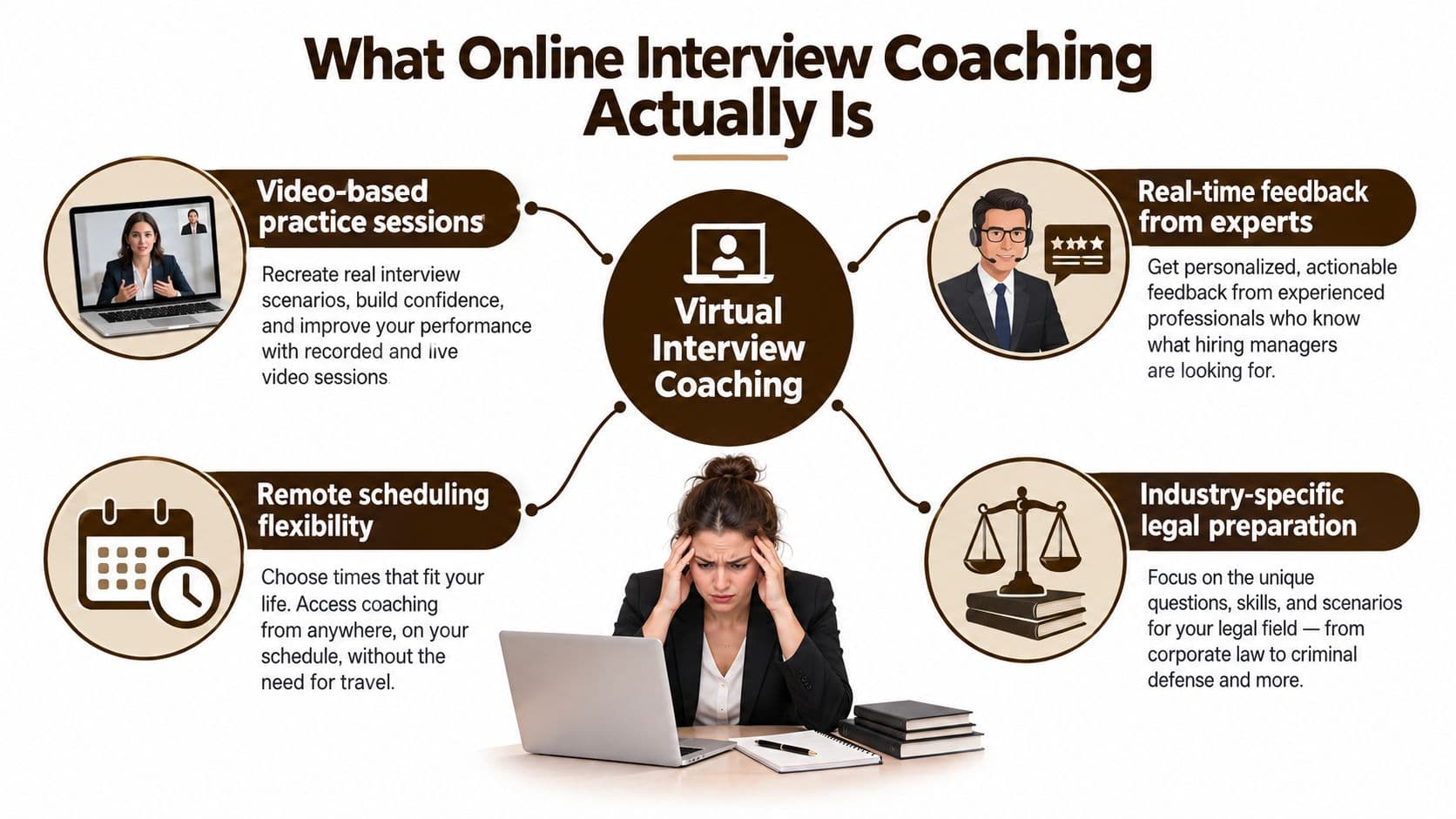
Interview coaching online is structured, remote preparation that trains three connected capabilities:
- Technology control, including camera framing, audio, lighting, platform permissions, screen sharing, and contingency planning.
- Camera-mediated communication, including eye-line, pacing, pauses, facial engagement, posture, and concise verbal acknowledgments.
- Competency-based answers, connecting your legal experience to the specific capabilities the firm or company needs.
A credible coach records practice sessions on the device and platform you'll use. The coach then reviews what you said, how long you took, whether you answered the question asked, and whether your nonverbal behavior supported your credibility. That feedback is more useful than general encouragement because it gives you something observable to change.
What coaching isn't
Online coaching isn't a confidence pep talk. Confidence may improve after repeated practice, but confidence without structure can produce polished answers that fail to establish your individual contribution.
It also isn't a generic STAR worksheet or a resume rewrite. A worksheet won't tell a senior associate how to explain a difficult client decision to a managing partner. A resume rewrite won't prepare a paralegal to answer a question about prioritizing conflicting deadlines while maintaining matter accuracy.
The right engagement starts with the target role. A litigation candidate may need to demonstrate case strategy, witness preparation, and judgment under uncertainty. An in-house counsel candidate may need to explain risk allocation, stakeholder management, and commercial practicality. A legal operations leader may need to show how they evaluate systems, influence executives, and deliver reliable processes.
Practical rule: If a coach can't name the competencies being tested, the program is probably presentation practice, not legal interview preparation.
Self-study can work when you already know your weaknesses and have a reliable way to observe them. Coaching becomes worthwhile when you keep reaching interviews but can't identify why you're being rejected, when the role is highly selective, or when the interview format differs materially from your day-to-day work.
Why Legal Hiring Makes Coaching Worth the Investment
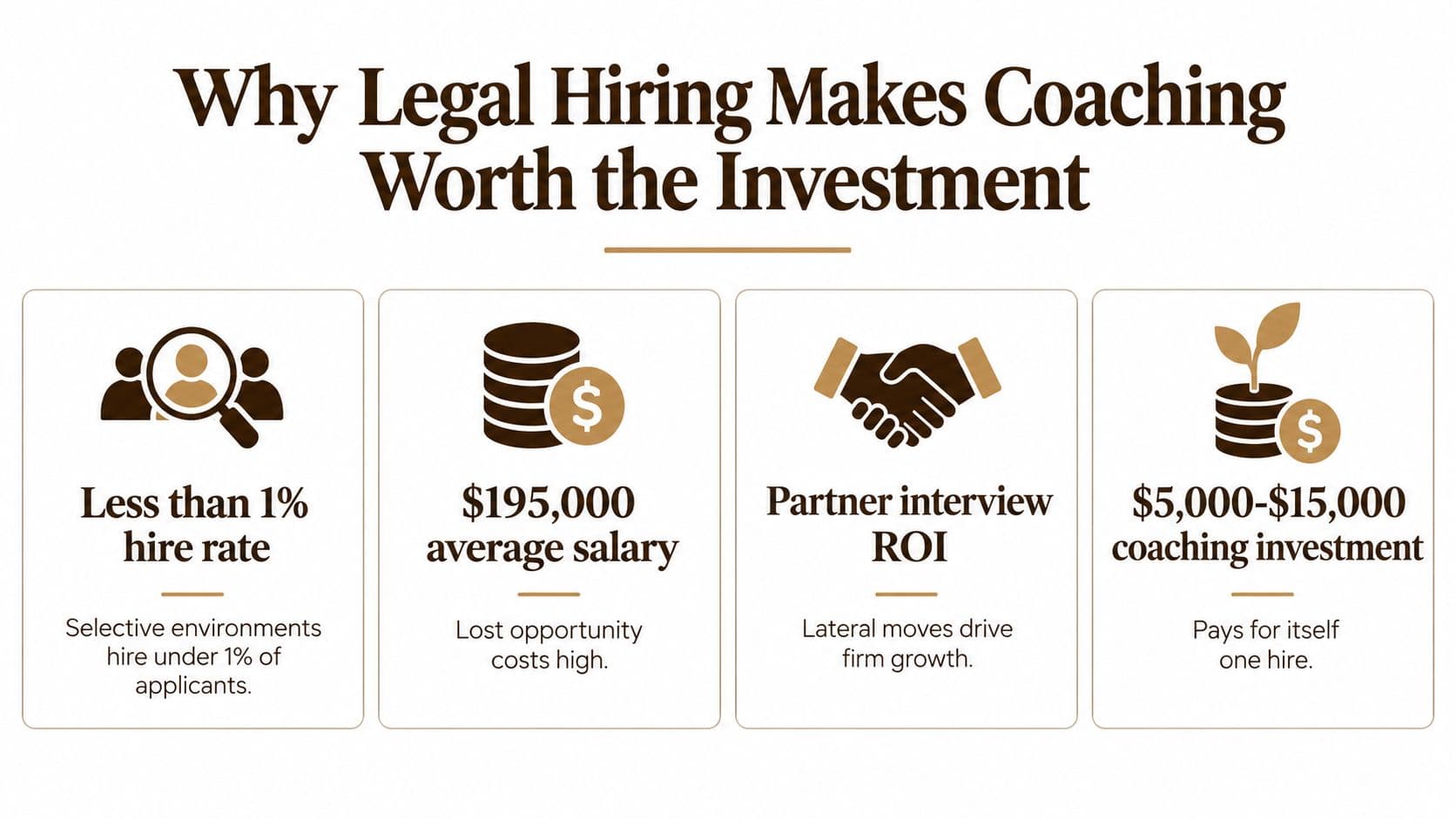
A candidate can give a sound legal answer and still lose the interview in the first few minutes. Video interviewing is now a standard part of recruitment. A Gartner survey reported that 86% of organizations used video interviews at some stage of recruitment in 2022, as reported in this summary of job interview statistics and trends. Other reported benchmarks indicate that approximately 60% of recruiters use video interviews regularly, for both remote and office-based positions.
Selective legal hiring exposes the gap between knowing the work and proving it under pressure. Firms with sub-1% acceptance standards, corporate legal departments, and competency-based panels may give candidates one short opportunity to turn complex experience into clear, decision-useful evidence. A virtual screen also makes small errors visible. Rambling context, unclear ownership, or a weak answer to a follow-up can end a candidacy before substantive expertise receives a fair hearing.
Where the stakes show up
Lateral and partner interviews require more than a list of matters. A partner candidate must explain portable relationships, leadership, relevant originations, strategic judgment, and the reason for moving. “I manage client expectations” says little unless the candidate shows the decision, personal contribution, and result behind that statement.
In-house interviews test whether you can turn legal analysis into practical business advice. Interviewers want to hear how you prioritize risk, communicate with non-lawyers, and recommend a course of action when the business cannot remove every uncertainty.
Paralegal and legal support interviews center on matter control, deadlines, document accuracy, technology, and escalation judgment. Candidates lose credibility when they describe team activity without identifying what they personally handled.
Legal operations interviews call for evidence of implementation discipline, stakeholder alignment, measurement, and process improvement without disrupting active matters.
Coaching earns its place when the evaluator has limited time to interpret your evidence:
- Recruiter screens: Establish role fit and a coherent career narrative quickly.
- Hiring partner panels: Address several senior listeners without becoming vague or overlong.
- Client-facing simulations: Show judgment, composure, and plain-English communication.
- Writing or technology exercises: Follow instructions and explain how you reached a conclusion.
Reported 2025 live online interview participation reached 78.2% in the United Kingdom, 77.8% in North America, and 72.7% in South Africa, as noted in the linked interview trends summary. Legal hiring therefore extends across distributed markets, not only remote roles. Online coaching should convert practice experience into structured evidence that survives short screens, virtual panels, and demanding follow-up questions.
How a Coaching Engagement Typically Runs
A serious engagement begins with a diagnostic, not a canned list of questions. The coach reviews the job description, your resume, the interview format, the likely stakeholders, and the role's seniority. The output should be a competency map that identifies what the employer is likely to evaluate and which parts of your experience can prove each point.
For a senior litigator, that map may include case strategy, client communication, judgment, leadership, and business development. For a paralegal, it may focus on matter management, accuracy, prioritization, confidentiality, and technology. The coach should make those distinctions before the first mock interview.
The practice cycle
A useful workflow has four stages:
- Diagnostic interview: You answer representative questions without heavy coaching. The coach identifies recurring problems, such as long context-setting, weak endings, unclear ownership, or answers that never reach the decision.
- Recorded mock rounds: You practice on your actual laptop, camera, headset, and platform. The coach varies the questions and may introduce follow-ups, interruptions, or a skeptical stakeholder.
- Structured debrief: You receive specific feedback on substance, relevance, structure, delivery, and technical execution. Time-coded notes are valuable because “be more concise” is vague, while “your answer reaches the decision at this point” gives you a clear edit.
- Final rehearsal: You run a realistic simulation without continuous interruption. The coach tests whether the improvements transfer when you have to listen, think, answer, and monitor the screen at once.
A provider should give you tangible artifacts rather than ending each session with general praise. Request:
- A written competency rubric tied to the target role.
- Time-coded feedback from recorded sessions.
- Revised versions of weak answers, preserving your facts and voice.
- A story bank organized by competency and practice area.
- A technology and day-of-interview checklist.
- Recovery language for a technical failure, misunderstood question, or answer that goes off track.
What separates a real engagement
The coach's legal background matters, but it isn't enough by itself. A former attorney who only tells stories about their own interviews may not know how to evaluate your answer as a recruiter, partner, or general counsel would.
Ask whether the coach can distinguish the expectations of a junior associate, senior associate, partner, paralegal, in-house counsel, and legal operations leader. Ask how confidentiality is handled, particularly when your examples involve clients, internal investigations, settlements, privileged advice, or sensitive business information.
The best feedback doesn't force you to sound rehearsed. It removes unnecessary detail so the evidence can be heard.
Turning Legal Experience into Structured Answers
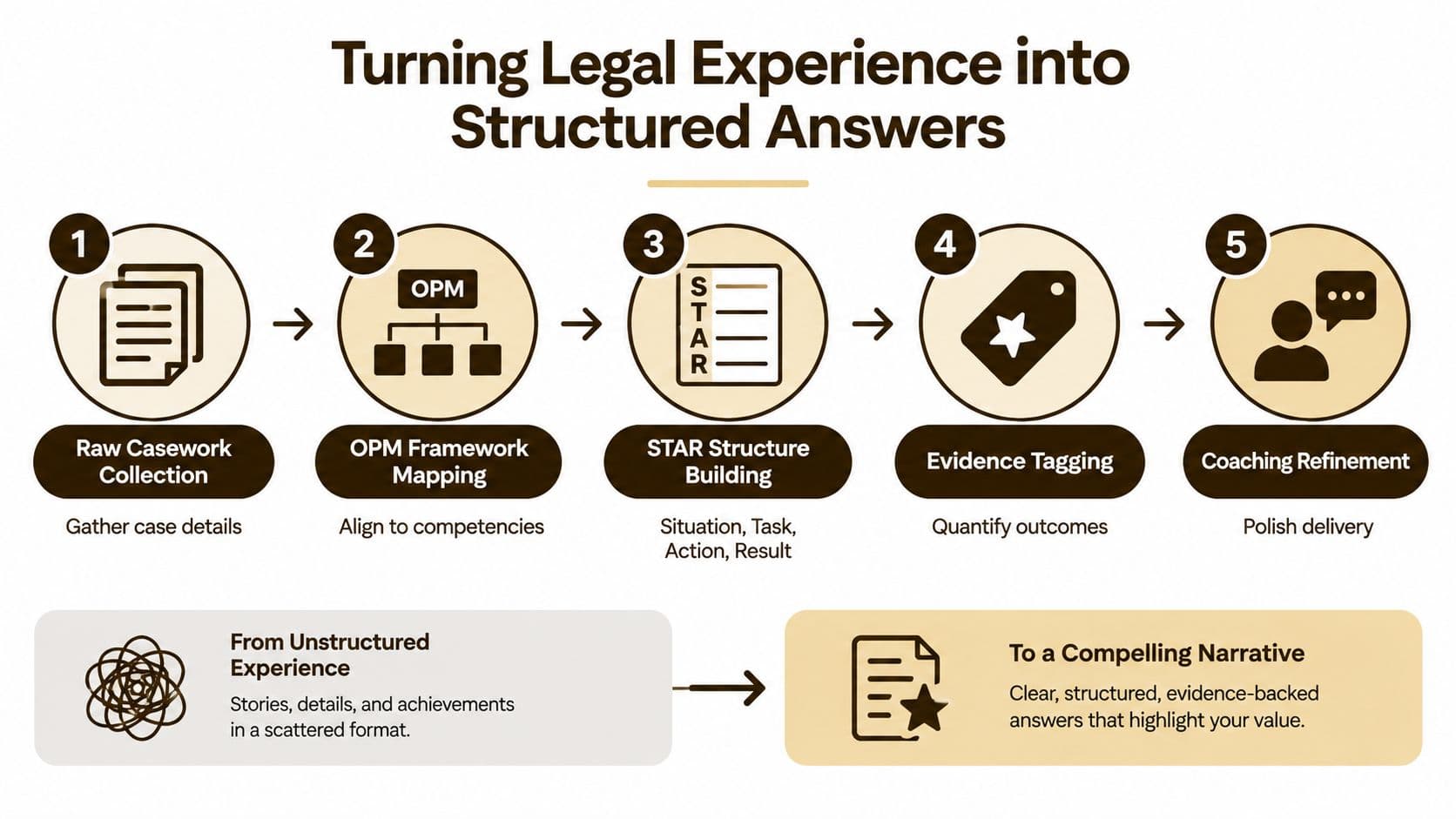
Structured interviews improve the quality and consistency of evaluation because they connect questions to job-related competencies. The U.S. Office of Personnel Management's guidance on structured interviews explains that greater structure can increase validity, rater reliability, and agreement while reducing interviewer discretion and adverse impact.
For candidates, the practical lesson is straightforward: don't make the interviewer extract the evidence. Give the answer a clear architecture.
Use Situation, Task, Action, Result as a working sequence, not a script. The situation establishes context. The task defines your responsibility. The action shows your judgment and behavior. The result demonstrates what changed, what you learned, or what verifiable outcome followed.
Map the answer to the legal competency
A litigation example should not merely prove that you worked on a significant case. It should prove a competency the target employer values.
- Case strategy: Explain the problem, the competing options, your analysis, and the strategic choice you made.
- Client communication: Show how you translated legal risk, managed expectations, or helped a client make a decision.
- Judgment: Describe a moment when the facts were incomplete, the stakes were meaningful, and you chose a defensible course.
- Matter management: Identify how you controlled deadlines, delegated work, escalated issues, or protected quality.
- Compliance: Explain how you identified an obligation, evaluated risk, and built a practical response.
- Business development: Show how you understood a client's need and contributed to a relationship or opportunity without overstating your role.
Consider a transactional attorney asked, “Tell me about a time you had to protect the client while keeping a deal moving.” A weak answer lists the transaction and says the team negotiated hard. A structured answer explains the business objective, identifies the clause or risk at issue, shows the candidate's recommendation and negotiation approach, and closes with the agreement reached and the lesson carried forward.
A paralegal answering a prioritization question should name the competing deadlines, explain the triage decision, identify the system or communication used, and show how accuracy was maintained. An in-house counsel candidate should make clear how legal advice changed the business decision, not just state that stakeholders were consulted.
Use this guide to in-house lawyer interview questions to build a role-specific question bank, then attach one or more stories to each competency. Your coach should score the response for individual contribution, analytical reasoning, evidence, outcome, and relevance. If you can't identify what you personally did, the story isn't ready.
The recording should reveal whether your structure survives pressure. You may know the facts perfectly but bury the answer under chronology. You may also describe a favorable result without showing how your judgment produced it. Coaching earns its place by exposing those gaps before the employer does.
Camera Presence and the Technology Routine
Treat your camera and connection as part of the interview performance. Reported data indicates that 39% of candidates have experienced technical problems during video interviews, while 28% had not tested their setup beforehand, according to video interview statistics from HireTruffle. A preventable technical failure can distract the interviewer before you've established your legal judgment.
Run the same routine before every serious interview:
- Frame the shot: Position the camera at eye level and leave enough space for natural movement without placing your face against the edge of the frame.
- Check the sound: Record a short answer and listen for echo, clipping, background noise, or a microphone that makes you sound distant.
- Control the light: Place the main light in front of you rather than behind you, and remove visible distractions from the background.
- Test the platform: Confirm permissions, screen sharing, display name, captions, and any required virtual background or document function.
- Verify the connection: Run the call from the location you'll use, not from a different room with better service.
- Prepare a fallback: Keep a charged phone available and know how you'll tell the interviewer that you need to switch channels.
Rehearse the medium
Look near the lens while speaking, then return your attention to the interviewer's image while listening. You don't need to stare at the camera. You do need to avoid looking repeatedly at your own video, another monitor, or notes placed too far from the lens.
Pause briefly after a question. Video calls can create audio overlap, and an immediate answer can sound rushed. Use short acknowledgments such as “Yes, I can speak to that,” then answer directly. Keep facial engagement natural. Excessive nodding and forced smiling look as artificial as a blank expression.
Review each recording twice. First, listen without watching the video. Assess clarity, answer structure, pacing, verbal clutter, and whether your conclusion is easy to identify. Then watch the video with the sound muted. Assess eye-line, posture, visible attention, gestures, and whether your face communicates engagement.

Practice recovery, not just perfection. Say, “The connection dropped for a moment. I want to make sure you heard the point about my recommendation,” and restate the key sentence. If you lose your place, take a breath and say, “Let me answer that more directly.” A composed recovery can demonstrate the same steadiness that legal employers value in client and matter work.
For visual presentation, your headshot and resume guidance can help align your professional materials with the impression you want to create. But don't confuse a polished profile with interview readiness. The live exchange is where your judgment becomes observable.
Where Generic Coaching Misses the Real Risks
Most online coaching starts and ends with STAR answers, confidence, and camera polish. Those basics matter, but they miss the risks now facing legal candidates.
AI changes the preparation question
Candidates increasingly want to know whether an employer will use automated tools to assess video, written responses, or interview performance. Recent Gartner research found that only 26% of candidates trust AI to evaluate them fairly, 32% worry AI could cause their application to fail, and 6% admitted participating in interview fraud, including impersonation, according to Gartner's survey on AI evaluation.
The answer isn't to optimize yourself into a synthetic candidate. A legal-aware coach should help you ask what technology is being used, what consent applies, how your information is handled, and whether a human reviews the result. It should also establish an ethical policy for generative AI. Using a tool to organize your experience before an interview is different from receiving undisclosed real-time answer generation during the interview.
Legal employers need evidence of discretion. A candidate who produces flawless keyword-rich responses but can't explain how they protected confidentiality or handled ambiguity may create more concern, not less.
Accessibility is part of preparation
A quiet room, uninterrupted broadband, standard eye contact, and a familiar recording interface aren't universal conditions. A 2025 evaluation of virtual interview training reported an 83% overall task-success rate, with most failures linked to interface usability and accessibility problems associated with particular technology combinations, as described in this virtual interview training evaluation%20Evaluating%20the%20usability%20of%20VIT-TAY.pdf).
Ask a coach how they prepare candidates with visual, hearing, mobility, neurodivergent, caregiving, or limited-technology circumstances. The answer should include captioning, screen-reader considerations, accessible platform checks, reasonable accommodation discussions, and recovery practice. Accommodation advocacy isn't a weakness. It is part of ensuring the employer evaluates job-relevant competence rather than uncontrolled production conditions.
A useful resource on evaluating communication in a broader way is this communication skills assessment guide. The right standard is not identical eye contact or a particular facial performance. The standard is whether you can communicate accurately, listen, reason, and respond in a way that supports the work.
Ask before you book: Will the coach help me handle AI disclosure, accommodation requests, confidentiality boundaries, and a failed connection, or only rehearse polished answers?
How to Choose an Online Interview Coach
Choose a provider the way a legal hiring partner would evaluate a candidate. Look for evidence, not broad promises.
| Criterion | What to look for | Red flag |
|---|---|---|
| Legal-sector familiarity | Experience with attorneys, paralegals, in-house counsel, or legal operations hiring | One generic script for every profession |
| Competency mapping | A rubric tied to practice area, seniority, and target role | Feedback limited to confidence and eye contact |
| Recorded practice | Mock interviews on your actual device and platform | No recording, replay, or time-coded review |
| Interview-process alignment | Preparation for recruiter screens, partner panels, simulations, and stakeholder concerns | A standalone session disconnected from the employer's process |
| Confidentiality | Clear handling of client facts, privileged material, recordings, and personal data | Pressure to disclose sensitive matter details |
| Accessibility and recovery | Technical contingencies, accommodations, captions, and recovery scripts | Assumption that every candidate has identical conditions |
| Follow-through | Written feedback, revised answers, story bank, and day-of checklist | Verbal encouragement with no usable work product |
Compare the engagement, not the marketing
A marketplace may give you broad coach choice, but you must verify the individual coach's legal recruiting experience and methodology. A general career coach may be effective for a career narrative but less prepared to evaluate portable business, client judgment, privilege, conflicts, or the difference between firm and in-house decision-making.
A recruiting firm can offer a different model. Five Star Placements provides permanent placement and candidate interview coaching aligned with legal hiring processes, including preparation for formats, stakeholder concerns, explanations of experience, storytelling, and mock-interview feedback. Its broader work includes customized screening for law firms and corporate legal departments, with a contingency-based engagement model for placement.
Ask for a sample rubric before committing. Ask who will review your recording. Ask whether the coach will challenge an answer as a managing partner, general counsel, recruiter, or operations executive would. If the provider avoids those questions, keep looking.
The right coach doesn't make you sound like a motivational speaker. The coach makes your actual legal judgment easier to evaluate.
A Practical Plan for This Week
Start with a diagnostic, especially if you've reached interviews but haven't advanced. Bring the job description, your resume, the interview invitation, and three examples of matters or situations that show your judgment.
Then complete these actions:
- Request a recorded mock interview on the employer's actual platform or a close equivalent.
- Ask for a competency rubric tied to the target role, not a generic list of interview traits.
- Run the technology routine with your real camera, microphone, lighting, connection, and backup plan.
- Prepare two structured answers that identify your individual action and a verifiable result.
- Review each recording twice, first for audio and structure, then for visual presence.
- Practice one recovery, such as restarting an answer, correcting a misunderstanding, or moving to a phone connection.
Virtual hiring will continue to include live screens, asynchronous formats, and technology-assisted evaluation. The durable skill isn't memorizing perfect answers. It's learning to communicate legal judgment clearly when the format, audience, and pressure change.
Five Star Placements offers legal recruiting and candidate interview coaching aligned with law-firm and corporate legal hiring processes, including mock interviews, storytelling, and feedback on how you explain your experience. If you're preparing for a selective virtual interview, visit Five Star Placements to discuss the role and the preparation support that fits it.
Need help filling a legal role?
Five Star Placements partners with law firms and legal departments nationwide.
Schedule a Call