
Lateral Hiring Process in Law: Stages, Roles and Pitfalls
November 29, 2026 · 18 min read · Five Star Placements
Table of contents
Your top commercial litigator just gave two weeks' notice, three active trial matters need immediate senior coverage, and your practice group doesn't have a fifth-year associate ready to step up. Or maybe you're on the other side of the table: a partner with a growing book of corporate clients who just fielded a confidential call from a recruiter and needs to know what happens between a first conversation and day one at a new firm.
In both situations, the lateral hiring process determines whether the move creates lasting value or turns into an expensive reset a year later. Most legal recruiting guides treat a lateral search like a straightforward pipeline of sourcing, interviews, and salary negotiation. That view skips the two checkpoints where deals most often break down: conflicts clearance and portable-business verification.
Treating conflicts clearance and revenue verification as hard gates before an offer goes out protects both the firm and the incoming attorney. Keeping a formal scorecard on collected revenue, matter ownership, and client transfer at 30, 90, 180, and 365 days after the start date turns a signed offer letter into a measurable hire rather than a costly guess.
Table of Contents
- What Lateral Hiring Means in Law Firms Today
- The Stages From Search Brief to Cleared Offer and Start Date
- Who Does What Across the Process
- How to Evaluate Candidates Beyond the Résumé
- Common Challenges and How to Fix Them
- Measure the Hire and Decide Your Next Step
What Lateral Hiring Means in Law Firms Today
Say a 40-lawyer litigation boutique loses a senior trial lawyer right before discovery closes on two major cases. The managing partner has never run a targeted outside search before and asks a straightforward question: how does bringing in one experienced attorney work?
A lateral hire is an experienced attorney or legal professional who moves from one law firm or corporate legal department to another at roughly the same seniority level. Unlike campus recruiting, where a firm hires law school graduates for long-term training and mentorship, lateral recruitment brings in practitioners who already know how to run depositions, draft complex agreements, or lead client relationships. You're buying practice-ready judgment and immediate capacity instead of building them from scratch over several years.
Who Moves Across the Lateral Market
Lateral searches aren't limited to one title, and lumping every attorney move into the same workflow creates avoidable friction. Firms typically recruit across three distinct tracks:
- Associates: Mid-level and senior associates fill immediate matter-delivery gaps, bring specific court or deal experience, and step directly into active billing teams.
- Counsel and staff attorneys: Experienced specialists handle focused practice needs, high-volume matter management, or niche regulatory work without necessarily tracking toward equity partnership.
- Partners: Senior practitioners join to expand a practice area, lead a team, and bring established client relationships, a profile that carries its own diligence demands when you look closely at what defines a lateral partner.
Reading the Volume Numbers Without Misjudging Your Firm
Lateral hiring is a measurable core channel across U.S. legal employers, not an occasional exception. In 2024, U.S. law firms hired 4,295 lateral lawyers, a 13.9% volume increase from 2023, with a median of 4 lateral hires per office or firm against an average of 9.9, according to the NALP 2024 lateral hiring report.
A small number of large, multi-office recruiters pulls the national average up sharply, so a 40-lawyer boutique shouldn't measure its hiring pace against an average near ten lawyers a year.
That median-versus-average gap matters operationally. A midsize or boutique firm making two to four lateral hires a year can't rely on high-volume hiring templates built for global firms with twenty-person recruiting departments. One misjudged senior hire at a forty-lawyer office hits firm culture and cash flow far harder than it does at a thousand-lawyer firm.
Role mix reinforces the same point. In the NALP 2022 lateral hiring analysis covering more than 8,100 lateral lawyers across participating U.S. offices and firms, associate recruitment represented 63.5% of all lateral hiring, compared with 18.0% for partners, while counsel, staff attorneys, and other legal roles made up the balance. Because associates account for the largest share of moves while partners carry the highest revenue and conflict exposure, a reliable lateral hiring process must adjust its screening depth to candidate level, practice specialty, and firm scale before outreach starts.
The Stages From Search Brief to Cleared Offer and Start Date
A disciplined lateral hiring process runs through eight sequential stages. Many firms treat conflicts checking as a routine administrative task handed off after an attorney signs an offer letter, which is how firms end up rescinding offers or facing disqualification motions. Placing conflicts clearance inside the process as a formal gate prevents an exciting candidate from creating confidentiality exposure or disrupting existing clients.
The flowchart below maps how a search moves from initial intake through conflicts clearance to a confirmed start date.
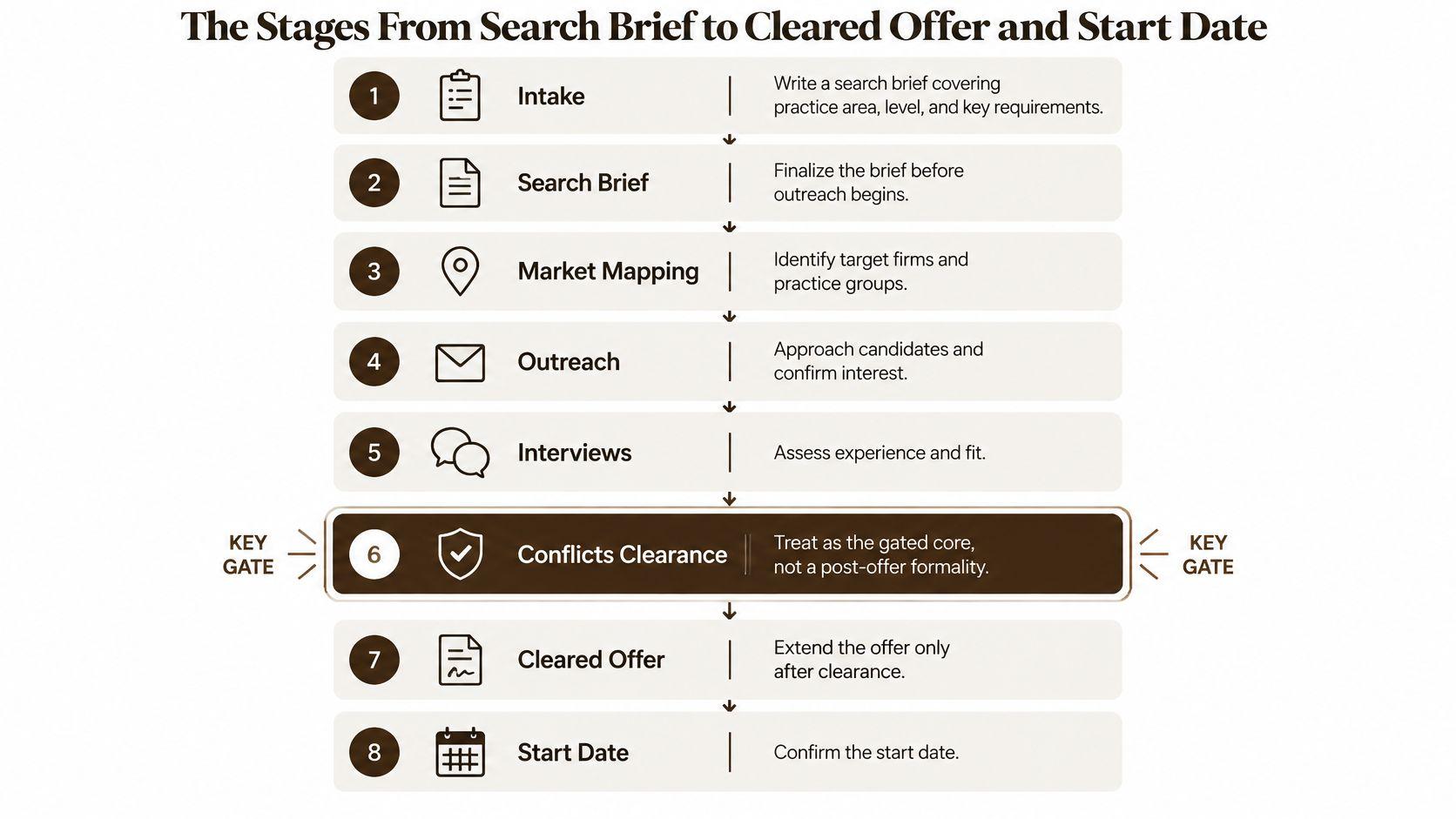
Walking Through the Eight Stages
Every stage needs a concrete deliverable before the hiring team advances. Skipping an output to save a week usually adds a month of rework later.
| Stage | What Happens | Output Before Moving On |
|---|---|---|
| 1. Intake | Firm defines practice, level, portable-business expectations and must-have admissions | Signed search brief |
| 2. Sourcing | Recruiter approaches candidates, including passive ones | Shortlist of interested candidates |
| 3. Screening | Résumé, matter history, bar status and references reviewed | Vetted shortlist |
| 4. Disclosure | Candidate supplies complete client and adverse-party list | Full conflicts dataset |
| 5. Interviews | Practice leaders assess technical fit, team fit and client relationships | Interview scorecards |
| 6. Clearance | Conflicts and background checks run against disclosed data | Cleared file or contingent status |
| 7. Offer | Compensation, guarantees and start date negotiated | Accepted offer, contingent on clearance |
| 8. Transition | Client-transfer rules and matter handover agreed | Start date and transition plan |
Stage 1 starts with a written search brief detailing the exact practice specialty, seniority band, required state bar admissions, compensation range, and any portable-business expectations. During Stage 2, recruiters map target firms and reach out discreetly to employed attorneys who aren't browsing public job boards. Stage 3 filters that pool by verifying bar standing, examining deal sheets or litigation dockets, and checking references before a hiring partner spends billable time in interviews.
Stage 4 is where legal recruiting diverges sharply from corporate hiring. Before final interviews wrap up, the candidate completes a standardized lateral questionnaire listing every current, concluded, and open matter, every client, and every adverse party, including potential portable clients. According to NALP's 2020 Lateral Hiring Best Practices Guide, reviewing concluded and open representations alongside active ones is essential because an attorney may still hold confidential information or knowledge that requires an ethical screen on specific firm matters.
In Stage 5, practice leaders test technical depth, team dynamics, and client relationships directly against the search brief using consistent interview scorecards rather than gut reactions.
Running Conflicts Clearance as a Hard Gate
Stages 6, 7, and 8 protect the firm's existing book of business. Even when a firm needs to extend a Stage 7 offer quickly to lock in a sought-after candidate, that offer must be expressly contingent on satisfactory background and conflicts clearance.
To make Stage 6 and Stage 8 defensible, follow a four-step technical protocol:
- Map every disclosed entity into the conflicts database: Enter every client, subsidiary, and adverse party from the candidate's lateral questionnaire so automated and manual checks catch direct and positional conflicts.
- Assign formal risk ownership: Hand final sign-off to the firm's general counsel or risk committee rather than the hiring partner who wants the seat filled.
- Document waivers and ethical screens in writing: Where a conflict is waivable, obtain signed client waivers or build a formal ethical wall (including restricted document-management access and written notices to staff) before the candidate touches any firm file.
- Freeze client and matter transfers until written clearance arrives: During Stage 8, agree on joint client-notification rules and matter handovers, and prohibit any client or file transfers until final clearance is confirmed in writing.
Larger business-generation claims naturally lengthen this gate. A mid-level associate with twenty disclosed matters clears far faster than a senior corporate partner bringing forty active clients and five years of opposing-party history. Before any start date is finalized, the firm's clearance file should hold four items: the signed lateral questionnaire, a resolution log for every database hit, executed waivers or ethical-screen memos, and written final clearance from risk leadership.
Who Does What Across the Process
Firm size changes who carries the operational load in a lateral search, even though the underlying decisions stay the same. In 2024, law firms with more than 1,000 lawyers increased total lateral hiring by 21%, while firms with fewer than 250 lawyers experienced an 11% decline, according to The American Lawyer's reporting on NALP's 2024 data. Large global firms typically staff internal recruiting directors, lateral integration managers, and full-time conflicts analysts. A boutique or midsize firm rarely has that bench, which means the managing partner often juggles sourcing, interviews, compensation, and onboarding between client calls.
When leadership doesn't assign explicit decision rights, good candidates drift away during silence. Mapping each stakeholder to one concrete decision point shows exactly who can move a search forward and who can pause it.
| Role | Core Responsibility | Decision Point |
|---|---|---|
| Managing or hiring partner | Sets the business case and approves the offer | Go or no-go on the search and final offer |
| Practice group leader | Judges technical skill, portable business and team fit | Shortlist and interview ranking |
| General counsel or risk committee | Owns conflicts and background clearance | Clearance, waivers and ethical screens |
| Recruiter | Runs sourcing, screening and candidate feedback | Which candidates reach the client |
| HR or firm administrator | Handles compensation, onboarding and records | Offer structure and start date |
| Candidate | Discloses clients, matters and adverse parties | Whether to proceed |
Where Unclear Ownership Stalls a Search
The managing or hiring partner approves the budget, confirms headcount need, and signs off on final economic terms. Searches stall here when a practice group interviews three strong attorneys before management agrees on whether the firm can fund a guaranteed base salary.
The practice group leader evaluates legal writing, courtroom or transaction leadership, and how the candidate's billing expectations align with the team. If the practice leader delegates interviews without setting scoring standards, different partners weigh different traits and produce split feedback that drags decisions out for weeks.
Ownership rule: Separate commercial enthusiasm from risk approval by giving the general counsel or risk committee independent authority to hold an offer until conflicts clear.
The general counsel or risk committee protects existing client relationships. Problems arise when a hiring partner pressures staff to fast-track a partner hire before adverse parties are fully checked, exposing the firm to disqualification motions after the attorney arrives.
HR or the firm administrator benchmarks compensation against internal pay bands, verifies malpractice insurance tail coverage requirements, and prepares IT access and bar-transfer records. Skipping this check creates internal pay compression when a lateral associate arrives earning more than a loyal incumbent at the same seniority.
The candidate owns timely, accurate disclosure of matters, adverse parties, and any non-solicitation or notice obligations to their current employer, along with the final decision to accept or walk away.
Holding the Search Together End to End
The recruiter controls sourcing quality, initial vetting, and the communication loop between candidate and firm. When a law firm brings in an outside recruiting partner, the first operational question to ask is who owns the search from intake to closing rather than handing the file across three junior coordinators. At Five Star Placements, Senior Legal Recruiter CJ Ohm manages each search from first call to accepted offer, keeping one point of accountability over candidate screening, interview momentum, and offer alignment.
How to Evaluate Candidates Beyond the Résumé
A polished law school pedigree and a list of impressive firm names tell you almost nothing about whether an attorney will succeed in your office. Ten years on a résumé can represent a first-chair litigator who manages clients independently, or a senior associate who spent a decade handling discovery disputes behind a single rainmaker.
For lateral partner hires, the biggest blind spot is the portable book of business. Self-reported portability estimates routinely overshoot what moves. Lateral partner candidates screened in 2023 claimed an average client-portability rate of 57% (better than half of their book), while adjusted actual portability landed closer to 35%, or roughly one in three clients, according to Legal Sales and Service Organization's analysis of lateral evaluation data citing NALP materials.
The same analysis highlights a 2021 survey showing why that gap hurts firms so badly: 56% of firms named the ability to generate business, port clients, and build a practice as the most important lateral-partner quality, yet nearly half reported that most lateral partners underperformed on portable business. Worse, 67% of firms reported partners departing after failing to bring prior-firm business, and 56% cited departures tied to weak new-client development.
Before signing off on any senior lateral offer, hiring leaders should inspect the underlying client documentation and portfolio data rather than relying on interview presentations.

Applying a Practical Portability Discount Rule
Those figures point to a clear underwriting rule. When candidates claim roughly 57% portability and realize around 35%, firms should treat roughly three of every five claimed clients as the practical ceiling during financial modeling. Never set multi-year compensation guarantees on headline originations alone; tie guarantees, draw step-ups, and integration bonuses to collected revenue and independently verified client movement.
Validating a partner's pitch requires five concrete checks:
- Matter-level client list: Request a breakdown of active clients, billing rates, realization history, and whether the candidate is the primary relationship partner or a service partner on each account.
- Multi-year financial track record: Review several years of originations and collections to distinguish recurring institutional clients from one-off deals or litigation windfalls.
- Client concentration and retention: Check whether one client accounts for half the book, and inspect how long key clients have stayed with the attorney.
- Reference corroboration: Where confidentiality permits, speak with former colleagues, co-counsel, and permitted client references to verify true relationship ownership.
- Evidence-based discounting: Apply a conservative conversion factor to projected revenue, factoring in conflicts, billing-rate differences, and non-solicitation constraints at the prior firm.
Adjusting Evaluation Criteria by Seniority Level
Associate and counsel searches require a different evidence pack than partner searches. Applying partner-style business-development scrutiny to a fourth-year associate wastes time, while hiring a partner solely on technical credentials invites revenue shortfalls.
| Criterion | Associate or Counsel | Partner |
|---|---|---|
| Relevant experience | Matter types, court or deal experience, hours worked | Practice leadership and team built |
| Client book | Limited; mainly matter-level involvement | Matter-level client list, checked against references |
| Portable business | Rarely central | Several years of originations and collections, discounted for conversion |
| Readiness | Workload and billing fit from day one | Transition plan for client relationships and team |
| Retention signals | Prior tenure and reasons for moves | Record of prior departures and client retention |
Rigorous screening starts before a partner ever reads a résumé. At Five Star Placements, every candidate we send has spoken with our team on a call before the client sees them. We vet each candidate's credentials, bar status, matters handled, and fit, and confirm their interest in the specific role. Pairing that upfront screening with structured candidate selection methods keeps interview panels focused on verified evidence instead of first impressions.
The video below breaks down practical ways legal hiring teams assess lateral candidates beyond paper credentials.
Testing Culture and Team Fit in Structured Interviews
Even when the numbers check out, a lateral hire can fail on operating style. An attorney coming from a rigid, high-hour firm may struggle in a collaborative boutique with flat management and hands-on client service, and the reverse happens just as often.
Build structured interview questions around four daily realities: how much autonomy versus partner supervision the attorney expects, how they handle a client who pushes back on legal strategy, what billing and origination expectations motivated their prior job changes, and what a productive first six months looks like in their view. Score every candidate against the same rubric so charm in a thirty-minute lunch doesn't override real misalignment.
Common Challenges and How to Fix Them
Most stalled or failed lateral hires trace back to six predictable operational breakdowns. The most expensive failure is portable business landing well below projection after a partner joins. It almost always stems from accepting a self-reported book of business at face value without verifying collections or discounting conversion rates. Fixing it starts before the offer by stress-testing the numbers and linking compensation guarantees to collected revenue rather than stated originations.
When a partner or finance leader reviews actual billing and realization figures side by side before extending terms, revenue surprises drop sharply.

Diagnosing the Six Most Frequent Breakdowns
Ordering lateral search problems from highest financial impact to operational friction helps firm leaders put safeguards in the right places first.
| Problem | Likely Cause | Fix |
|---|---|---|
| Portable business below projection | Self-reported book, never verified | Discount projections and tie pay to collected revenue |
| Hire leaves within a year | Transition plan never agreed | Confirm practice leader and matter handover before start |
| Candidate cannot be cleared | Adverse party or open matter left off the questionnaire | Re-run the check; keep the offer contingent |
| Poor culture or role fit | Vague search brief | Rewrite the brief and score interviews against it |
| Slow shortlist | No defined feedback loop with the recruiter | Ask for prompt, candid feedback and adjust the search |
| Late offer decline | Nobody checked what the candidate would accept | Confirm likely acceptance before the offer goes out |
Early departures within the first year are the second costliest failure. Firms frequently assume an experienced lawyer needs minimal onboarding, so nobody designates a practice-group sponsor or maps out how active firm matters will transfer during the first month. Agreeing on the sponsoring partner, matter handover schedule, and billing-system orientation before the start date eliminates the isolation that drives early exits.
Conflicts surprises usually trace back to an incomplete lateral questionnaire where an adverse party, former affiliate, or recently closed matter was omitted. Keeping every pre-clearance offer expressly contingent lets risk counsel re-run checks cleanly and pursue waivers or ethical screens without legal fallout.
Culture and role mismatches happen when the search brief lists generic adjectives instead of concrete case complexity, supervision style, and partnership timelines. Rewriting the brief and forcing every interviewer to score against it corrects the pipeline immediately.
Shortlists stall when hiring partners sit on résumés for ten days without explaining why a candidate missed the mark. At Five Star Placements, we ask clients for prompt, candid feedback on each candidate and adjust the search based on that feedback so sourcing stays calibrated in real time.
Late offer declines occur when a firm spends six weeks interviewing an employed attorney without testing compensation expectations, bonus structures, or counteroffer risk. Before an offer goes out, we tell the client what the candidate is likely to accept, which keeps written terms aligned with reality.
Quick Repairs Versus Starting Over
Not every snag requires scrapping a search. Re-running a conflicts screen on a newly disclosed matter, sharpening recruiter calibration after a candid feedback call, or clarifying offer terms before sending the letter usually takes a few days to resolve.
Other failures demand a hard stop and a new search. An unwaivable direct conflict with a flagship firm client, a portable book that evaporates under reference verification, or repeated interview rejections driven by an unrealistic search brief can't be patched with minor tweaks. Recognizing the difference early saves months of wasted partner hours.
Measure the Hire and Decide Your Next Step
A signed offer letter isn't proof that a lateral hire succeeded. It only confirms that recruiting ended and integration began.
Market activity makes post-hire measurement urgent rather than optional. In 2025, U.S. lateral hiring climbed 16.4% across 305 surveyed law-firm offices, with lateral associates representing 58.2% of hires and lateral partners 22.3%, according to NALP's 2025 lateral hiring research. Yet that same NALP summary cites a 2025 legal-market report revealing an average three-year retention rate of only 52% for Am Law 200 associates, compared with 61% for counsel and 76% for partners. High hiring volume masks heavy attrition whenever firms stop tracking performance after day one.
Post-hire reality: The riskiest phase of lateral hiring starts after acceptance, when unexamined revenue assumptions and missing integration support quietly push strong attorneys back into the market.
Running 30, 90, 180, and 365 Day Reviews
Before extending an offer, document a clear performance baseline tied directly to the interview scorecard and financial model. Then run structured check-ins at four fixed milestones, applying disciplined quality-of-hire measurement to compare actual progress against pre-offer projections:
- Day 30 (Access and transition): Confirm systems access, conflicts-wall compliance, matter handovers, and initial client-transfer outreach are underway without bottlenecks.
- Day 90 (Workload and collaboration): Review utilization, billing hygiene, realization rates, team collaboration, and early feedback from partners and staff working alongside the hire.
- Day 180 (Revenue and matter ownership): Measure collected revenue, verified client transfers, independent matter ownership, and cross-selling traction across practice groups.
- Day 365 (Full-year ROI and retention): Evaluate annual collections against compensation guarantees, assess long-term career or partnership trajectory, and confirm retention alignment for year two.
When a partner's portable-business estimate proves lower than projected, don't wait for the year-end compensation meeting to address it. Have the practice group leader recalibrate targets, cross-marketing support, and client-introduction plans at the 90-day or 180-day review while there is still time to course-correct.
Deciding Your Next Step as a Firm Leader or Candidate
If you're a managing partner, hiring partner, or general counsel preparing to open a lateral search, pause before emailing recruiters and verify two prerequisites: a signed search brief with realistic compensation and matter expectations, and a named conflicts clearance owner with authority to sign off before offers become unconditional. Those two controls determine whether a search closes smoothly or collapses late. Every search at Five Star Placements starts with a thirty-minute call about the role before sourcing begins. We're built for boutique and midsize law firms, as well as companies hiring in-house counsel, where our candidate network and placement record are concentrated, and law firms and legal departments can schedule a call with us to discuss their legal recruitment needs.
If you're an attorney considering a lateral move, start by clarifying what you want in your next firm (practice autonomy, billing model, partnership path, and team culture) before taking recruiter calls. Assemble an accurate, confidential list of your current, open, and concluded clients, matters, and adverse parties in advance so you can move through disclosure and clearance without surprises when the right opportunity appears.
Five Star Placements specializes in permanent legal recruitment for boutique and midsize law firms as well as corporate legal departments, pairing hands-on candidate vetting with transparent communication from intake through accepted offer. Whether you're a firm leader preparing a confidential partner or associate search or an attorney weighing your next move, our team helps you handle screening, expectation alignment, and hiring decisions without wasted cycles. Visit Five Star Placements to explore our legal recruiting services and schedule a thirty-minute conversation about your goals.
Need help filling a legal role?
Five Star Placements partners with law firms and legal departments nationwide.
Schedule a Call