
Compliance Officer Hiring: How to Find the Right Candidate
November 24, 2026 · 20 min read · Five Star Placements
Table of contents
The U.S. Bureau of Labor Statistics projected 436,400 compliance-officer jobs in 2025, rising to 453,100 by 2035, a 4% increase published on O*NET OnLine's federal employment trends page. That isn't the profile of a niche occupation with no available talent. It's a massive, durable national workforce that keeps expanding year after year.
Yet corporate legal departments, banks, healthcare networks, and regulated businesses still watch compliance searches sit open for six months without a viable finalist. When hiring managers run into that wall, they usually blame candidate scarcity, bump the base salary by ten percent, and ask recruiters to widen the sourcing net. Those moves rarely fix the stall.
Most failed compliance officer hiring starts as a role-design problem, not a talent problem. Candidates with real regulatory judgment read a job posting for ten seconds and spot a broken mandate, an unclear reporting line, or a two-person workload crammed into one seat. If you want qualified finalists who accept the offer and stay past their first examination cycle, fix the scope, authority, and staffing structure before you open the search.
Table of Contents
- Compliance Officer Roles and the Profile Each Needs
- Design the Mandate and Avoid the Stalled Search
- Pricing the Role Against Market Pay and Workload
- Qualifications That Go Beyond Regulatory Knowledge
- Screening Candidates for Technical Risk Judgment
- How to Run the Search From Scope to Offer
Compliance Officer Roles and the Profile Each Needs
Most stalled searches go off the rails before a single resume arrives because the hiring team picks the wrong role level. A general counsel asks for a senior leader who can sit in front of the audit committee, while the hiring budget and daily tasks belong to a hands-on testing analyst. Experienced candidates spot that disconnect on the first screening call and withdraw.
The four primary compliance levels carry completely different scopes, proof points, and warning signs. Match your vacancy to one row in the table below before writing a job description.
| Role level | Core scope | Typical background | Must-have evidence | Red flag |
|---|---|---|---|---|
| Compliance analyst or specialist | Monitoring, testing and reporting on defined controls | Several years in compliance, audit or regulated operations | Hands-on monitoring and documented testing | Only policy writing, no testing experience |
| Compliance manager | Runs the compliance program for one business line or region | Investigations, vendor risk and regulator-facing reporting | Program ownership with measurable results | Manager title with no authority over budget or staff |
| Chief compliance officer | Sets the enterprise program and reports to the board | Senior leadership in a regulated sector or legal department | Board reporting and independent escalation authority | Title given without decision rights |
| In-house compliance counsel | Gives legal advice to the business inside the legal department | Law degree, bar admission and regulatory practice | Legal judgment combined with business-facing communication | Advice given without business context or regulatory practice |
Notice the recurring trap in the red-flag column. The fastest way to repel senior talent is hanging a lofty title on a seat that lacks real decision rights, budget control, or independent escalation. An officer who can't pause a non-compliant product launch or take a material finding straight to the board isn't functioning as an executive, regardless of what the business card says.
Why One Pipeline Spans Four Distinct Levels
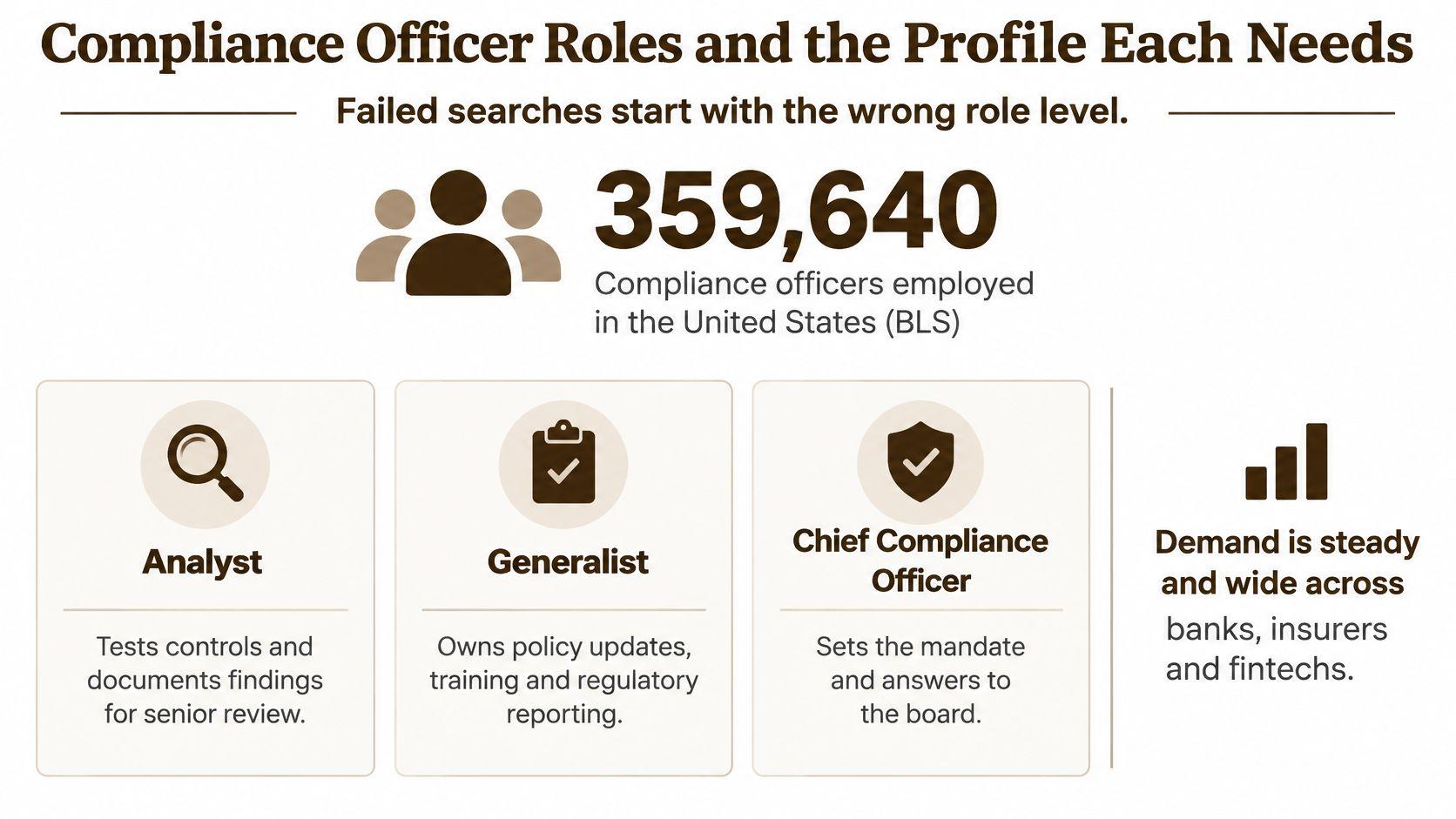
Market scale explains why recruiters and legal leaders can't treat compliance as a single job family. According to the Bureau of Labor Statistics Occupational Outlook Handbook, employers counted 359,640 compliance officers in May 2022, earning a median annual wage of $71,690 and a mean annual wage of $76,980. Pay stretched from $41,050 at the 10th percentile to $118,060 at the 90th percentile, with roughly 32,700 openings projected annually from growth and replacement needs across government, healthcare, manufacturing, financial services, and other regulated industries.
That wide pay dispersion shows why one hiring pipeline has to serve completely different career bands. Entry-level analysts running routine control sampling operate in a different talent market than seasoned program owners managing enterprise risk, audit readiness, and ethics governance. Because businesses and government agencies face a permanent obligation to comply with laws and regulations, recruiting for these roles is a recurring operational requirement rather than a brief reaction to one enforcement cycle.
The visual below summarizes how the core compliance tiers divide responsibility from daily control testing up to board-level oversight.
If you're still debating whether you need a strategic executive or an operational lead, review what a chief compliance officer does against your actual weekly calendar of regulatory deliverables. Then pick exactly one role level from the table and write it at the top of your hiring intake sheet. Don't draft a single bullet point of the job posting until every stakeholder signs off on that choice.
Design the Mandate and Avoid the Stalled Search
When a search goes quiet for months, hiring teams assume the talent pool is dry. Market data point to a sharper diagnosis: the seat itself is often built to fail. In a 2025 survey of more than 300 compliance officers published by Corporate Compliance Insights, respondents flagged heavy workloads, long hours, stress, and strained work-life balance alongside strong demand for automation and better tools. That same report notes separate market figures showing that roughly 38% of financial institutions run compliance with only one or two people, while 47% struggle to find qualified talent and 25% can find talent but can't afford it.
Lean legal departments amplify this pressure. The Association of Corporate Counsel's 2022 Law Department Management Benchmarking Report, cited alongside the ACC 2024 Chief Legal Officers Survey, surveyed 427 legal departments across 24 industries and 26 countries and found that 55% housed compliance inside legal while another 18% ran it as a separate function reporting to legal. That places 73% of compliance programs inside the legal department's organizational sphere, where the median total legal-staff size is just six. In the 2024 CLO survey itself, 13% of chief legal officers expected to hire privacy professionals and another 13% planned to add allied legal professionals, including compliance analysts.
Put those numbers together and you see why experienced officers interrogate the role before they ever talk about salary. Small legal and compliance teams require versatile operators who combine regulatory judgment, investigation skills, and daily execution. When an employer asks one hire to carry enterprise governance, frontline monitoring, and board reporting without tools or backup, strong candidates pass.
Seven Mandate Decisions to Lock Down Before Posting
Before you publish a job description or brief a recruiter, settle seven structural questions in writing. Every one of them will come up during serious candidate interviews.
- Reporting line and independence from the business: Specify who the officer reports to and confirm that revenue leaders can't override compliance findings or set the officer's bonus based on sales volume.
- Decision rights, including authority to pause activity: State clearly when the officer can halt a product rollout, freeze an onboarding flow, or block a third-party vendor until deficiencies are fixed.
- Budget for people and tools: Put a real dollar figure on annual spend for outside regulatory counsel, testing software, training platforms, and future hires rather than promising to revisit budget next year.
- Staffing ratio against the workload: Map current transaction volume, regulatory filings, active jurisdictions, and audit cycles against headcount so candidates see a survivable workload.
- Technology and automation support: Name the systems already in place for transaction monitoring, policy management, or case tracking, and be candid about manual gaps that need automation.
- Board or committee access: Define how often the officer presents to the audit or risk committee and whether they hold private executive sessions without commercial management in the room.
- Boundaries between compliance, legal, risk, and internal audit: Draw crisp lines showing who owns policy drafting, who tests controls, who handles privilege and litigation, and who runs independent assurance.
Merging a strategic chief compliance officer and an operational compliance manager into a single title is the most common way employers violate this checklist. A seasoned CCO wants to architect enterprise controls, advise the board, and manage specialist leads. Handing that executive a queue of daily alert clearances and manual spreadsheet audits causes fast burnout and guarantees you'll re-run the search within eighteen months.
Practical rule: If your written mandate requires the same person to brief the board on enterprise strategy in the morning and clear routine customer alerts all afternoon, you're hiring for two jobs under one salary.
Before interviewing candidates, audit your hiring plan against the mistakes that derail compliance searches. The photo below captures the kind of candid role-scope discussion that needs to happen early, not after an offer is drafted.

Common Mandate Mistakes and How to Fix Them
- CCO authority at a manager's budget: You expect executive stature and personal regulatory accountability, yet the budget covers no headcount and no software. Fix it by downgrading the title to manager with clear external-counsel support, or funding the department before recruiting a CCO.
- One title carrying strategic and operational duties: Combining program architecture with frontline testing repels both career tracks. Split the work into a senior lead plus a dedicated analyst, or outsource routine monitoring while your lead builds the program.
- Hiring for rule memorization alone: Candidates who recite statutory citations often stall when asked to build repeatable operational controls. Rewrite your intake scorecard to weight control execution and risk judgment over textbook recall.
- Treating pay as the only lever: Adding twenty thousand dollars to base pay won't fix a broken reporting line or a 70-hour workweek. Invest first in staffing ratios, automation tools, and clear escalation authority.
- Granting a title without decision rights: Business units quickly learn they can ignore a compliance officer who lacks escalation teeth. Write explicit pause-and-escalate authority into the charter and have the CEO or general counsel back it publicly.
- Letting commercial teams edit compliance conclusions: If business leaders rewrite audit findings before the board sees them, ethical candidates will walk out during diligence. Guarantee unfiltered reporting of material deficiencies to the board committee.
- Sending an offer before checking acceptance: Dropping a formal letter without testing compensation, title, and authority expectations wastes weeks and poisons final rounds. Confirm every deal point verbally before drafting paperwork.
Run one final sanity check on your completed mandate before you recruit. Ask yourself whether a qualified compliance officer could look at your written authority, budget, headcount, and tools and present a credible 90-day plan on day one. If the honest answer is no, pause the search and repair the mandate first.
Pricing the Role Against Market Pay and Workload
Say a midsize regulated firm budgets near the national median for a compliance hire, then writes a job description demanding regulator-facing exam leadership, enterprise policy architecture, and direct board reporting. Every qualified applicant either asks for fifty percent more or drops out after learning the full scope. That's why pay must be set after you finalize the mandate, never before.
A clearly scoped role tells you exactly where your vacancy belongs on the market compensation curve. Routine control testing, alert disposition, and documentation roles sit toward the lower end of the compliance wage spread. Mid-level managers who own a regional program, manage vendor reviews, and coordinate exams sit in the middle bands. Enterprise leaders who carry board accountability, personal regulatory exposure, and cross-functional governance authority sit at the top of the range.
If you're calibrating compensation for a leadership seat that sits above an individual manager but below a public-company CCO, looking closely at the scope of a director of compliance helps separate program-management pay from executive-level packages.
Workload Belongs Inside the Offer Price
Base salary is only half of what experienced candidates price when they evaluate an offer. Because burnout, heavy workloads, and long hours drive turnover across compliance teams, a rich base salary won't retain an officer who inherits an unstaffed program running on manual spreadsheets. Smart candidates calculate the hidden cost of under-resourcing right alongside cash and equity.
A generous paycheck can persuade a seasoned compliance officer to sign an offer letter, but staffing ratios, automation budget, and real board backing decide whether they're still in the seat a year later.
When you build your compensation package, price the supporting resources as part of the offer. Access to automated monitoring tools, a realistic analyst-to-workload ratio, and dedicated budget for specialist outside counsel often close a strong candidate faster than an extra slice of base salary alone.
Three Steps to Price the Package
- Set the level strictly from the signed mandate. Ignore legacy titles from your org chart and anchor the role to its decision rights, reporting line, and board exposure.
- Match your pay band to scope and local market reality. Federal occupational wage data group all compliance roles together without breaking out exact titles, industries, or metro cost differences, so benchmark your band against current local salary data for your specific sector before publishing a range.
- Stress-test the package against the 90-day plan. Confirm that total compensation, headcount approvals, and technology spend equip the new hire to hit their first-quarter deliverables without burning out.
Qualifications That Go Beyond Regulatory Knowledge
Most compliance job descriptions read like a carbon copy of the same regulatory checklist: AML and KYC workflows, sanctions screening, regulatory reporting, and policy drafting. Those skills form the baseline, not the differentiator. Treating them as the whole hiring bar leaves you with candidates who know yesterday's rulebook while missing the operational risks already running inside your company.
Effective compliance officer hiring evaluates three distinct layers of qualification. The regulatory core is layer one. If a candidate lacks working familiarity with the statutes and agencies governing your industry, they can't anchor the program.
Layer two is cross-functional operating fluency. Modern compliance officers don't sit in an ivory tower issuing advisory memos. They work weekly alongside information security, privacy, internal audit, enterprise risk, and incident response teams to test whether systems conform to law and to build practical strategies for managing identified gaps. A candidate who has never sat in a technical post-mortem or negotiated a remediation deadline with an engineering lead will struggle the moment a real control breaks.
The AI Governance Execution Gap
Layer three is the qualification almost every job description forgets to test: AI-governance capability. Industry coverage from Wayoh's analysis of chief compliance officer hiring trends reports that more than 83% of compliance teams use AI tools, yet only about 25% have a strong governance framework in place. That gap isn't a theoretical future issue. Operational teams are deploying automated screening, underwriting, and monitoring tools right now without defensible oversight.
Asking a candidate whether they've used RegTech software misses the point. You need to know whether they can build governance controls around automated decision-making from scratch. Look for concrete capability across seven operational areas:
- Model inventory: Maintaining a live register of every internal and vendor-built automated tool touching customer, financial, or regulated data.
- Explainability: Requiring business owners and vendors to document how an automated system reaches an output so regulators and auditors can trace decisions.
- Human oversight: Designing clear human-in-the-loop review checkpoints for high-impact actions, such as automated adverse-action notices or account closures.
- Data quality: Verifying that training and input datasets are accurate, representative, and free from silent drift that corrupts compliance outputs.
- Vendor risk: Challenging unsupported marketing claims from third-party AI providers, reviewing testing documentation, and locking audit rights into vendor contracts.
- Ongoing monitoring: Tracking false positives, inconsistent flagging, and model degradation over time rather than treating approval as a one-time checkbox.
- Incident escalation: Establishing clear thresholds and response paths when an automated tool produces biased, erratic, or non-compliant results.
Candidates don't need to write code or build machine-learning pipelines to pass this bar. They do need to interrogate data, recognize where automated models fail, and translate technical risk into clear governance decisions for boards and non-technical executives.
I'd argue that a technically fluent compliance officer is often worth more than a traditional regulatory generalist, even outside technology companies. Healthcare systems, manufacturers, insurers, and midsize financial firms are adopting automated tools much faster than their governance programs mature. You can pair a technically sharp officer with outside regulatory counsel for niche statutory questions; you can't easily teach a pure policy writer how to audit a live automated system under pressure.
Adjacent Talent Pools Worth Sourcing
If you limit sourcing to candidates who already hold the exact title on your requisition, you'll miss some of the strongest problem-solvers in the market. Expand your pipeline to five adjacent disciplines that build overlapping risk-governance habits:
- Privacy professionals already map data flows, run impact assessments, and translate vague legal standards into concrete technical controls.
- Data governance leads bring rigorous habits around lineage, documentation, and input quality that directly strengthen automated compliance monitoring.
- Internal auditors know how to sample evidence, test whether controls work in practice rather than on paper, and document findings cleanly for committees.
- Cybersecurity risk analysts operate comfortably with access controls, vendor security reviews, and incident escalation timelines.
- Legal operations managers excel at building scalable workflows, managing outside-counsel spend, and implementing compliance technology across lean legal departments.
Screening Candidates for Technical Risk Judgment
Regulatory priorities have turned compliance interviews into a technical risk-control evaluation, especially for financial-services employers under SEC oversight. The SEC's cybersecurity examination priorities specifically target registrants' policies and procedures, governance practices, data-loss prevention, access controls, account management, ransomware response, and controls addressing risks from artificial intelligence and polymorphic malware. When regulators inspect live technology controls at that level of granularity, an officer who only memorized rules can't protect the organization.
Traditional behavioral interviews fail here because polished candidates can rehearse smooth answers about teamwork and regulatory passion without proving they can build a working control. Replace generic interview questions with structured, scenario-based exercises. Ask finalists to take a real regulatory obligation and translate it into control objectives, name the system owners, define required audit evidence, evaluate exceptions, and map the escalation path for material deficiencies.
The table below lays out four practical scenario tests and the specific proof points a strong candidate puts on the table.
| Competency | Scenario test | Strong answer shows |
|---|---|---|
| Control design | Turn a rule into control objectives for a new client-onboarding tool | Names control owners, evidence and testing frequency |
| Technology risk | Review an automated adverse-action model alongside a vendor's accuracy claims | Asks for a model inventory, data quality checks and human oversight |
| Incident escalation | Respond to a ransomware alert in the first hour | Sets a reporting timetable and escalates material deficiencies |
| Board communication | Write a one-page executive summary of the risk | Separates facts, risk rating and the decision the board must make |
Notice how each prompt forces candidates out of abstract theory and into operational execution. In the ransomware scenario, weak candidates recite boilerplate policy language about convening a committee. Strong candidates ask who isolates affected accounts, what evidence must be preserved for regulators, when outside counsel and insurers get notified, and what exact threshold triggers an executive or board escalation.
Scoring Answers Without Sacrificing Independence
Give every interviewer the same scoring rubric before the first candidate walks in so you evaluate risk judgment consistently across panels. If you're refining your broader hiring framework, pairing these technical prompts with structured candidate selection methods keeps personal bias from creeping into final decisions. Score each scenario response across four concrete criteria:
- Technical fluency: Does the candidate ask the right operational questions about data inputs, access permissions, system ownership, and exception logs without needing to be an engineer?
- Judgment under uncertainty: When facts are incomplete during a simulated incident or vendor review, do they prioritize the highest-impact risks and state clear assumptions instead of freezing?
- Documentation discipline: Do they specify exactly what evidence proves a control worked, where it lives, and how it holds up during an exam or enforcement inquiry?
- Willingness to challenge business decisions: When an interviewer pushes back as a revenue leader asking for an exception, does the candidate hold firm on required obligations while proposing lawful alternatives?
Pay close attention to that fourth dimension. Your selection process must actively protect compliance independence. If commercial stakeholders dominate the interview panel and downgrade candidates who push back on aggressive business assumptions, you'll end up hiring an internal advocate rather than an independent risk officer. That mistake stays invisible during calm quarters and turns catastrophic during an examination.
Clearing Baseline Vetting Before the Panel Meets
Scenario interviews take focused preparation, so your hiring committee shouldn't waste forty-five minutes verifying basic career history or checking whether a candidate wants the job. Recruiter-led pre-screening solves that bottleneck before resumes ever reach your desk.
At Five Star Placements, every candidate we send has already spoken with us on a call before you ever see their profile. We vet each candidate's credentials, bar status where applicable, matters handled, and overall fit, and we confirm their genuine interest in the specific role. Clearing those fundamentals upfront lets your internal panel spend the entire interview testing technical risk judgment, control design, and board communication.
How to Run the Search From Scope to Offer
A disciplined search moves in a strict sequence because every stage depends on the decisions locked in before it. Skipping straight to sourcing or rushing out an offer almost always signals that someone skipped the mandate audit. Remember too that most corporate compliance functions sit inside or report directly to the legal department, so every step below should test whether a candidate can operate smoothly inside legal reporting structures as well as across commercial, IT, and audit teams.
The six-step workflow below maps the full path from initial scope definition through accepted offer.
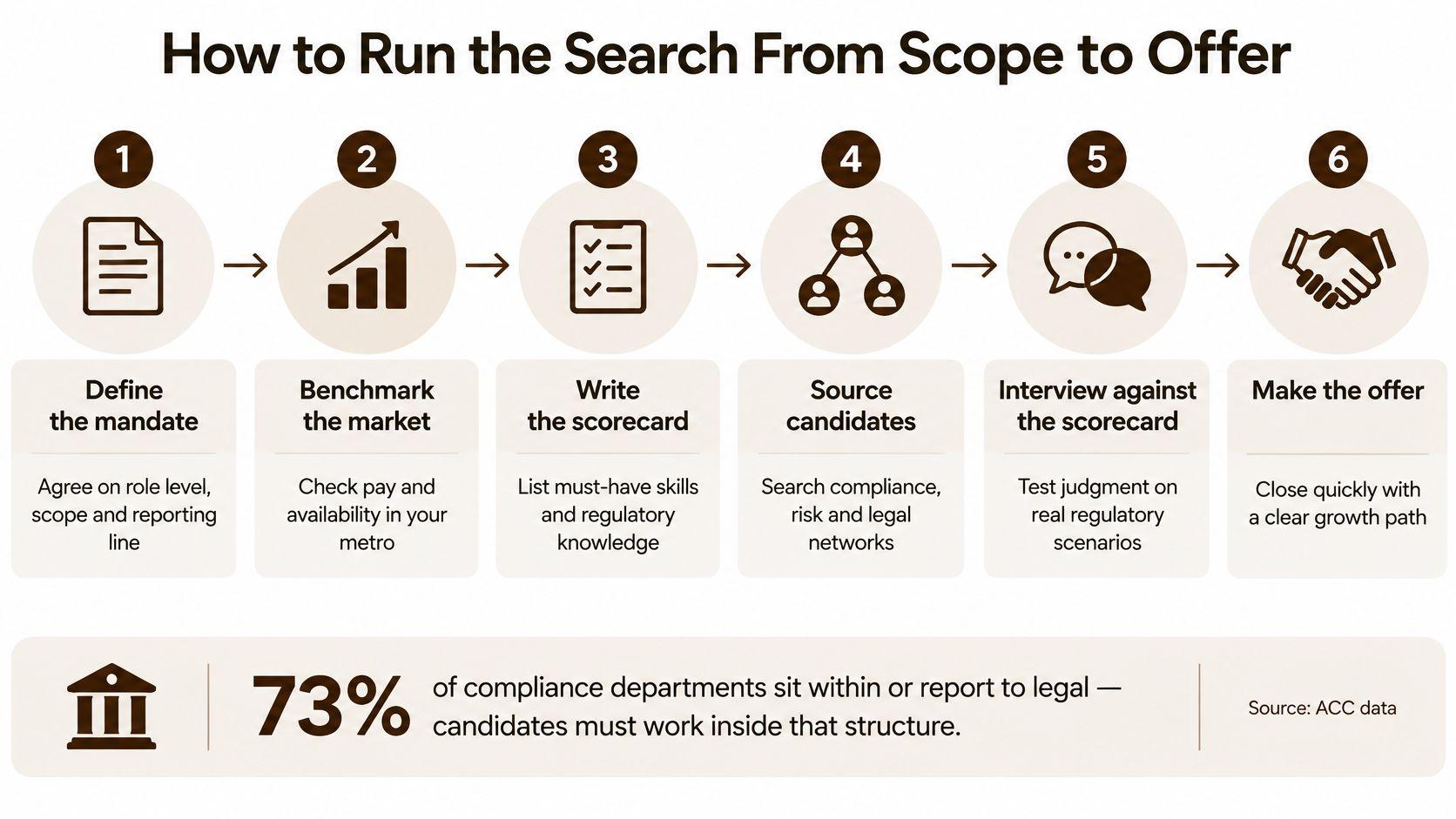
Follow these six steps in order and confirm every decision in writing before advancing to the next stage:
- Audit the vacancy against the mandate checklist and lock the role level. Before calling a recruiter or posting an opening, confirm your single target level, reporting independence, pause-and-escalate authority, headcount support, and software budget. If leadership can't agree on whether the hire owns enterprise strategy or daily testing, pause here until they do.
- Draft the job description around that level and select your scenario tests. Cut generic boilerplate and list the key regulatory priorities, internal partners, and 90-day deliverables. Choose two or three scenario exercises right now so the scorecard matches the exact job you advertised.
- Source across regulated sectors and adjacent risk functions. Don't restrict outreach to direct competitors in one narrow vertical. Strong compliance operators move successfully across financial services, healthcare, manufacturing, and government agencies, and high-performing specialists often sit in privacy, internal audit, cybersecurity risk, or legal operations teams.
- Screen resumes against all three qualification layers, then run scored scenario interviews. Filter first for baseline regulatory familiarity, cross-functional operating experience, and technical or AI-governance exposure. Once shortlisted candidates reach the panel, run identical scenario prompts and grade every response on the same four-part rubric.
- Deliver prompt, candid feedback after every candidate and calibrate immediately. Don't wait until you've interviewed six finalists to admit the role scope feels off or the technical bar needs adjusting. At Five Star Placements, we ask clients for prompt, candid feedback on each candidate and adjust the search right away based on what you see, keeping timelines tight and shortlists relevant.
- Confirm acceptance expectations before drafting the offer, and verify mandate alignment. Never send a surprise offer letter hoping the candidate will negotiate up. Before an offer goes out, we tell our clients what the candidate is likely to accept so compensation, start date, and expectations are already aligned. Double-check that the written reporting line, committee access, and decision authority in the formal offer match the mandate you promised during interviews.
For a deeper look at how legal and compliance hiring managers spot structural fit versus surface polish during executive interviews, watch this short walkthrough before running your next finalist round.
Making Your Kickoff Call Count
Every stalled search I've audited had one thing in common: the hiring team jumped into sourcing with a title instead of a finished mandate. You avoid months of dead-end interviews by completing the seven-point mandate checklist before your first recruiting conversation.
Treat your intake call as a scope review, not a wish list. Bringing clear decision rights, staffing numbers, and two scenario prompts cuts weeks off your search before outreach even begins.
When your mandate is ready, law firms and corporate legal departments can schedule a call with our team to walk through the role. Senior Legal Recruiter CJ Ohm manages each search from the first call to the accepted offer, and Account Manager Sain Rhodes serves as your point of contact throughout the process. Bring your completed mandate checklist to that kickoff conversation so the search starts from clear scope, realistic resources, and measurable judgment tests rather than an improvised job title.
Five Star Placements recruits compliance counsel, chief compliance officers, and regulatory attorneys for law firms and corporate legal departments nationwide on a contingency basis, vetting every candidate's credentials, matters handled, and role fit before you ever review a profile. If you're ready to turn a defined compliance mandate into a shortlist of thoroughly screened finalists, connect with our team at Five Star Placements to schedule an intake call.
Need help filling a legal role?
Five Star Placements partners with law firms and legal departments nationwide.
Schedule a Call