
Attorney Placement Pending: What It Means and What to Do
November 23, 2026 · 14 min read · Five Star Placements
Table of contents
An email arrives with a subject line you've now read four times: your attorney placement is pending. No start date, no rejection, no request for anything. You check whether the posting is still live, then check your phone, and learn nothing new either way.
Nothing in that message tells you whether the file is a day from an offer or dead since March. That's the trouble with the word. Attorney placement pending describes where a hire sits in a process, not how likely it is to close. A pending candidate can be in credential screening, in a third round of interviews, holding an accepted offer with no confirmed start date, or sitting in a search nobody has touched in six weeks.
The fix is procedural rather than emotional. Every pending placement has a stage, every stage has an owner, and every owner owes a next action with a date on it. Once you can name both, the wait stops being a feeling and becomes a line item you can manage.
What follows separates the stages, sets the realistic timing, and marks the exact point where waiting should turn into escalation. Firms hiring attorneys and attorneys weighing a move need the same three things: a named owner, a dated next step, and an agreed moment to walk.
Table of Contents
- What Pending Means at Each Stage of a Placement
- How Long a Pending Placement Usually Takes
- How to Move a Pending Placement Forward
- Why Placements Stall and How to Spot a Dead Search
- Interim Counsel or Waiting, and How to Choose
- Decide Your Next Move on a Pending Placement
What Pending Means at Each Stage of a Placement
Two people end the same call unsatisfied. The candidate asked, "Any word?" and the hiring partner said, "Still pending." Neither learned anything, because the word carried no stage, no owner and no date.
A pending attorney placement is a candidate, role or offer that has entered the hiring process but hasn't reached a confirmed start. That's the whole definition. Everything useful sits underneath it, in which gate the file has cleared and which one it's still waiting on.
A mortgage file in underwriting behaves the same way. The loan isn't approved because the folder is thick. It's approved when the appraisal, the title search and the income verification each come back clean. A file can sit in underwriting for three weeks and be one document from closing, or sit there indefinitely because nobody ordered the appraisal in the first place. Attorney searches work identically, and the only reliable way to tell which situation you're in is to name the stage.
The same word from three seats
For a candidate, pending usually means waiting on someone else's decision. For an employer, it means a requisition still open, which may be a healthy search or a role nobody has funded. For both, it can mean an accepted offer whose start date depends on a notice period or a conflicts check. Those are three different sets of phone calls, and each has a different person who should be making them.
The law firm hiring process moves through these stages in order, so the stage itself tells you who should be moving next. Locate the file you're asking about in the table below, then read across.
| Stage | What Is Happening | Who Acts Next | Action to Take |
|---|---|---|---|
| Submitted and screened | Credentials, bar status and matters handled are being checked | Recruiter | Confirm screening is complete and list anything still missing |
| Interview scheduling | Candidate and decision makers are matching calendars | Both sides | Propose two dates within one week |
| Feedback and decision | Client reviews interview notes and decides whether to proceed | Client | Ask in writing for a decision date |
| Offer and acceptance | Terms are negotiated and the candidate accepts or declines | Client and candidate | Confirm compensation, title and start date in writing |
| Start date pending | Offer accepted but not yet started, often due to notice periods or conflicts clearance | Candidate and new employer | Track conflicts clearance and notice period against the start date |
| Stalled | No activity past the agreed decision date | Nobody by default | Name an owner, escalate or re-scope the search |
Find your row before you do anything else. Four of the six rows resolve with one short message that names a next action and a date. The stalled row is the only one that needs a decision rather than a follow-up, and it's the row people leave untouched for months because nobody wants to be the person who asks whether the role is still real.
How Long a Pending Placement Usually Takes
Duration is the question everyone asks and the one with the least satisfying answer, because pace depends on the role rather than on the market's mood. A first-year associate search in a busy corporate practice and a partner search in a thin market are different races run on different tracks.
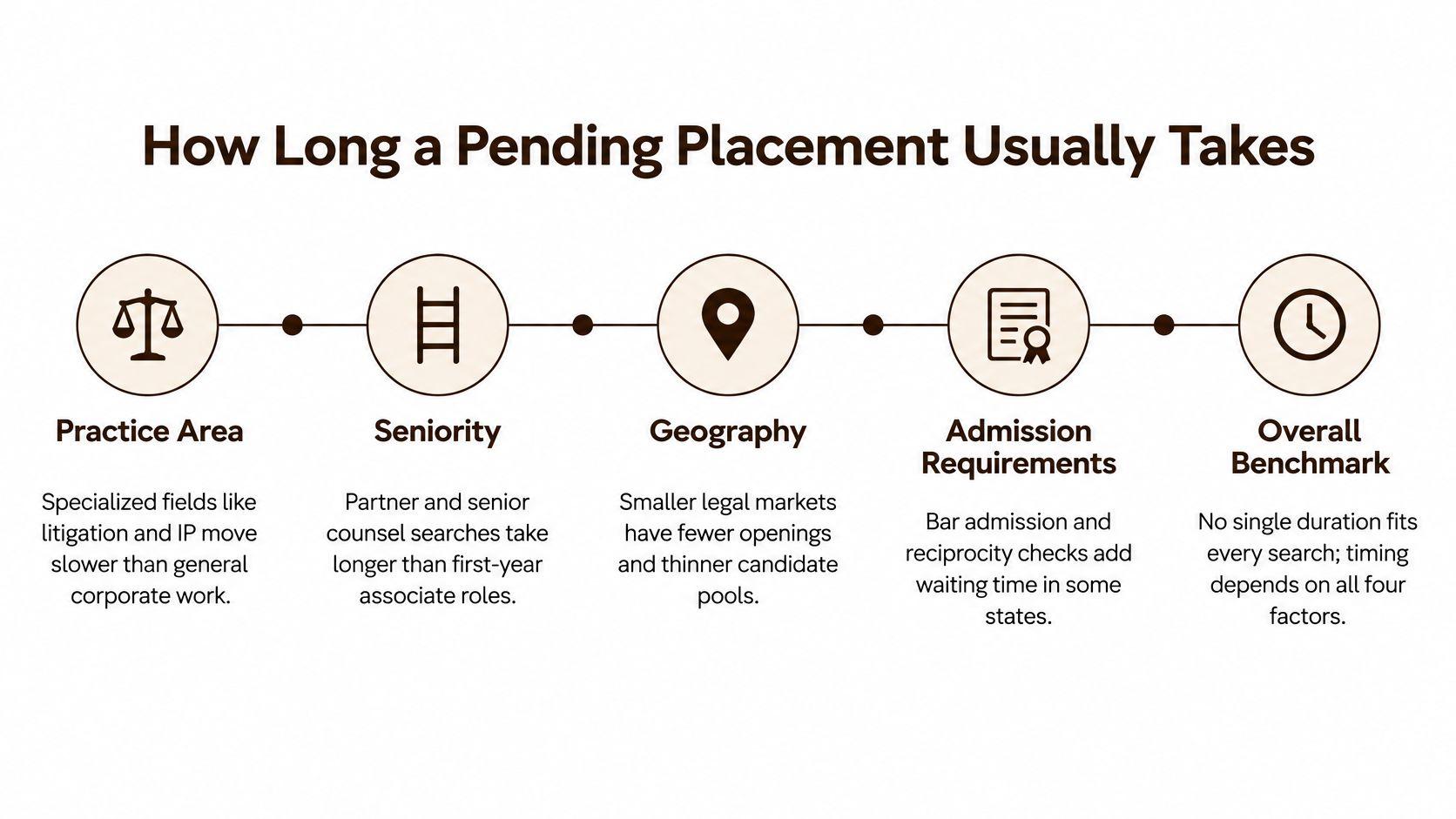
Four factors do most of the work. Practice area sets the size of the pool, and litigation or IP searches work through a smaller, more specialized group than general corporate hiring. Seniority changes the number of interviews, since a partner or senior counsel hire involves more decision makers than a first-year associate. Geography determines bench depth, and a smaller legal market holds fewer openings and fewer people to fill them. Admission requirements add a step that urgency can't compress, because bar admission and reciprocity checks run on their own timetable.
| Benchmark | Figure | What It Means for the Wait |
|---|---|---|
| First candidate within two weeks (Five Star Placements placement records) | 70% of searches | Two weeks is a realistic first checkpoint |
| U.S. lawyer openings per year (BLS projection) | About 28,700 | Demand keeps many searches open at once |
| 2025 law graduates in bar-required jobs within 10 months (ABA) | 83% | Most candidates land roles, but not all quickly |
Read the first row as a checkpoint rather than a promise. In 70% of our searches, the first candidate goes to the client within two weeks, based on placement records since January 2025. That makes two weeks a reasonable moment to expect movement, and if your file hasn't produced a shortlist by then, the silence is telling you something about the search rather than about you.
The second row explains why files move at different speeds in the same city on the same day. The Bureau of Labor Statistics projects roughly 28,700 lawyer openings a year across the 2025 to 2035 decade, counting both growth and replacement, so a slow file usually reflects competition rather than one employer's hesitation. Your best-fit candidate is being interviewed elsewhere this week.
Why most candidates land, and some don't
American Bar Association data reported by Reuters legal coverage shows 83% of 2025 U.S. law graduates held jobs requiring bar admission within 10 months of graduation, up one percentage point from 2024, which was itself a record year. Nearly 5% were still unemployed and seeking work. Many do land, though a meaningful share take longer than the average suggests.
These figures describe market conditions and our own search records, not a guarantee for any single file. Use them as a rule of thumb: when a search passes two weeks without a shortlist, or an interview stage passes its agreed decision date, move to the procedure below instead of waiting for the next update.
How to Move a Pending Placement Forward
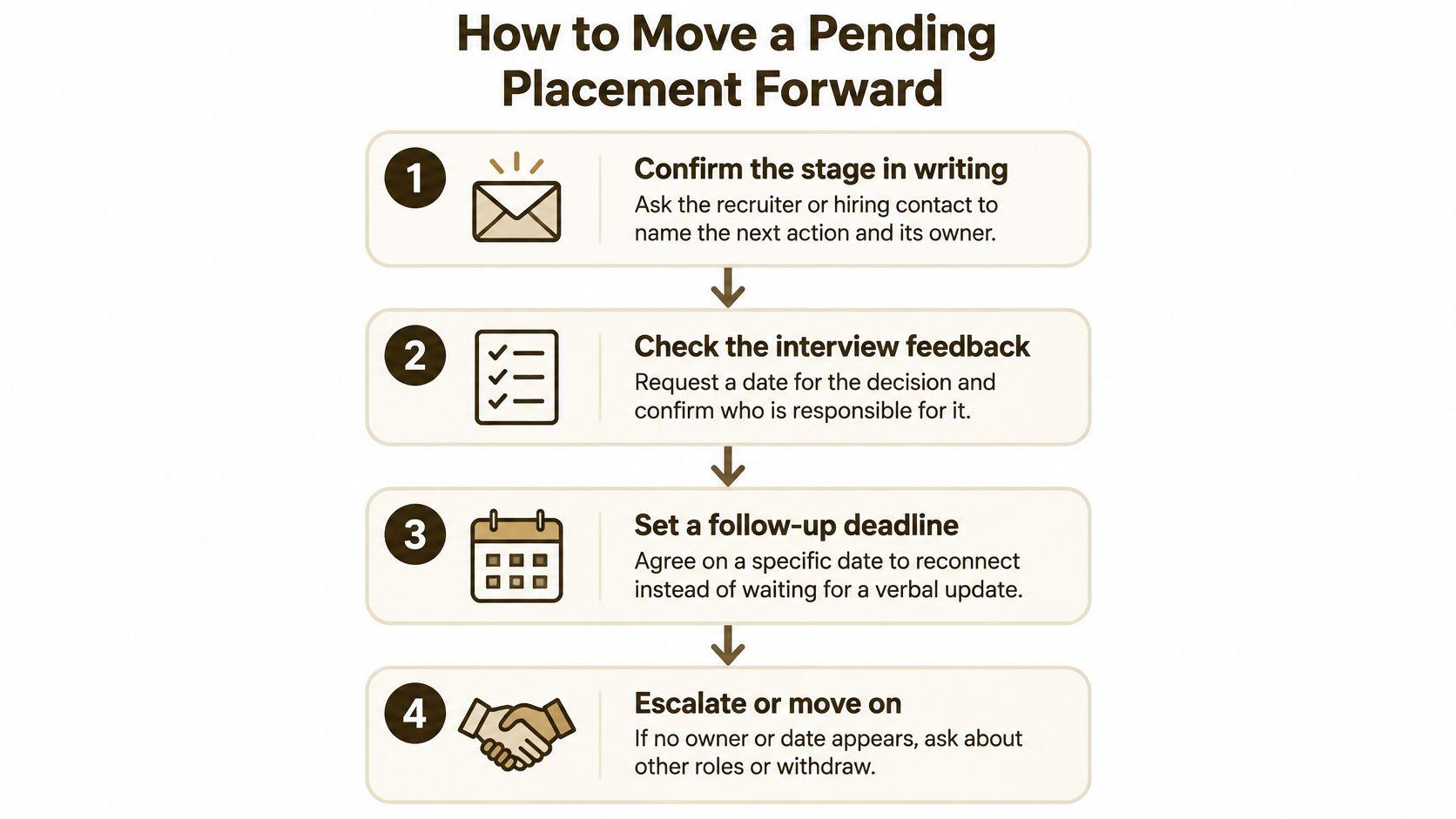
Pending placements move when someone applies pressure at the right gate. Pressure applied everywhere at once reads as anxiety and slows the file down, so work through these six moves in order.
-
Confirm the stage in writing. Send one short message naming the stage you believe the file is in, and ask the recruiter or hiring contact to confirm it and name the next action and its owner. The common slip is accepting a verbal "we're still evaluating," which commits nobody to anything and resets the clock to zero.
-
Check the mandatory gates early. Active bar admission in the right jurisdiction, conflicts clearance, work authorization and the specific practice experience the role requires. These four stop most late-stage failures and all of them can be confirmed in a single call. The BLS Occupational Outlook Handbook entry for lawyers projects 5% employment growth from 2025 to 2035 and reports that 91% of workers in the occupation hold an advanced degree, which is why a credential matrix beats resume matching. Separate the pass/fail variables from the coachable ones, such as interview presentation or familiarity with firm systems, and don't let a coachable gap hold up a decision.
-
Ask for a decision date and write it down. Not "soon." A date. Put it in the same calendar you use for client deadlines, and say plainly what you'll do if it passes. Without a date, a file drifts because no two people have agreed on where the finish line sits.
-
Follow up on a fixed cadence, and handle the current employer carefully. Twice a week is plenty and keeps you present without becoming noise. Confidentiality is the part candidates get wrong: applications to Five Star Placements are confidential, and we won't contact an applicant's employer without permission, so give that consent in writing before any reference or outreach begins.
-
Ask for candid feedback after every interview and send yours back in short form. "Great interview" tells a search nothing, while two sentences on the matter mix, the team's pace and the compensation conversation give the client something to adjust against. If you're working through an intermediary, the guidance on working with a recruiter covers how to keep that feedback loop tight.
-
Keep a backup slate warm until someone signs. Pausing after one candidate declines extends the vacancy and hands the next qualified prospect to a competing employer, so keep two or three genuine options active. A shortlist that stops moving is a stalled search wearing a better suit.
What healthy looks like: a named owner, a dated next step, and a shortlist that keeps moving while one candidate decides.
Why Placements Stall and How to Spot a Dead Search
A litigation boutique has posted the same associate role four times since winter. Two candidates have interviewed, neither heard back, and the recruiter who submitted both can't name the person who decides. The posting stays live because taking it down feels like giving up.
A long pending period reads as a talent shortage. Sometimes it is one. Often it's a process that never got funded, scoped or staffed with a decision maker. An analysis of legal hiring found that half of approximately 7,600 U.S. law-firm attorney postings had been listed for at least 147 days, while warning that evergreen postings inflate listing age and don't reflect actual hiring time, according to Voll Recruiting's legal market trends analysis.

That interview happens in rooms like this one, and far too often it happens twice with no decision afterward. The question for a hiring partner isn't how long the role has been open. It's whether the role is marketable, approved and operationally ready.
The age of a posting tells you how long a role has been listed. It doesn't tell you whether anyone intends to fill it.
Six signals that the process, not the market, is the problem
| Stall signal | Likely cause | Fix |
|---|---|---|
| Approval date unknown | Role not yet funded or approved | Confirm approval and budget in writing, or pause the search |
| Compensation range undisclosed | Budget not set or candidates screened out late | Publish a pay range before outreach |
| Decision maker repeatedly unavailable | No named owner for the decision | Name a decision owner with a dated review |
| Candidates decline citing unclear scope | Specification does not match actual work | Rewrite the scope from current matters |
| Role reposted without change | Evergreen listing or unresolved hiring need | Stop reposting and close or re-scope the requisition |
| No current matter tied to the role | Opening based only on anticipated growth | Tie the role to a named matter or pause |
Run the audit in one afternoon and the answer usually surfaces on its own. Record the approval date, the pay range, how many interviews converted to a decision, how long the decision maker takes to respond, and the reasons candidates gave when they declined. Add one line noting whether the opening is tied to a current matter or to anticipated growth, because a role that exists only in a forecast loses every scheduling argument to a role that exists in a docket.
If the approval date is missing or the pay range stays hidden, you don't have a hard search. You have a search that was never ready, and adding more candidates to it wastes their time and your reputation with them. Pause it, rewrite the specification from the matters the firm is handling, or escalate to whoever controls the budget with the numbers in front of you.
Interim Counsel or Waiting, and How to Choose
A pending placement leaves a practical question: can the work wait for a permanent hire, or does the department need temporary coverage? The answer depends on three things: whether the role is approved, whether its budget is committed, and how soon the work needs attention.
| Path | Best When | Main Risk | Trigger to Move |
|---|---|---|---|
| Keep the permanent search open | Role is approved and budget is committed | Slow fill and lost matters | Shortlist stalls past the agreed decision date |
| Use interim counsel while searching | Role is approved but timing or headcount is uncertain | Handoff costs and unclear ownership | Matter backlog or regulatory deadlines exceed current capacity |
| Redesign the role before hiring | Scope, budget or reporting line is still unsettled | Further delay before any hire | Interview feedback shows the specification is wrong |
A Q2 2025 report on global in-house counsel market conditions describes hiring under budget constraints, delays to permanent hiring during restructurings, and continued demand for interim talent where organizations need budget flexibility. That context can help explain why a department may keep a permanent search open while considering temporary coverage.
Where each path fits
Keep the permanent search open when the role is approved, funding is committed, and the matters can wait through a normal hiring cycle. Set a named owner and a dated decision checkpoint. If the shortlist passes that date without a decision, the search is still pending: the owner should identify what is blocking progress and choose whether to continue or change course.
Interim coverage can address a backlog that cannot wait for headcount approval or a permanent hire. Temporary counsel may keep contracts or closing checklists moving while the search continues. The handoff can create confusion, though, if two people handle the same matter or neither owns it. Before coverage begins, document who owns each matter and when responsibility transfers.
Redesign the role when its scope, budget, or reporting line remains unsettled. For example, separate routine contract administration from strategic counseling if one job description is trying to cover both. Adding legal operations responsibilities may also change the kind of candidate the search needs. A search cannot resolve a specification that keeps changing, so set a date to approve the revised scope before asking candidates to consider it.
For project-based needs, on-call counsel arrangements may be worth considering alongside a permanent search. Match the arrangement to the work, and name who will supervise the matters and review whether the coverage is still needed.
The two-part test: If the role matters strategically but its budget is not committed, consider interim coverage for a defined period and set a review date. If the specification is still changing, settle it first. In either case, assign an owner to the next decision and put its date on the calendar.
Decide Your Next Move on a Pending Placement
When a placement is pending, treat the status like a work queue: name who owns the next action, record when it is due, and decide what happens if that date passes. Waiting without those three details makes it hard to tell whether the search is progressing or stalled.
Delay has a measurable cost. At the 2024 median annual wage of $151,160 for lawyers, one month of vacancy represents roughly $12,597 in base-salary-equivalent capacity, before billed revenue, benefits, or recruiting costs, according to the BLS career outlook analysis. In a corporate department, the gap may also mean more outside-counsel spending and slower contracting.
Choose among three paths: keep waiting to a dated checkpoint, escalate or re-scope the search, or use interim or external sourcing for a defined period. First confirm the current stage in writing. Then set a decision date and check any mandatory approval or hiring gates. Tell the other side which path you have chosen, and who owns the next step.
Five Star Placements recruits exclusively for legal roles and charges a contingent fee, with nothing due until the attorney starts. Law firms and legal departments can schedule a call to discuss their recruitment needs. Attorneys considering a move can browse current openings or describe what they are seeking, and Five Star Placements will contact them when a strong fit opens in its network. These are options alongside internal referrals and direct applications.
A pending status is information, not a verdict. Name the owner of the next action, its due date, and the point at which you will escalate.
If you are hiring, Five Star Placements starts every search with a thirty-minute call about the role. The firm can schedule that call to walk through the role before the search begins. If you are a candidate waiting for a decision, you can share what you are looking for and be contacted when a strong fit opens.
Need help filling a legal role?
Five Star Placements partners with law firms and legal departments nationwide.
Schedule a Call