
What Does a Chief Compliance Officer Do? a Practical Guide
September 24, 2026 · 15 min read · Five Star Placements
Table of contents
You're a general counsel with a regulatory inquiry on your desk, a board meeting approaching, and no clear owner for the answer. The legal team knows the rules, internal audit has identified control gaps, and business leaders insist the issue is isolated. Yet nobody can explain who owns the compliance program, who decides whether a concern reaches the board, or whether employees trust the reporting channel.
That's the moment the question becomes urgent: what does a chief compliance officer do, and does your organization need one now?
A CCO isn't a senior lawyer who reviews policies. The role combines regulatory judgment, program design, investigations, operational controls, board communication, and the independence to deliver unwelcome findings. For a managing partner, GC, or board member, the hiring decision is therefore about more than credentials. You're deciding how the organization will identify risk, respond to misconduct, and prove that its controls work.
Table of Contents
- When You Realize You Need a Chief Compliance Officer
- Defining the Role of a Chief Compliance Officer
- Core Components of an Effective Compliance Program
- Where the CCO Sits in the Organization
- How the Role Has Expanded Beyond Legal Compliance
- Hiring a CCO and What to Look For
- Interview Questions That Reveal a Strong CCO
- Making the Right CCO Hire for Your Organization
When You Realize You Need a Chief Compliance Officer
The conversation often starts with an event nobody planned for. A regulator requests documents. An internal audit reveals inconsistent approvals. A data incident forces leadership to examine privacy controls that previously existed only in policy manuals. The board agenda now needs a credible report on compliance, but the person preparing it has no authority over the teams creating the risk.
A new business line can create the same pressure without an immediate crisis. Expansion into a regulated market, acquisitions across jurisdictions, rapid hiring, new third-party relationships, or a more complex sales model can spread responsibility so widely that compliance becomes everyone's side assignment and nobody's operating mandate.
The modern CCO emerged from precisely this shift in accountability. After the early-2000s corporate scandal era and the Sarbanes-Oxley Act of 2002, the role expanded beyond narrow legal compliance into enterprise risk and ethics oversight. Later banking and governance reforms reinforced the expectation that compliance should connect to senior leadership and board accountability. In financial services, post-2008 requirements such as stress testing, anti-money-laundering due diligence, Basel-related reporting, and Dodd-Frank-era obligations made the function increasingly data intensive. The historical development of the CCO role explains why the position now sits much closer to governance than to routine policy administration.
Hiring judgment: Don't wait for a formal enforcement action to define the job. If leadership can't identify the owner of regulatory exposure, the organization already has a compliance leadership gap.
The right CCO is a strategic operator, not a defensive hire. They establish the organization's risk posture, create a reliable route for escalation, coordinate the response when something goes wrong, and give directors information they can use. Before opening a search, the GC should identify the trigger, the regulated activities involved, the decisions currently falling between departments, and the authority the new leader will receive.
Defining the Role of a Chief Compliance Officer
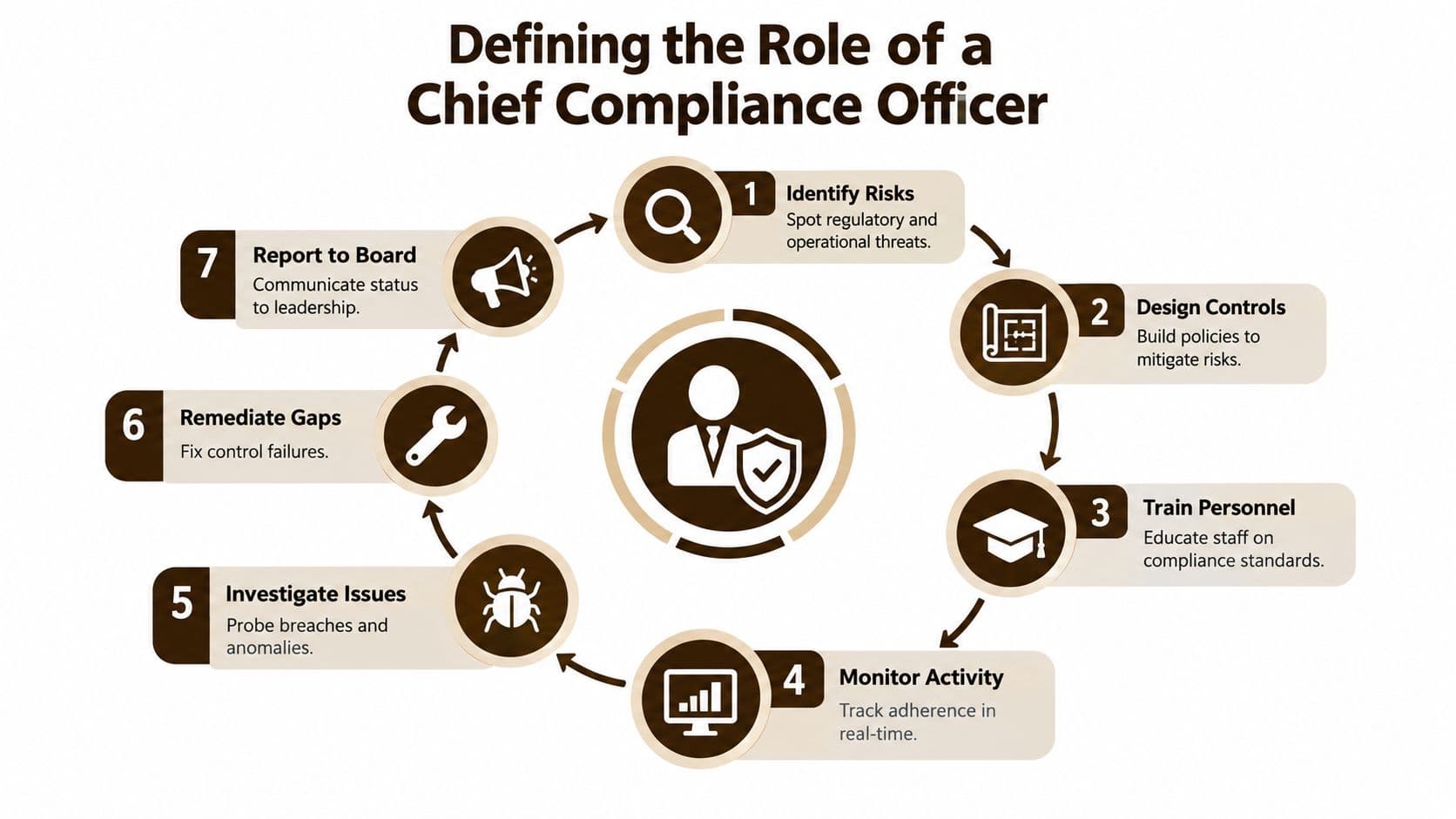
A CCO owns a closed-loop compliance management system. The cycle begins with risk identification and ends with remediation and reporting, then starts again as regulations, products, markets, and business practices change.
The work usually moves through these stages:
-
Identify risks. The CCO maps applicable laws, regulatory expectations, products, jurisdictions, vendors, and operational activities. Horizon scanning matters because a rule that hasn't yet created a violation can still require a control change.
-
Design controls. The CCO converts legal obligations into policies, procedures, approval workflows, access restrictions, monitoring routines, and documentation requirements. A policy that employees can't follow is not a useful control.
-
Train personnel. Training should reflect the employee's decisions and exposure. Sales, procurement, finance, managers, and investigators need different guidance, not a single annual presentation.
-
Monitor activity. The CCO reviews adherence through testing, audits, reports, metrics, complaints, and operational data. Monitoring verifies whether the written program works in practice.
-
Investigate issues. A suspected violation requires a controlled process for intake, preservation of records, interviews, analysis, confidentiality, and findings. The CCO must know when to involve legal counsel, HR, internal audit, or external investigators.
-
Remediate gaps. Corrective action can involve policy changes, discipline, additional training, control redesign, vendor intervention, or escalation to regulators and directors.
-
Report to leadership and the board. The CCO translates findings into decisions. A useful board report identifies the risk, control status, open issue, business impact, owner, and remediation path.
The CCO's lane overlaps with other control functions, but it shouldn't disappear into them. The GC provides legal advice and protects the company's legal interests. Internal audit independently evaluates controls and governance. A risk officer may own broader financial, operational, or strategic risk. The CCO coordinates with each function while remaining accountable for compliance program operation.
That distinction should appear in the job description, reporting charter, committee structure, and escalation protocol. If the CCO is expected to own the program but lacks access to data, investigators, business leaders, or the board, the organization has defined responsibility without giving the role the means to perform it.
The operating cycle is easier to understand when seen in motion. This overview of the CCO's operating responsibilities describes the role as a combination of regulatory mapping, policy management, training, monitoring, investigations, and leadership reporting.
Core Components of an Effective Compliance Program
A credible CCO inherits a system, not a stack of documents. The program should connect written standards to employee behavior, monitoring, investigations, discipline, and remediation. Standard program frameworks commonly include a code of conduct, risk assessment, policy management, education, monitoring, investigations, and consistent enforcement, along with documented reviews and recordkeeping. The University of Missouri's compliance job framework illustrates the operational breadth expected from a mature compliance function.
| Program Element | What Maturity Looks Like | Common Breakdown |
|---|---|---|
| Policies and procedures | Policies reflect current risks, assign ownership, explain approvals, and give employees usable instructions. | Policies are copied from old templates, disconnected from actual workflows, or left without owners. |
| Risk assessment | The organization periodically evaluates legal, operational, geographic, product, vendor, and conduct exposure. | Leadership treats the initial risk assessment as permanent and misses changes in the business. |
| Training and communication | Employees receive role-specific guidance, understand escalation options, and can explain what the rules mean in their work. | Training completion is treated as proof of effectiveness even when employees don't understand the controls. |
| Monitoring and auditing | Testing follows risk, produces documented findings, and tracks owners and deadlines through closure. | Reviews are irregular, overly narrow, or designed to confirm compliance rather than test it. |
| Reporting channels | Employees have accessible, confidential routes to report concerns, with defined intake and escalation procedures. | Reports disappear into email, employees fear retaliation, or nobody can explain who investigates. |
| Investigations and enforcement | Matters are triaged consistently, records are preserved, findings are documented, and discipline is applied consistently. | Similar conduct receives different treatment, or business pressure alters the investigation path. |
| Remediation and governance reporting | Corrective actions address root causes, and senior leaders and directors receive clear status information. | The organization closes individual cases without fixing the control that allowed the issue to occur. |
The strongest programs show documentation discipline. A reviewer should be able to trace a risk to a policy, a policy to training, training to monitoring, monitoring to a finding, and the finding to remediation. That traceability gives the board confidence that compliance isn't operating as a collection of disconnected projects.
Program maturity also appears in escalation speed and management information. A CCO should be able to explain which risks are increasing, which controls are failing, which investigations remain open, and whether corrective actions are changing behavior. A dashboard can support that work, but technology won't compensate for weak ownership or incomplete data.
For hiring partners, the practical question is simple: what will the candidate inherit? Ask for a program inventory before you write the search brief. A builder is needed where policies, reporting channels, and control ownership are absent. A scaler is needed where the program exists but must support new products, markets, subsidiaries, or regulatory demands. Those are different searches.
Where the CCO Sits in the Organization
Reporting structure determines whether the CCO can challenge revenue leaders, access sensitive information, and escalate concerns without interference. There's no universal model, but there is a wrong answer for every organization: placing the CCO somewhere that makes independence impossible while pretending the title solves the problem.
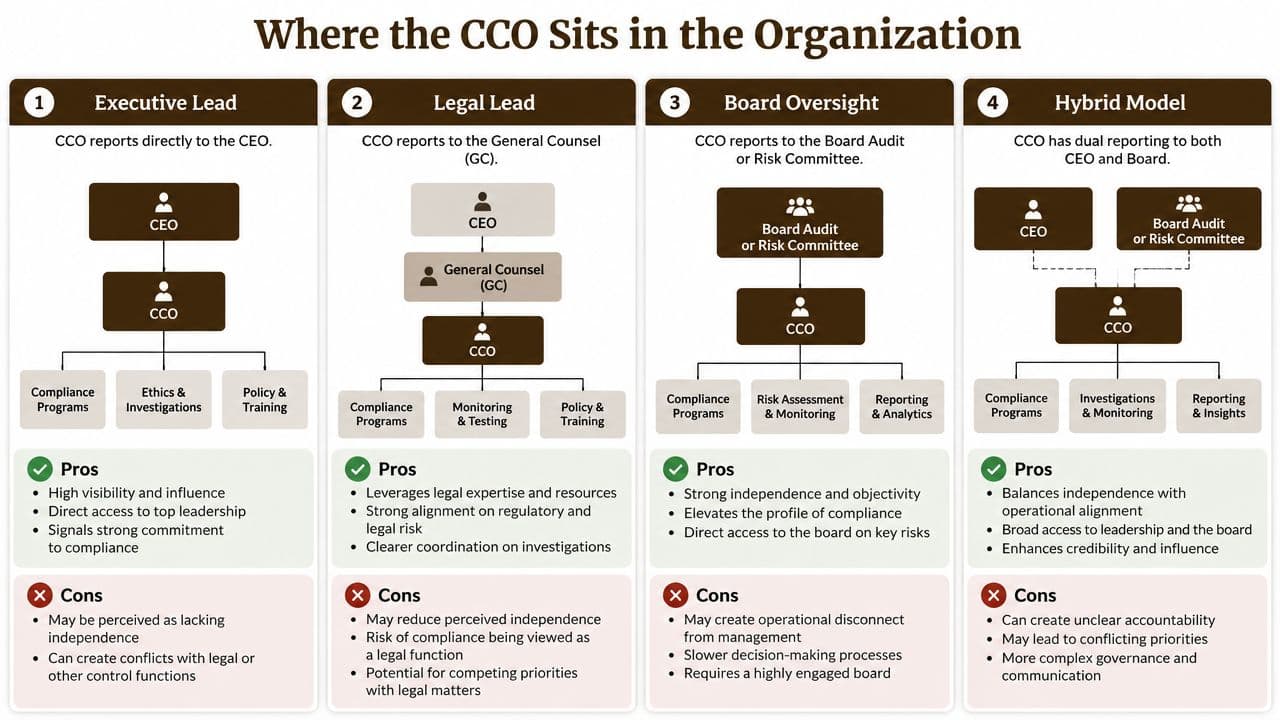
Four common reporting models
Directly to the CEO. This structure gives the CCO executive visibility and can work well where compliance is tightly connected to daily operations. It carries political risk if the CEO controls the revenue decision implicated by a compliance finding.
Through the General Counsel. A legal reporting line can create efficient coordination, privilege analysis, and access to counsel. The GC must preserve the CCO's ability to report independently, particularly when the compliance issue concerns legal leadership, executive conduct, or a disputed business decision.
To the audit or risk committee. Board reporting strengthens independence and gives directors direct visibility. It can become ineffective if the committee lacks the time, expertise, or meeting cadence to support active oversight.
Dual reporting. The CCO reports operationally to the CEO while maintaining a direct escalation route to the board. This often balances access and independence, but only if the charter defines who controls compensation, performance evaluation, investigation escalation, and removal.
Team design should follow exposure, not title inflation. A mid-market organization may begin with a CCO and an analyst, supported by legal, HR, audit, and external specialists. A multinational or heavily regulated business may need regional compliance heads, investigations expertise, privacy leadership, financial crime specialists, training resources, and data or reporting support.
The CCO's position should also be compared with adjacent leadership roles, including a legal operations director. Legal operations can improve systems, workflow, and department performance, but it doesn't replace independent compliance ownership.
Governance test: Ask whether the CCO can take a serious concern directly to the board, obtain the records needed to investigate it, and recommend action against a powerful executive. If the answer depends on informal permission, the structure is weak.
How the Role Has Expanded Beyond Legal Compliance
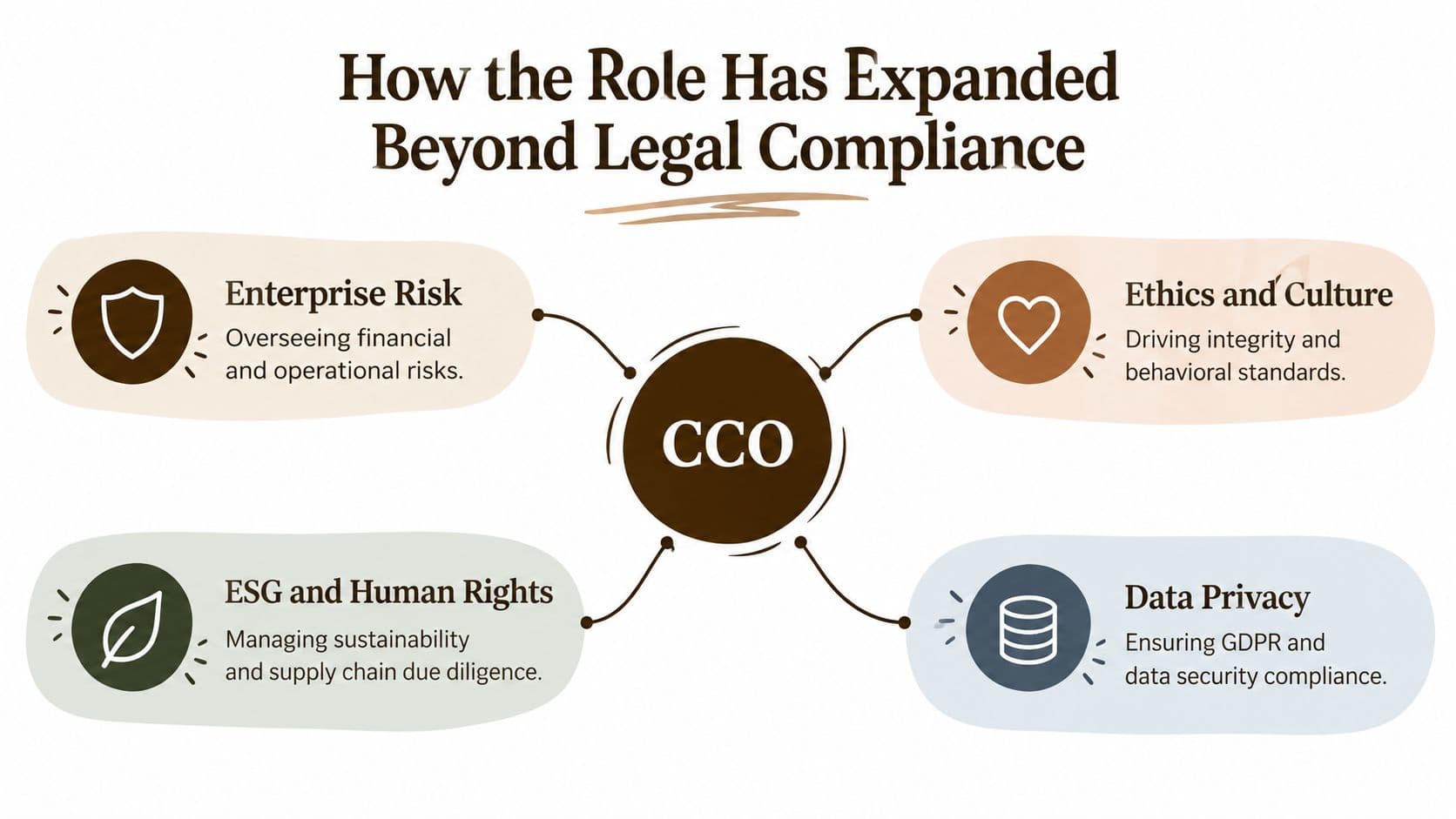
The CCO role has moved from rule interpretation to enterprise control leadership. The modern function may touch financial crime, privacy, cybersecurity, third-party risk, consumer outcomes, ethics, culture, supply-chain due diligence, and sustainability reporting. The exact scope depends on the organization, but the direction is clear: regulators and boards want evidence that compliance operates inside the business rather than beside it.
This expansion explains why a purely legal profile can fall short. A strong CCO needs to understand how a product is sold, how customer data moves, how vendors are selected, how incentives shape employee conduct, and how management information reaches directors. They must read operational data critically, select or oversee compliance technology, and distinguish a genuine control signal from a reassuring but meaningless metric.
In regulated markets, the role can include AML and sanctions oversight, consumer-outcome testing, KPI tracking, software selection, and direct regulator contact. The New York City Chief Compliance Officer role summary reflects this shift toward operating-control leadership rather than a purely advisory position.
What the expansion means for hiring
The candidate no longer needs to recite regulations alone. They should explain how a control affects cycle time, customer treatment, employee behavior, vendor risk, and executive decisions. They should be comfortable discussing dashboards and investigations with operations, then translating the same issue into risk language for directors.
Business fluency is particularly important when the CCO must push back. A candidate who understands commercial priorities can propose a safer path instead of merely saying no. That doesn't make the function less independent. It makes its advice harder to dismiss as disconnected from the business.
The hiring brief should therefore name the domains the CCO will own, influence, or coordinate. Vague phrases such as “oversee compliance” conceal major differences between a policy leader, a financial crime executive, a privacy and ethics head, and an enterprise governance operator.
Hiring a CCO and What to Look For
Hire for demonstrated operating judgment, not prestige. A senior lawyer may understand complex rules and still lack experience building controls, running investigations, measuring program performance, or confronting an executive whose conduct creates risk.
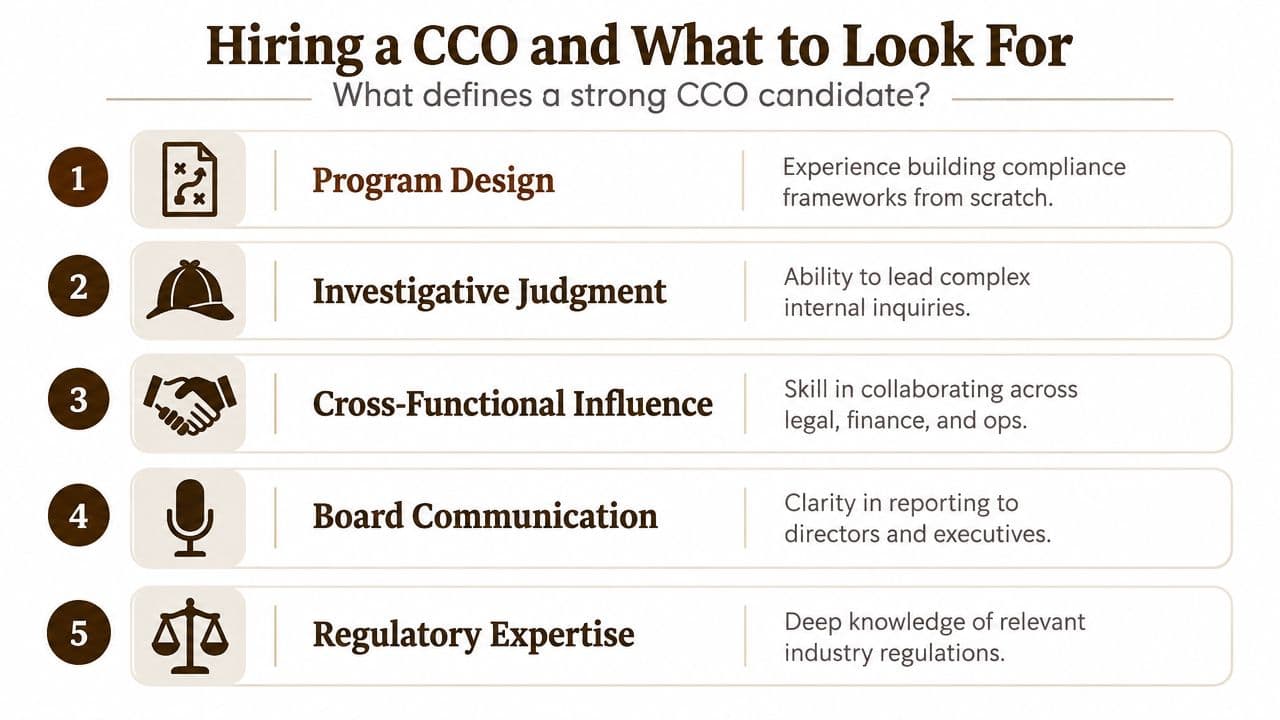
The candidate should be able to show how they've built, repaired, or scaled a compliance program. Look for evidence in five areas:
- Program design: They can map obligations to policies, controls, owners, training, monitoring, and remediation. Strong candidates describe what they changed and why, not just the committees they attended.
- Investigative judgment: They know how to triage allegations, preserve confidentiality, manage conflicts, involve counsel, and reach defensible findings. They can discuss a difficult matter without breaching confidentiality.
- Cross-functional influence: They've worked with finance, HR, information security, procurement, sales, operations, and audit. The function depends on cooperation from people who don't report to the CCO.
- Board communication: They can reduce a complicated risk into a clear decision memo or board discussion. Directors need materiality, trend, control status, ownership, and next action.
- Regulatory expertise: Their knowledge must match the organization's exposure. Banking, healthcare, government contracting, technology, and manufacturing create different compliance demands.
A JD or equivalent legal training can be useful, but it shouldn't substitute for compliance leadership experience. Certifications such as CCEP, CRCM, or CIPP may support credibility when they match the role, while prior regulator or Big Law experience can help with complex inquiries. Neither is a guarantee of performance.
Ask candidates to distinguish program construction from program maintenance. Someone who inherited a well-funded function may be excellent at governance, but not the right person to build a first-line framework from the ground up. Conversely, a builder may need support adapting to a mature public-company environment.
Red flags are practical. Be cautious when a candidate can't explain program metrics, has never supervised frontline compliance work, speaks about compliance as paperwork, or offers only abstract language about “tone at the top.” A useful companion role for comparison is a director of compliance, which may carry substantial execution responsibility without the enterprise authority expected of a CCO.
Interview Questions That Reveal a Strong CCO
Credentials get a finalist into the room. Scenarios reveal whether they can operate when facts are incomplete, business pressure is high, and the board needs an answer.
Ask the candidate to respond to these prompts:
-
“You've joined an organization with scattered policies, no reliable risk inventory, and unclear reporting channels. What do you do first?”
A strong answer starts with exposure mapping, stakeholder interviews, urgent control risks, and a practical stabilization plan. It shouldn't begin with rewriting every policy. -
“A regulator requests records involving a business unit led by a powerful executive. How do you manage the response?”
Listen for preservation, scope control, independence, privilege coordination where appropriate, fact development, documented decisions, and a clear escalation path. The candidate should protect the integrity of the response without making unsupported conclusions. -
“You identify a control failure that could affect customers, but the business leader wants to delay disclosure until after a major commercial event. What happens next?”
The answer should show independence and judgment. The candidate should explain the applicable escalation process, involve the right legal and executive stakeholders, document the disagreement, and remain focused on the underlying obligation and customer impact. -
“What information belongs in a board compliance report?”
Strong candidates discuss material risks, trends, investigations, control testing, overdue remediation, resources, and decisions required from directors. They don't hide behind training completion as the only indicator of health. -
“Describe a compliance failure you owned.”
Look for specificity about the failed assumption, missed signal, root cause, corrective action, and how the candidate verified that the fix worked. A person who claims every program was successful may lack the accountability this role requires.
Use a panel that tests range. The GC can assess legal judgment, the audit chair or risk committee representative can test independence and board communication, and a business-unit leader can evaluate whether the candidate can influence operators without becoming their proxy.
A regulatory compliance attorney may offer strong subject-matter depth, but the interview should still test whether they can run a program. The CCO must turn knowledge into controls, decisions, investigations, and measurable remediation.
Making the Right CCO Hire for Your Organization
The assumption that any senior lawyer or former regulator can become a CCO is expensive. Compliance leadership is a distinct discipline that combines legal fluency, program engineering, investigative judgment, operational influence, and executive communication. A candidate can be brilliant in one area and still fail if they can't create a functioning system around it.
Make the hiring decision in this order:
-
Map the exposure before drafting the job description. Identify regulated products, jurisdictions, customers, vendors, data, reporting duties, investigations, and board expectations. Define what the CCO owns and what remains with legal, audit, risk, HR, privacy, and security.
-
Choose the reporting line before launching the search. Decide how the CCO reaches the CEO, board, audit committee, or risk committee. Put escalation rights, access to information, compensation authority, and removal protections into the governance documents.
-
Set first-year outcomes. The objectives should cover the risk inventory, policy ownership, training, reporting channels, investigation process, monitoring plan, management information, and remediation governance. Don't measure the leader only by the number of policies published.
-
Fund the operating model. A CCO without investigators, analysts, technology, budget, and cross-functional support is being asked to provide assurance without control over the inputs. Resource the program according to the risk the board expects the function to manage.
-
Test fit against the organization's actual stage. A high-growth company may need a builder. A regulated multinational may need a coordinator of regional specialists. A law firm or professional-services organization may prioritize conflicts, client onboarding, confidentiality, billing controls, and ethical culture. The title is the same, but the mandate isn't.
The labor market reinforces the importance of defining the search carefully. U.S. industry coverage cites an estimate of about 33,300 compliance officer openings per year on average from 2024 through 2034, reflecting replacement needs and continued regulated activity, as reported in coverage of the compliance leadership hiring market. That demand makes a vague brief even less defensible. Qualified candidates will compare authority, resources, reporting access, and the seriousness of the mandate.
The CCO you hire should be able to answer the original crisis with more than a legal opinion. They should show which control failed, who owns the fix, how the organization will monitor it, when the board will hear about it, and what leadership must decide. That is the difference between appointing a compliance title and building compliance capability.
Five Star Placements provides permanent placement for compliance counsel, regulatory attorneys, in-house legal leaders, and related governance roles, with screening aligned to program experience, regulatory exposure, and organizational culture. Visit Five Star Placements to discuss the CCO or compliance leadership search your organization needs now.
Need help filling a legal role?
Five Star Placements partners with law firms and legal departments nationwide.
Schedule a Call