
Interview Coaching New York: Options for Legal Candidates
November 22, 2026 · 15 min read · Five Star Placements
Table of contents
New York employers reported 372,000 job openings in December 2025, down from 500,000 in November, while hires that month reached 366,000, according to the Bureau of Labor Statistics New York job openings and labor turnover release. The openings rate fell from 4.8% to 3.6% over the same period. Hiring continued while available positions contracted, so each interview a lawyer or paralegal gets carries more weight than it did in November. A vague answer, an unquantified matter story, or a misread of the interviewer's question can weaken an otherwise strong candidacy.
That is why interview coaching in New York should address more than posture and polish. Candidates need to explain their judgment in business terms, including to interviewers who are not lawyers. They also need to understand what screening tools may assess before a person reviews their application. Both skills can be prepared through practice, yet generic interview advice often gives them little attention.
Table of Contents
- Interview Coaching Formats for New York Legal Candidates
- Role-Specific Prep for Lateral, In-House and Support Roles
- What a Coaching Session Covers, Step by Step
- Judgment Questions Legal Interviews Now Use
- Preparing Well Without Gaming the Assessment
- Screening Tools and the Questions to Ask Before Interviews
- Confirm the Right Coaching Plan Before You Book
Interview Coaching Formats for New York Legal Candidates
A mock interview and a group workshop solve different preparation problems. Individual sessions let candidates practice role-specific answers and receive focused feedback. Workshops provide practice in answering questions aloud and responding under pressure.
| Format | Best For | What It Covers | Typical Length |
|---|---|---|---|
| One-to-one mock interview | Lateral attorneys and partner candidates | Role-specific questions, answer feedback and follow-up questions | 90 to 120 minutes |
| Practice-area interview prep | Associates changing practice focus | Matter stories, client scenarios and partner questions | Two sessions of 60 to 90 minutes |
| In-house counsel readiness session | Lawyers moving to corporate legal departments | Business hypotheticals, executive briefings and risk recommendations | One 60-minute session plus a take-home briefing exercise |
| Support-staff interview coaching | Paralegals, legal assistants and operations staff | Competency examples, skills demonstrations and role questions | 60 to 90 minutes |
| Group workshop | Early-career candidates | Shared practice rounds and peer feedback | 2 to 3 hours |
| Self-guided preparation | Candidates who need a low-cost start | Question banks, recorded practice and written STAR answers | Open-ended |
New York's professional and business services sector employed about 1.402 million people in 2025, up from 1.284 million in 2021, a gain of roughly 118,800 jobs, or 9.2%, according to Federal Reserve Bank of St. Louis data from the Current Employment Statistics survey. That broad sector includes many kinds of work, so the figure does not tell a candidate which interview format to choose. The useful question is what evidence the role calls for, and how much practice you need to present it clearly.
Match the format to the decision criteria
A lateral partner and a litigation paralegal face different questions. A partner may need to explain a book of business and team leadership. A paralegal may need to describe how they protect confidential information and keep deadlines on track. Choose a format that gives you practice with the decisions and examples relevant to your target role.
Before booking, ask what feedback you will receive. Will the coach identify where an answer lacks evidence, or offer only a general impression? Will the practice include follow-up questions that test your reasoning? Useful feedback points to a specific answer, explains what the interviewer may still need to know, and gives you a clear way to improve it.
For candidates considering a move, Five Star Placements speaks with each candidate on a call before presenting them to a client, then vets their credentials, bar status, matters handled and fit, and confirms their interest in the specific role. This provides screening transparency about the candidate and the role. It does not replace interview practice, but it can help candidates understand what opportunity they are discussing.
Group workshops suit candidates who want repeated practice answering questions aloud. They offer less time for individual critique, so a candidate preparing to discuss a specific matter or business decision may benefit from one-to-one preparation as well.
Role-Specific Prep for Lateral, In-House and Support Roles
Find your row, then read the third column as a to-do list rather than a description. The same three matters can support a litigation application, a corporate application and an in-house application, but each room scores different evidence from them.
| Role | Likely Interview Focus | Evidence to Prepare |
|---|---|---|
| Lateral litigation attorney | Case strategy, client handling and portfolio fit | Matters handled, outcomes and court exposure |
| Corporate or transactional lateral | Deal experience, deadline management and client development | Transactions supported, deal size range and client contacts |
| In-house counsel | Business judgment, stakeholder communication and risk prioritization | Business decisions influenced and executive briefings delivered |
| Partner or practice leader | Book of business, team leadership and firm economics | Revenue originated, team outcomes and retention record |
| Paralegal or litigation support | Process accuracy, confidentiality and software skills | Deadlines met, errors prevented and tools used |
| Legal operations executive | Budgeting, vendor management and process ownership | Processes improved, savings achieved and reporting systems built |
Why the same answer fails in a different room
A litigator describing a summary judgment win answers a strategy question with a procedural story. In a corporate interview, that same story lands as irrelevant because nobody in the room buys or sells litigation. A corporate associate describing a closing answers a deadline question with a deal volume number but no account of what nearly broke and how it was caught. Both candidates have real accomplishments. Neither has translated them into the language of the room.
The fix is one inventory, re-described for each target. Keep the matters. Change the nouns. In a law firm interview, the unit of value is a matter and its risk. In a corporate legal department, the unit of value is a decision and its cost. In a partner conversation, it's a client relationship and its revenue.
For anyone moving in-house, the vocabulary shift is bigger than the question set, and it's worth rehearsing the specific questions corporate counsel get asked about commercial judgment and stakeholder management. Our guide to in-house lawyer interview questions covers the framing in more detail.
Partners need a different discipline. Bring numbers you can defend under challenge: originated revenue over the last three years, the clients who would follow, the associates who would come with you, and how your rate fits the firm's realization. Expect a question about why your book is portable and a question about what you'd do in year one to grow it.
Warning for litigators: A jury verdict is not proof of commercial judgment unless you can explain the business stakes, the budget you protected and the settlement range you recommended along the way.
Support staff get tested on reliability, not strategy. Prepare three examples of errors caught before they reached a filing, a deadline saved by your own tracking system, and a confidentiality judgment you made without escalating. Name the tools you use daily, since "proficient in the case management system" gets checked in the first five minutes.
What a Coaching Session Covers, Step by Step
Structured interviews, which use predetermined questions and anchored scoring, are widely regarded as more predictive than unstructured conversations. For a candidate, that makes preparation less like memorizing a script and more like organizing evidence to meet a clear set of criteria.
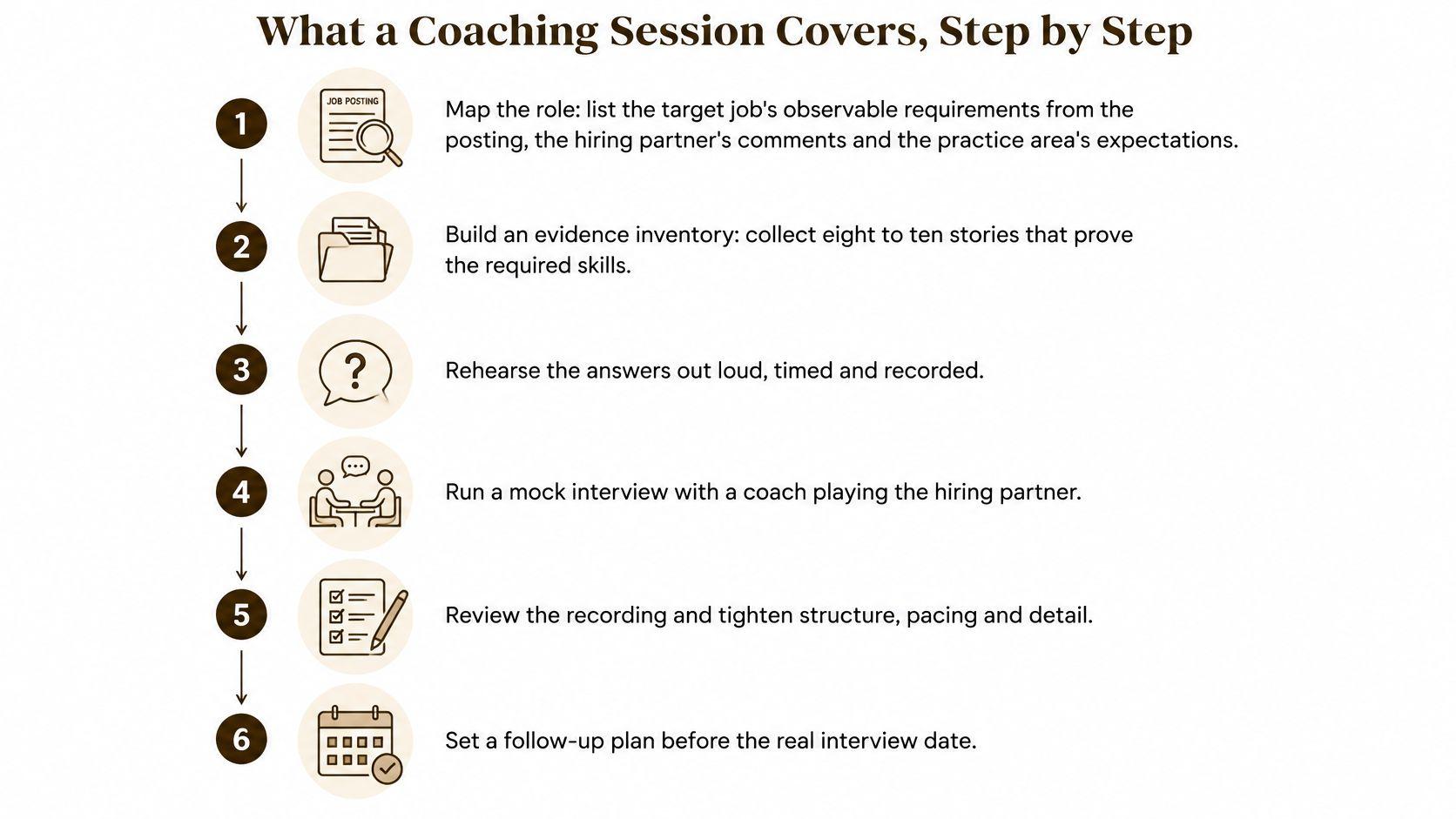
A focused session can follow six steps:
-
Map the role before drafting answers. Pull observable requirements from the job posting and the hiring team's description of the position. These might include docket load, deal flow, client contact, supervision, or internal stakeholders. The map helps you choose relevant evidence instead of trying to make every story fit.
-
Build an evidence inventory. For each example, note the matter or transaction, your scope, the constraints, the action you took, and the result you can support. Include advice you gave, deadlines you met, errors you caught, and processes you improved. Be clear about what you handled independently and what a partner supervised.
-
Shape each answer around situation, action, rationale, and result. The rationale shows your judgment: why you chose a particular motion, settlement posture, or escalation, and what alternatives you considered. Then make the answer concise: identify the issue, explain the trade-off, state your action, and describe the outcome.
-
Run a mock interview with follow-up questions. A prompt such as “Describe a time you disagreed with a partner about strategy” tests more than recall. Follow-ups about what you would change, who challenged your approach, or what the decision cost reveal whether you can explain your reasoning clearly.
-
Review the feedback and select two answers to strengthen. Feedback tied to specific competencies helps distinguish a polished answer from one that demonstrates the skill. Rework the two weakest examples; use the remaining time to improve pacing and clarity.
-
Repeat those answers with different follow-ups. Keep the underlying facts consistent while answering a new challenge. This tests whether you understand the decision, rather than remembering a rehearsed version.
A useful session should leave you with a one-page evidence sheet, a concise opening answer, and a short list of questions about the role and practice. Those materials help you stay focused without turning the interview into a recitation.
Judgment Questions Legal Interviews Now Use
Something changed in how business-facing legal roles are interviewed. Employers hiring in-house counsel increasingly use experience-based questions and hypotheticals to test how an attorney handles ambiguity, prioritizes risk, communicates with nonlegal stakeholders and balances legal advice against business objectives, Bloomberg Law's coverage of in-house counsel interviews reports. The interviewer is no longer checking whether you know the law. They're checking how you think when the law gives three defensible answers.

In those hypotheticals, the reporting describes interviewers who care more about your assumptions, the questions you ask and the structure of your analysis than about reaching one correct conclusion. That has a direct coaching implication. A technically flawless answer that never states a priority can score below a plainer answer that ranks risks and picks an option.
One simulation, built out
Take the most common format: a ten-minute executive briefing. The prompt is a product launch with a regulatory question, a contract dispute with a key vendor, or an investigation that may or may not need outside counsel. You have ten minutes and a CFO who has another meeting.
Use the same five-part structure every time.
The structure: State the decision you'd make. Name your single biggest assumption. Rank the top three risks. Recommend one option and say why the others lose. Close with what would change your view.
The last element is the one candidates never prepare and interviewers remember. Saying "if the regulator signals a second request, I'd move from option B to option A within 48 hours" demonstrates that your recommendation is conditional on facts rather than temperament.
A litigation strategy question becomes far stronger when you reframe it as a business decision. Instead of describing motion practice, describe a budget of a stated size, a timeline to resolution, a settlement range and the cost of being wrong in each direction. You are still talking about litigation. You are answering in the language the person across the table uses to report to a board.
Then expect the challenge. A business leader will ask why the cheaper option isn't good enough, or why your timeline is realistic given the discovery scope. Rehearse the answer to "what would you do if we told you to move in half the time," because that question tests whether your judgment holds under pressure or collapses into agreement.
Two drills you can run this week without a coach. First, pick a live matter and deliver a ten-minute briefing to a nonlawyer friend, timed, with no slides; if they ask what a term means, you failed the translation test. Second, record a two-minute answer to a risk-prioritization question, listen back and count how many sentences start with "so" or "basically." Filler is what a nervous candidate uses instead of a recommendation. The same translation skill decides culture fit conversations, which our piece on culture fit interview questions breaks down.
Preparing Well Without Gaming the Assessment
The shortcut has a name: the memorized answer written for a predicted question. Legitimate preparation helps you understand what the role evaluates and explain your real experience clearly, under pressure and under follow-up. That distinction matters in a hiring market where New York counted roughly 131,000 legal-services employees in 2025, up from 128,000 in 2024, in the Federal Reserve Bank of St. Louis legal-services employment series. A wide pool rewards role-specific evidence over generic confidence.
Peripheral coaching pushes the other way. It produces three recognizable artifacts: answers memorized for predicted questions, borrowed stories that do not match your actual work, and tactics designed to flatter whoever is scoring you. Each survives a low-pressure conversation and fails once an interviewer treats your answer like a deposition exhibit and starts asking for basis, scope and authority.
Three tests before you keep an example
- Is it true and documented? If you cannot name the matter, the year and your own scope in it, the story will fray the moment someone asks a detail question.
- Does it match the competency being asked about? A story about collegiality is not evidence of judgment under deadline, even if it is a good story.
- Can you survive a follow-up that goes one layer deeper? Scripts die here. A polished answer that cannot answer "who disagreed with you and what happened" costs more credibility than a plainer answer that can.
Calibrate every example to the employer's decision criteria: degree of autonomy, exposure to partners or business stakeholders, confidentiality, billing responsibility, legal-operations ownership. For judgment questions, prepare the choice, the alternatives you rejected and the cost of being wrong, then rehearse the sentence where you recommend a path before you explain the law. Ask the recruiter or coordinator which competencies each round is meant to score, so you practice the same gates the panel will use instead of guessing at them.
Two housekeeping rules trip up experienced lawyers. Clear every example of client-identifying detail before you speak it, and say out loud that you have generalized the facts. Then check that your inventory covers the awkward questions, such as why you left, why the gap, and how much of that matter you ran.
Signs the coaching is working: your examples get shorter, the follow-ups stop surprising you, and you explain tradeoffs in your own words rather than reciting a framework.
Screening Tools and the Questions to Ask Before Interviews
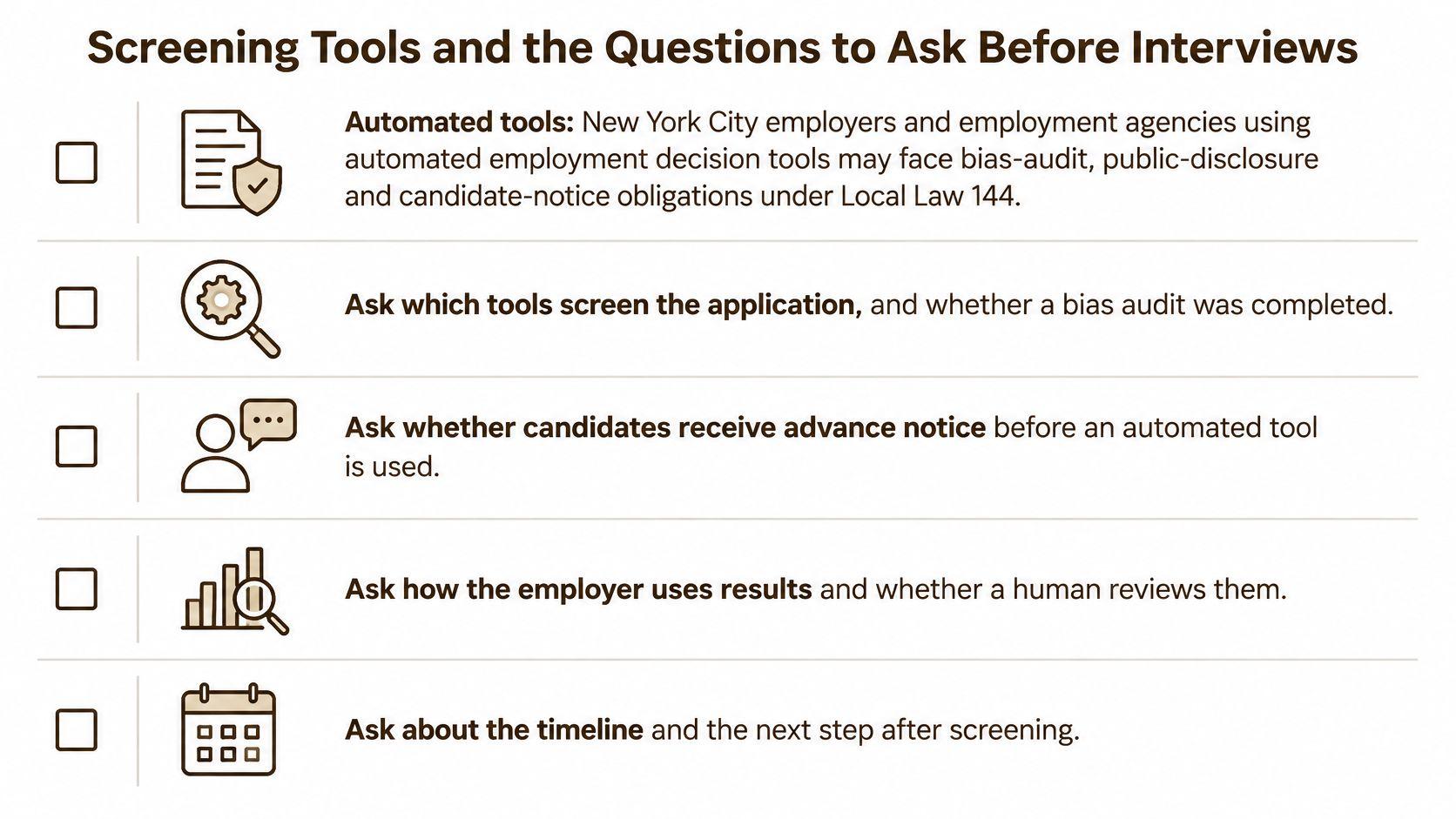
New York City employers and employment agencies using automated employment decision tools may face bias-audit, public-disclosure and candidate-notice obligations under Local Law 144, and New York's State Comptroller has described requirements to audit such tools no more than annually, publish results and inform candidates about their use, per the Comptroller's December 2025 release on hiring transparency. Read that sentence carefully. It creates notice and audit duties. It does not guarantee that a human reviews your application, and it does not remove bias from a model.
Questions that are reasonable to ask
- Will automated scoring or video analysis be used, and at which stage? Ask it as a process question about the timeline, not as a challenge to the employer's methods.
- Does this stage affect whether I move forward? You're entitled to know where the gate is, which tells you where to concentrate preparation.
- Are reasonable accommodations available, and how do I request them? Ask early, ideally before the recorded or timed stage rather than after it.
- How does the advertised compensation range relate to this role? Salary transparency conversations belong in the first exchange, not the final one.
- Who reviews the output, and does a person make the final decision? A fair question that also tells you how much weight to put on format and pacing in a recorded answer.
Asking how a process works is legitimate. Asking for the exact weights a scoring model applies is an attempt to reverse-engineer an assessment, and it lands badly. Prepare your evidence in both written and spoken form, because a résumé summary and a two-minute spoken overview may both be evaluated, and the two often contradict each other.
For accommodations, keep the request short and non-adversarial. A workable phrasing: I want to make sure I can complete the recorded stage properly, so could you tell me who handles accommodation requests and what information they need from me? That names no diagnosis, implies no accusation and creates a written record.
Disclosure rules matter most in consequential situations, which is why they're worth understanding before you sit down. Our guide to candidate screening tools covers how legal employers sequence these stages.
Confirm the Right Coaching Plan Before You Book
Four decision rules cover most situations. Staying in the same practice area but changing firms means starting with mock interviews built around your practice area. Moving in-house means starting with the executive briefing simulation, since that's the format you'll be graded on. Support professionals should start with competency examples and a skills check against the software the posting names. Early-career candidates get the most value from a group workshop for repetition plus self-guided drills for the answers that keep failing.
Then do three things before you pay anyone.
- Write the evidence inventory, eight to ten matters, with your scope in each, in one page.
- Pick two target roles and compare them against the role table. The gaps between the two lists are what coaching should fix.
- Draft your screening and process questions, using the ones above, so the first conversation with a recruiter or coordinator isn't wasted on logistics.
One more check before you share anything. Ask any firm you speak with to confirm its confidentiality terms in writing before you name your current employer. Applications to Five Star Placements are confidential, and we will not contact an applicant's employer without that applicant's permission.
The right plan is the one that tests the skills your target employer will assess. Everything else is rehearsal for a different interview.
If you're weighing a move and want interview preparation that matches the role rather than a generic question list, Five Star Placements runs candidate coaching built around how law firms and corporate legal departments evaluate laterals, in-house counsel and support staff. Attorneys can browse current openings or tell us what they're looking for, and we'll reach out when a strong fit opens in our network. Start with a conversation at Five Star Placements and we'll map your evidence to the room you're walking into.
Need help filling a legal role?
Five Star Placements partners with law firms and legal departments nationwide.
Schedule a Call