
What Happens in a Second Interview for Legal Roles in 2026
October 25, 2026 · 11 min read · Five Star Placements
Table of contents
The invitation has arrived. You're meeting the practice group next week, the General Counsel wants another conversation, or the recruiter has mentioned a writing exercise. You've cleared the opening conversation, but you're not sure whether to prepare more stories, review substantive law, or start thinking about compensation.
The useful way to understand what happens in a second interview is to ask what the employer still needs to verify. Your résumé and first-round answers established a starting point. Your preparation should now make your experience easier to examine, especially where the first conversation left gaps.
Table of Contents
- Second Interview Formats for Each Legal Role
- Why the Second Round Differs From the First
- Sample Questions and Exercises by Legal Role
- How Interviewers Score Your Answers
- How to Prepare for a Second Interview Step by Step
- Confirm the Next Step Before You Accept an Offer
Second Interview Formats for Each Legal Role
A second interview is a later-round, often more structured meeting where the employer tests role-specific ability and brings in people who influence the hiring decision. It isn't just another introductory call, although the format varies by employer.
Use the following comparison as a planning guide, not a guaranteed agenda. Confirm the actual schedule with your recruiter or interview contact rather than assuming a particular meeting length.
| Role | Typical format | Who interviews | Typical length | What gets tested |
|---|---|---|---|---|
| Associate | Conversations with practice group members, potentially with a writing or fact-pattern exercise | Partners and practice group members | Depends on the interview schedule and any exercise | Practice judgment, writing, collegiality |
| Lateral partner | Leadership and team-fit discussion, sometimes with a book-of-business review | Managing partner and practice leaders | Depends on the scope of the practice discussion | Origination potential, leadership, team fit |
| In-house counsel | Contract or risk scenario followed by a stakeholder presentation | General Counsel plus a business executive or CFO | Confirm discussion and presentation time separately | Business judgment, escalation, communication |
| Paralegal or legal operations | Workflow prioritization or document-handling task | Supervising attorney or operations director | Depends on whether a practical task is included | Accuracy under deadline, process thinking |
Read the Agenda for Clues
For an associate, meeting several practice group members gives you a reason to prepare examples that work at different levels of detail. A supervising partner may want your analysis. A potential colleague may want to understand how you hand off work and respond to edits.
For a lateral partner, prepare to distinguish your own contribution from the resources a proposed practice would require. Treat client development, staffing, and leadership as separate discussion topics rather than folding everything into a revenue narrative.
For in-house and support roles, look closely at who joins the meeting. A business executive suggests you should practice explaining recommendations without legal shorthand. An operations director gives you a reason to prepare a concrete workflow example.
Practical rule: Find your role, identify the likely task, and ask whether you'll need to produce work or only discuss it.
Don't infer the whole process from the invitation's title. Ask whether the schedule includes a panel, separate conversations, a meal, or an exercise, and whether any preparation materials will arrive beforehand.
Why the Second Round Differs From the First
Think of the first interview as a screen door and the second as a stress test. The opening conversation checks whether your background fits the opportunity. The later conversation examines how you apply that background when the facts are incomplete or the demands compete.
Expect the conversation to become more specific.

The research summary on structured interviewing describes its use late in selection, when the applicant pool has narrowed. A practice leader, hiring partner, department head, or panel may join to assess job-related competencies through more consistent questions and closer examination of representative work.
An opening question might ask why litigation interests you. A later scenario might ask how you'd respond when a client demands an answer by Friday, but a key document is missing. Your answer should address the missing information, the deadline, and what you can responsibly tell the client now.
Prepare for the Shift
- Structure: Expect targeted questions rather than relying on conversational chemistry.
- Situational judgment: Prepare to explain decisions, assumptions, and alternatives.
- Representative work: Be ready to discuss what you produced and why you approached it that way.
Use the video as another preparation resource, then rehearse those shifts aloud.
Sample Questions and Exercises by Legal Role
A useful second-round design pairs behavioral questions with a short, realistic work sample. The distinction matters: describing experience isn't the same as demonstrating how you'd perform the task.
The Society for Industrial and Organizational Psychology's discussion of selection methods supports assessing candidates through complementary evidence, including structured interviews and work samples. For your preparation, that means practicing both a past example and an unfamiliar problem.
These are illustrative questions, not predictions about your particular employer.
| Role | Likely exercise | Sample question |
|---|---|---|
| Associate | Brief issue-spotting memo or oral client update | How would you approach a breach-of-contract claim when a response deadline is approaching? |
| Lateral partner | Practice strategy discussion | How would you build a team for a new regional practice? |
| In-house counsel | Contract-clause critique or escalation plan | A vendor rejects our indemnity clause the day before signing. What do you do? |
| Paralegal | Prioritization exercise on deadlines and filings | Several attorneys need work by the same afternoon deadline. How do you sequence it? |
| Legal operations | Process-improvement plan with a measurable target | Which metric would you track for intake turnaround, and why? |
Show the Reasoning Behind the Recommendation
For the associate exercise, don't rush straight into a legal conclusion. Identify the relevant documents, the procedural posture, the assumptions you're making, and the research needed before advising the client. Separate an immediate protective step from the longer analysis.
For the vendor scenario, avoid treating acceptance and rejection as the only choices. Explain what you'd want to know about the transaction, the proposed allocation of risk, and who has authority to approve an exception. Then give a recommendation appropriate to the facts available.
Candidates preparing for a corporate legal department can also use these in-house lawyer interview questions to practice switching between legal analysis and business-facing advice.
A paralegal prioritization answer should explain how you verify the actual deadlines before deciding which request comes first. For a legal operations exercise, define the proposed metric clearly enough that someone else could calculate it. Explain what a faster turnaround might conceal, such as incomplete intake or avoidable rework.
A defensible answer explains what you'd do, what you still need to know, and what would change your recommendation.
Be Precise About Your Own Work
Expect follow-ups when you describe an accomplishment as something “we” delivered. Prepare to explain what you drafted, reviewed, decided, coordinated, or escalated, without taking credit for someone else's work.
If you present a matter example, distinguish the team's outcome from your contribution. You can acknowledge that a partner set the strategy while explaining how your research changed an argument or how your case-management work kept the team informed.
Don't manufacture a dramatic result. A clear account of a limited responsibility is more useful preparation than a polished story you can't defend under questioning.
How Interviewers Score Your Answers
A well-designed scorecard resembles a judged competition: each entrant faces a comparable task, and each judge records observations before discussing the result. In hiring, those observations should concern job performance, not whether the interviewer enjoyed the conversation.
The meta-analysis of employment interview validity supports structured, job-related evaluation over unstructured interviewing. A practical application is to give finalists the same core questions and evaluate their responses against defined competencies.
| Competency | Strong answer looks like | Weak answer looks like |
|---|---|---|
| Technical judgment | Legally sound answer with stated assumptions and next steps | Confident conclusion with no caveats |
| Evidence-based reasoning | Uses relevant facts, rules, or prior matters | Relies on assertion and gives the interviewer little evidence |
| Communication | Adjusts the explanation for a nonlawyer | Uses heavy jargon without translation |
| Stakeholder management | Names who must be consulted and when | Works alone and skips affected parties |
| Execution risk | Identifies deadlines and what could slip | Promises speed without a plan |
| Personal contribution | States what the candidate personally did | Credits the team without explaining an individual role |
Make Your Evidence Easy to Record
Consider the difference between saying you're commercially minded and demonstrating it. In a contract exercise, you might identify the legal concern, explain its practical consequence, offer an alternative, and name the approval needed to proceed. That gives an interviewer observable behavior to assess.
The same principle applies to communication. Telling the panel that you're comfortable with executives proves little. Explaining a legal issue in plain language, then checking whether the listener needs more detail, demonstrates the skill directly.
Employers can organize their candidate selection methods differently, so don't assume you'll see the rubric. Use the job description to infer the evidence you should bring, while recognizing that the employer may weight competencies differently.
Handle the Trade-offs Explicitly
A cautious answer isn't automatically a strong answer. Listing every possible risk without making a recommendation leaves the decision with the interviewer.
Likewise, decisiveness isn't the same as certainty. You can recommend a course of action while identifying a fact that requires confirmation or a decision that belongs to the supervising attorney.
Answer discipline: Give the recommendation, explain its basis, and identify the condition that could change it.
Prepare a flexible answer structure rather than memorized wording. If the interviewer changes a fact, your reasoning should adapt with it.
How to Prepare for a Second Interview Step by Step
Start with the conversation you've already had, not a generic list of difficult interview questions. Your task is to identify what the employer has heard and what you haven't yet demonstrated.
The second-interview preparation guidance describes deeper discussions and potential work samples. Use that distinction to target the gaps instead of rehearsing your résumé again.
Build the Evidence Before Rehearsing
-
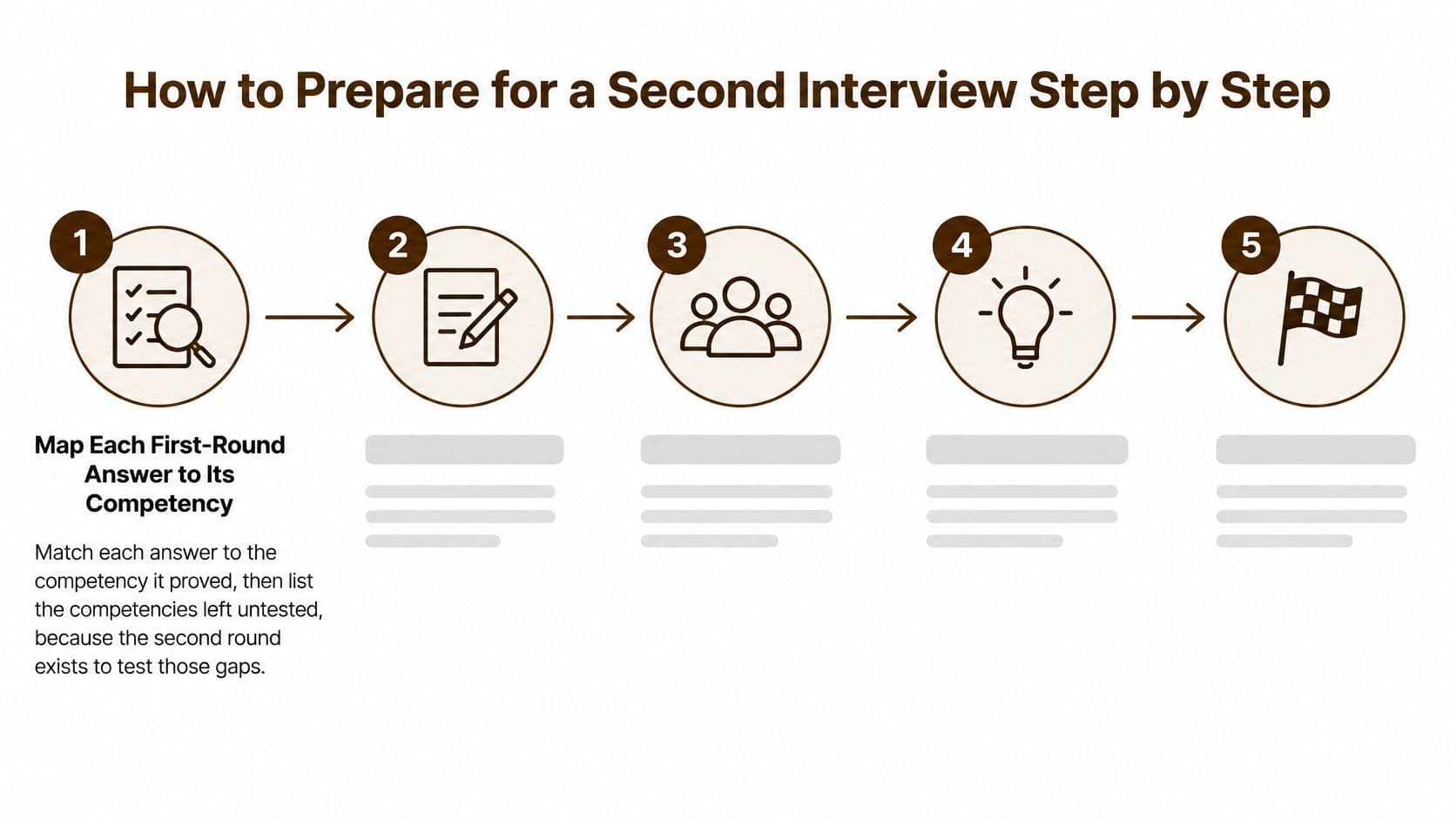
Map your first-round answers to competencies. For every legal role, write down the questions asked and the evidence you supplied. An associate might have established research experience without demonstrating client communication. A legal operations candidate might have described a system rollout without explaining adoption problems.
-
Ask what remains to be assessed. Ask your recruiter or interview contact which capabilities the next conversation will focus on. If they can't share questions, request the format, interviewer names, and whether technical judgment or a practical task will be assessed.
-
Build role-specific stories. Attorneys should prepare matter-strategy and client-communication examples. Paralegals should prepare a deadline conflict; legal operations leaders should prepare a process change with an outcome they can substantiate. Use situation, action, and result, with direct verbs such as “I drafted,” “I checked,” or “I escalated.”
-
Rehearse an update for a nonlawyer. For associates and in-house counsel, explain a hypothetical litigation risk to a business executive. Lead with the decision required, then explain the relevant exposure and recommendation. Don't begin with a procedural history unless the listener needs it.
Prepare for the Actual Meeting
-
Walk through the likely work sample. Associates can practice defending a memo outline. Partner candidates can explain how they'd assess a proposed practice's development needs; in-house candidates can outline how they'd review a contract portfolio. State what information you'd need before committing to a plan.
-
Confirm logistics and boundaries. For every role, ask whether the meeting is virtual or onsite, whether it includes a meal, and what notice you'll receive for an exercise. Clarify whether the task is timed, what resources are permitted, and how to submit it.
-
Research the people and prepare your questions. Review interviewers' practice areas and publicly available work. Ask about workload allocation, the remaining decision process, and what successful performance would look like. Keep questions specific to the role rather than asking for information already published.
If you need an outside listener, online interview coaching is an option alongside a trusted colleague or mentor. Ask for interruptions and follow-up questions, not just feedback on a polished monologue.
The preparation mistake to avoid is over-rehearsing the wording. Learn the facts of your examples and practice selecting the relevant details. You should be able to shorten an answer, clarify your contribution, or change direction without losing the substance.
Confirm the Next Step Before You Accept an Offer
A second interview isn't an offer. Reaching it generally means you've passed the initial qualification screen, but the employer may still be comparing finalists, resolving concerns, and aligning decision-makers.
The research on structured and serial interviews describes how interviewers' goals can change across successive conversations. Treat the closing discussion as a chance to understand what remains, rather than assuming a positive meeting has settled the decision.
Clarify the Remaining Conditions
Before responding to an offer, establish the terms and any outstanding requirements.
- Decision process: Ask for the expected decision date and who makes the final call.
- Remaining assessments: Confirm whether references, another writing sample, or a background check remain.
- Compensation: Request the applicable base, bonus, origination-credit, or equity terms in writing.
- Start date: Discuss notice obligations and any transition requirements before committing.
- Reporting line: Confirm who will supervise you and how work will be assigned.
For a lateral partner, don't leave assumptions about origination credit or team support unresolved. For an in-house candidate, clarify the reporting relationship and decision authority. Support and operations candidates should ask who sets priorities when requests conflict.
Respond to Uncertainty Directly
A moving decision date isn't proof that the employer has lost interest. Still, repeated delays or an additional round without a stated purpose justify a direct question: what decision will that conversation help resolve?
A legal recruiter can help relay feedback, clarify the remaining stages, and discuss terms with the employer. Use that channel to resolve ambiguity, not to avoid understanding the offer yourself.
Send a written thank-you promptly after the meeting. Restate a relevant strength tied to a business need the interviewer identified, then ask for the expected decision date in the same message. Keep it specific, brief, and easy to answer.
Five Star Placements provides permanent legal placement and candidate interview coaching for attorneys, partners, in-house counsel, legal support professionals, and legal operations leaders. Visit Five Star Placements to discuss your next role and preparation aligned with the employer's interview process.
Need help filling a legal role?
Five Star Placements partners with law firms and legal departments nationwide.
Schedule a Call