
Law Firm Partner Roles, Pay, and Career Path
October 24, 2026 · 14 min read · Five Star Placements

Table of contents
The most popular advice about becoming a law firm partner is simple. Get the title, ask what it pays, and compare that number with your current one. That advice fails both sides of the table. A managing partner and a lateral candidate can use the same word, partner, while describing completely different deals. One owns part of the firm, votes on major decisions, and shares profits. Another holds a senior title, receives a salary, and has no ownership stake. If you don't separate those deals first, every later conversation about pay, clients, and promotion gets muddy.
Table of Contents
- Why the Law Firm Partner Title Splits
- Equity and Non-Equity Partnership Compared
- Responsibilities That Come with the Role
- What Sets Law Firm Partner Compensation
- Career Steps from Counsel to Ownership
- How Firms Recruit and Evaluate Partners
- Succession Planning and the Next Hire
Why the Law Firm Partner Title Splits
Stop treating partner as one job. It's a label firms attach to several economic arrangements, and the differences aren't minor details you sort out after an offer. They determine who bears risk when revenue falls, who can vote, and who owns anything.
U.S. firms once ran mostly on a single-tier ownership model. A partner generally held an ownership interest, participated in profits, and often had voting or governance rights. Firms now widely distinguish equity partners from non-equity, income, or salaried partners, who may be paid on a more fixed basis with limited authority.
Two Laterals and Two Different Deals
Consider two lateral candidates with similar practices and similar stated books of business. One joins as an equity partner, contributes capital, and receives a share of residual profits. A strong year lifts that person's income. A weak year cuts it, and the capital stays exposed.
The other joins as an income partner on a largely fixed package. The downside is smaller, but so is the upside, and there's no automatic route to a vote on compensation, admissions, or strategy. A search brief that says only “partner, corporate practice” can't distinguish those candidates or those seats.
Ask this first: Is this seat ownership, senior employment, or a step toward ownership on stated conditions?
That question leads to the ones that matter in diligence.
- Capital: Does the partner contribute money, when, and on what return terms?
- Profit share: Is pay a draw against profits, a salary, a bonus formula, or a mix?
- Governance: Does the partner vote, and on which decisions?
- Client portability: Which relationships are personal, which are institutional, and what happens on departure?
- Progression: What must happen for a non-equity partner to gain equity, and who decides?
When a hiring committee skips those questions, it writes a vague brief and receives impressive resumes that don't fit the actual seat. When a candidate skips them, a higher headline number can hide weaker rights. Role design comes before pay, pay mechanics come before career promises, and a firm can only fill the seat well once it has named which deal it's offering.
Equity and Non-Equity Partnership Compared
Equity partnership is an ownership position. An equity partner typically receives profit distributions, reports partnership income, and often holds voting or governance rights. The partner may also carry capital obligations and direct exposure to firm profitability.
A non-equity partner holds the partner title without the same ownership interest. Income and salaried partners are commonly paid through salary, bonus, or a formula. They may lead matters and clients, but they usually don't share residual profits in the same way and may have limited votes.
The Mix Has Changed Over Time
The split isn't a temporary label trend. NALP's 2025 diversity report on multi-tier firms counted 20,036 partners, with 55.7% equity and 44.3% non-equity, down from 61.3% equity in comparable 2011 data. That 5.6-percentage-point decline means the title now covers a wider range of rights than it once did.
Read that shift practically. A firm can grow its partner count without growing its ownership group at the same pace. A candidate can gain seniority and status without gaining capital ownership or control. Neither outcome is automatically bad, but neither should be discovered after signing.
Equity and Non-Equity Partner Economics
| Deal term | Equity partner | Non-equity partner |
|---|---|---|
| Ownership | Holds an ownership interest | Generally no ownership interest |
| Pay form | Profit distributions and partnership income | Salary, bonus, or formula-based pay |
| Voting | Often has governance rights | Often limited or no vote |
| Capital | May contribute capital | Usually no comparable capital role |
| Risk | Direct exposure to firm profits and losses | Less direct exposure to residual profitability |
Why the Pay Gap Follows the Structure
The economics explain much of the compensation distance between tiers. Average equity-partner compensation was about $1.937 million in the 2024 Am Law 200 data, compared with $558,000 for non-equity partners, and Thomson Reuters reported profits per equity partner rose more than 11.6% year over year in 2024.
That gap isn't just seniority pay. Equity partners participate in what's left after expenses, so demand, pricing, staffing costs, and borrowed funds flow into their returns. Non-equity partners sit closer to a compensation plan set by the firm. Before comparing two offers, separate status from economics. A title tells you how a firm presents someone. The tier tells you how the firm pays, governs, and shares risk with that person.
Responsibilities That Come with the Role
A law firm partner isn't a senior associate with a new signature block. The change is accountability. Associates and counsel can own excellent slices of work. The partner owns the client problem from pitch through collection, including the parts nobody bills for.
Start with the matter lifecycle. The partner helps win the work, scopes it, prices it, staffs it, and makes conflicts and risk calls. The partner also watches realization, which means checking whether recorded time becomes bills and whether bills become cash. When a client pushes back on scope or fees, that conversation usually lands with the partner.
Client, People, and Economic Accountability
Responsibility falls into three tests a firm can write into a search brief.
- Client control: Does this person originate work, deepen institutional relationships, or mainly service clients others own?
- People leadership: Does the partner supervise associates and counsel, mentor juniors, interview candidates, and build a team that can deliver without constant rescue?
- Economic accountability: Does the partner own pricing, staffing efficiency, write-offs, and collections for a book of matters?
Those tests expose a common confusion. A junior partner may run day-to-day matters for institutional clients, supervise a small team, and have little say over rates or strategy. A practice leader sets staffing models, approves pricing approaches, recruits laterals, and answers for the group's margin. Both may carry the partner title. Their jobs are not interchangeable.
A useful responsibility test names what the partner controls, whom the partner develops, and which economic results the partner must answer for.
Managing partner duties sit one level above practice leadership. They add firm-wide decisions on compensation systems, lateral admissions, finances, and culture. If you're clarifying that distinction, this explanation of what a managing partner does in a law firm helps separate firm leadership from practice-level ownership.
Match the brief to the tier. Don't demand full origination and governance accountability from a salaried role with no vote. Don't grant equity for senior technical skill alone if the seat requires client generation, mentoring, and profit responsibility. A clear brief protects the firm and gives the candidate a fair picture of success.
What Sets Law Firm Partner Compensation
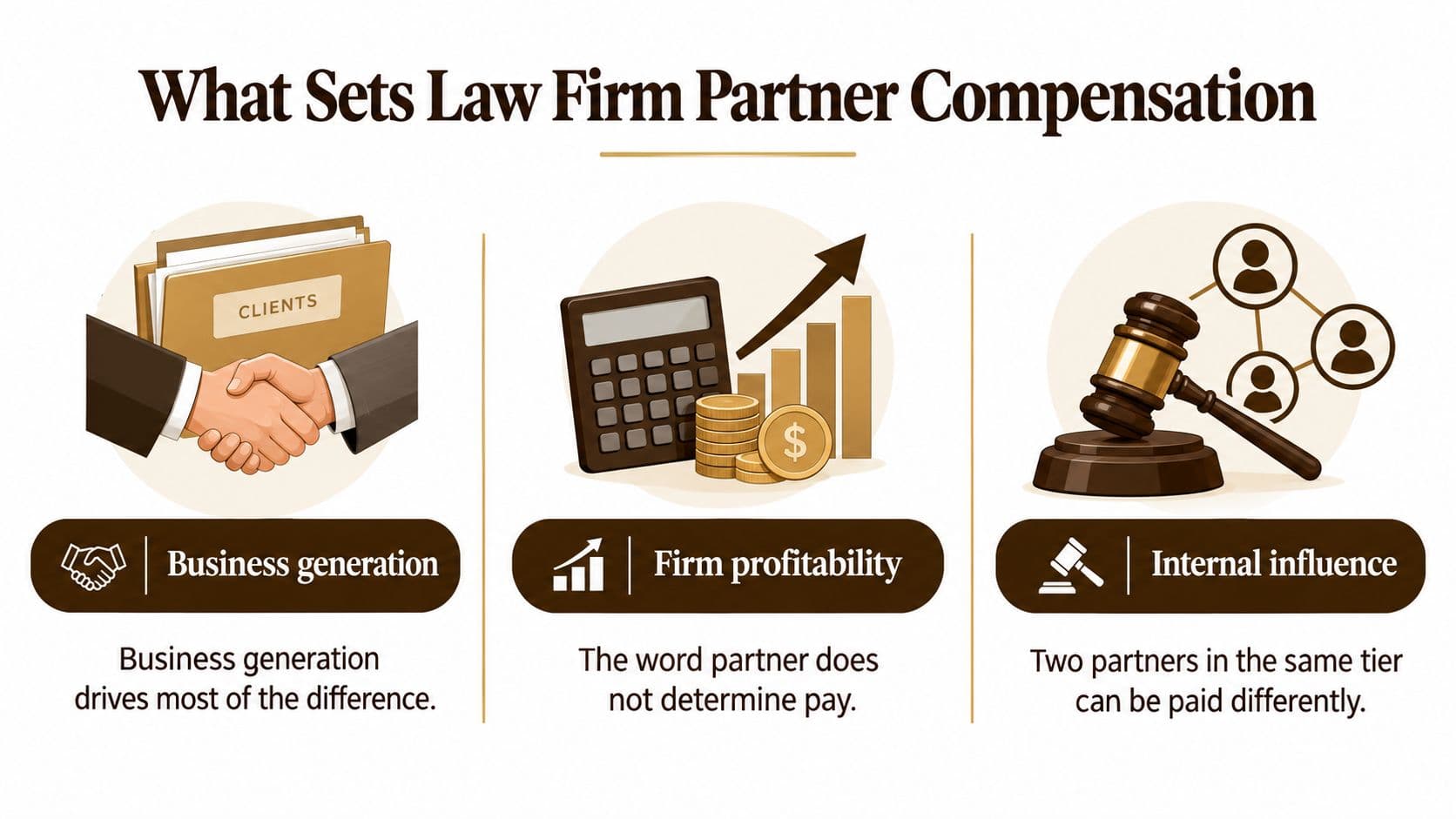
Two partners in the same tier can earn very different amounts. Title doesn't explain that spread. Business generation does most of the work, because a partner who controls client revenue brings the firm work it can staff, bill, and collect.
The visual below groups the main drivers. Look at it as a diligence map, not a promise that every firm weighs each factor the same way.
Originations and Rates in Plain Terms
Major, Lindsey & Africa's 2024 survey of more than 1,700 U.S. partners found average compensation of approximately $1.411 million, up 26% from 2022, with originations alone explaining 64% of compensation variation and originations plus billing rates explaining 72%.
The mechanism is straightforward. If hours and realization are broadly similar, a partner with more controlled revenue and higher billing rates generates more matter revenue. That leaves more margin available for compensation. A stated book, by itself, proves less than many candidates and firms assume. Collections show what clients paid. Realization shows how much value survived discounts and write-offs. Rate fit shows whether the book works at the receiving firm's prices.
How to Compare Two Offers
Don't rank offers by the largest stated number. Break each one into parts you can verify.
- Guaranteed versus contingent pay: Separate a guaranteed draw or salary from profit that depends on firm and personal performance.
- Credit rules: Define who receives origination credit, how shared credit works, and whether credit expires.
- Book quality: Check collections, client concentration, matter duration, and dependence on institutional relationships.
- Capital and repayment: Model buy-in, deferred compensation, clawbacks, and forgivable loans, including what triggers repayment.
- Firm economics: Ask how profitability supports the promise, a point covered in this guide to profit per equity partner.
Practical rule: The strongest offer is the one whose credit, collections, and repayment terms you can model, not necessarily the one with the biggest first-year number.
A candidate with concentrated clients and weak collections may transfer less value than headline originations suggest. A firm that benchmarks pay against verified production and its own rate structure avoids buying a book that shrinks on arrival.
Career Steps from Counsel to Ownership
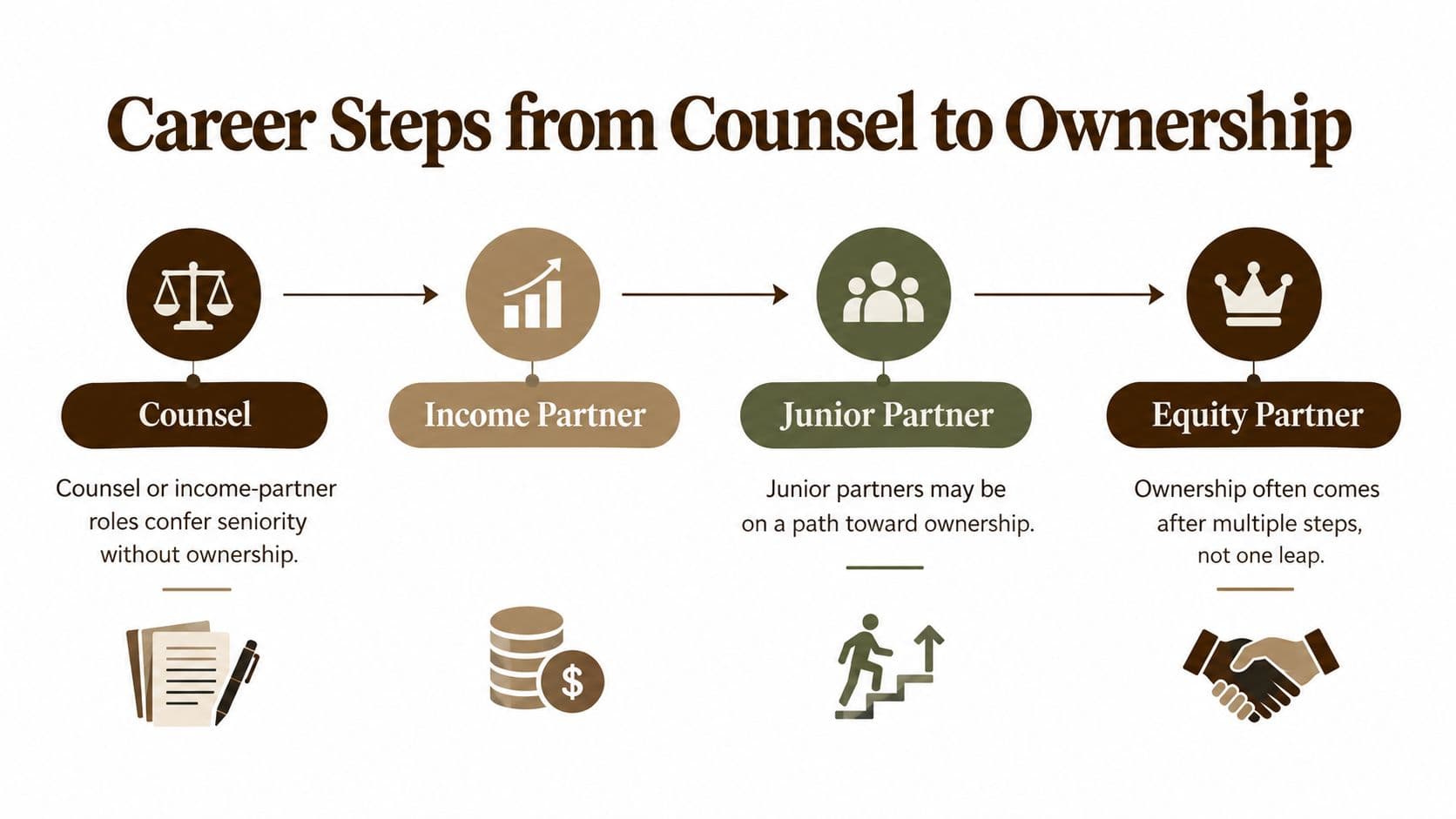
The path to ownership isn't one promotion clock. Lawyers reach equity through different combinations of institutional work, portable clients, sponsorship, and timing. Some never seek equity because a counsel or income-partner role fits the work they want to do.
The diagram below shows common steps without implying that everyone moves through each one, or moves at the same speed.
Two Recognizable Routes
An internal associate may become counsel, then a junior or income partner who services institutional clients. That lawyer builds trust, inherits relationships gradually, and waits for a capital call and an equity vote. The risk is becoming indispensable on other partners' clients without receiving origination credit or a tested book of one's own.
A lateral may skip that sequence. With portable clients, verified collections, and rate fit, that lawyer can enter as a senior partner or directly into equity. The latter route looks faster, but it carries integration risk. Clients must move, conflicts must clear, and new colleagues must trust the partner with shared work.
The short video below adds context on partner progression. Watch it for the career logic, then test any path against credit, sponsorship, and ownership terms at your own firm.
Who Reaches Ownership
Aggregate partner counts can hide unequal access to the ownership tier. NALP reported women represented 24.8% of equity partners in 2024, up 1.1 percentage points from 2023, while earlier Aon-cited data put women at approximately 23% of all partners but only 19.6% of equity partners in 2018. Historical ABA-related data placed lawyers of color at 7.33% of partners in the top 200 firms in 2014, with 10.21% of non-equity partners and 7.53% of equity partners.
Those patterns make sponsorship and credit allocation career issues, not side topics. Evaluate advancement separately for equity and non-equity roles. A firm can improve its overall partner numbers while keeping ownership access narrow. A candidate should ask who will sponsor client exposure, how credit gets recorded, and which milestones trigger an equity decision.
How Firms Recruit and Evaluate Partners
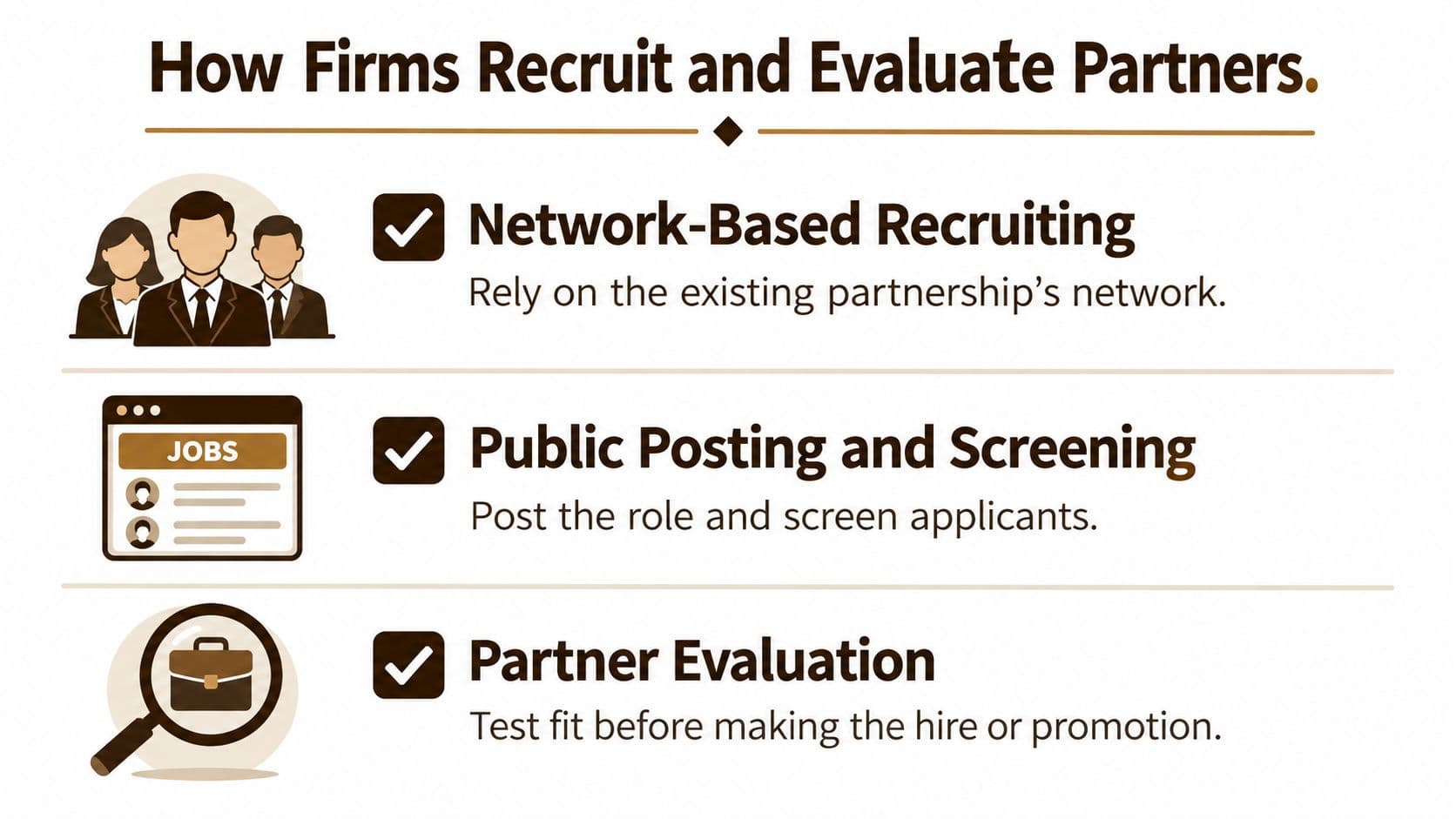
Firms usually reach a partner search through one of three routes. Each route can work. Each fails in a different way when the seat isn't defined or diligence stops at a resume and a claimed book.
The checklist below frames that choice before you compare cost or speed.
Three Search Routes Compared
Partnership network. Existing partners recommend people they know from matters, bar work, or prior firms. Referrals arrive with informal references and some sense of culture fit. The limits are reach and sameness. A network tends to reproduce the current partnership and may miss candidates outside familiar circles.
Posting and internal screening. The firm advertises, collects applications, and screens through HR or a hiring partner. That route creates a record and a wider funnel. It can also consume partner time, move slowly, and struggle with confidential searches where strong candidates won't apply publicly.
Contingency recruiter. Five Star Placements runs permanent partner searches on contingency, paid only on a successful hire, covering managing, equity, senior, junior, and practice-specific partners nationwide, with screening for skills and culture. That's one concrete option for firms without internal capacity. It doesn't replace the firm's own diligence on economics and conflicts.
Pressure and Diligence
Lateral hiring carries real budgets and expectations. Compensation is the most influential factor in exploring a move for 63% of surveyed partners, firms reportedly allocated an average of approximately $4.17 million and a median of about $2 million to lateral recruiting, and 54% expected lateral hiring to be their main growth engine in 2025, as summarized in lateral market commentary from Abshire Legal Search.
With that much at stake, evaluate the seat and the candidate together.
- Seat definition: Equity or non-equity, capital terms, voting rights, and management duties.
- Verified economics: Originations, collections, realization, rates, and client concentration over time.
- Relationship ownership: Who controls each client relationship and who owns it after a departure.
- Risk checks: Conflicts, restrictive obligations, and dependence on one matter or referrer.
- Integration plan: Sponsors, shared pitches, staffing, and first matters, a topic expanded in these lateral partner hiring strategies.
Speed matters because vacancies delay revenue and client coverage. Culture fit matters because a partner shapes teams and client trust. Neither justifies a shortlist built from titles alone. The right outcome is a small group of candidates tested against the actual deal, the actual book, and the actual work of leading people.
Succession Planning and the Next Hire
Succession is often described as a senior partner's retirement plan. For the firm, it's a continuity risk. Key clients may trust one person. Revenue may concentrate in a few relationships. Equity may need liquidity when a partner leaves, and the next generation may never have been tested in front of the client.
Recent retirement research summarized by the Futurum Group found 60% of firms lack a formal retirement policy, only 31% begin retirement discussions five or more years in advance, and just 45% report having a set retirement age.
A Retirement Age Is Not a Plan
A set age tells you when someone may leave. It doesn't transfer a client. A productive partner can phase down gradually, bringing a successor into pitches, sharing credit, handing over matter judgment, and stepping back from authority in stages. That approach protects the client and gives the firm evidence that the successor can hold the relationship.
Delay can feel rational for a high-performing partner who still enjoys the work and produces revenue. It becomes dangerous when no successor has led the client, priced the work, or handled a difficult conversation. The firm then discovers its gap at the worst moment, after illness, departure, or a sudden retirement turns planning into emergency coverage.
A Short Transition Scorecard
Score each major relationship before you need a replacement.
- Key-client ownership: Who else knows the decision makers and has their confidence?
- Matter handoffs: Which active matters can transfer now, and which need a longer runway?
- Successor sponsorship: Has the incumbent visibly backed the successor with credit and introductions?
- Economics: How do compensation, origination credit, and capital change during transition?
- Records and risk: Are conflicts, files, passwords, and institutional knowledge transferable?
- Post-retirement role: Will the departing partner advise, mentor, or step away fully?
That scorecard often reveals a hiring need well before a vacancy. A firm may need a lateral partner or practice leader months or years ahead so clients can build trust while the incumbent remains available. Start with a one-page seat definition covering equity status, capital, origination expectations, portable business, and management duties. Search against that page. If internal capacity is the bottleneck, a contingency partner search can supply reach and screening while the firm keeps control of the final economic and cultural judgment.
If you're defining an equity, non-equity, or succession-driven partner seat and need a confidential shortlist tested for practice fit and culture, Five Star Placements can run a contingency-based permanent search with no fee due until a successful hire. Visit Five Star Placements to discuss your partner hiring needs and turn your one-page seat definition into qualified candidates.
Need help filling a legal role?
Five Star Placements partners with law firms and legal departments nationwide.
Schedule a Call