
How to Hire a Paralegal: Pay, Steps and Practical Tests
November 28, 2026 · 15 min read · Five Star Placements
Table of contents
The most common advice about how to hire a paralegal starts with a job description and ends with an interview. That's not enough. A polished résumé won't tell you whether someone can catch a filing defect, verify an authority, or recognize when a client's question needs an attorney.
Start with the work, the budget, and the evidence you'll accept as proof of competence. Then use a practice-specific assessment, structured interviews, and documented reference checks to choose someone who can produce reliable work under your attorneys' supervision.
Table of Contents
- Define the Role and Set a Pay Band Before You Post
- Where to Find Paralegal Candidates and What Each Channel Costs
- Screen With Work Samples Instead of Résumé Review
- Test AI Judgment Without Weakening Supervision
- Interview, Check References and Make a Defensible Offer
- Decide In-House or Recruiter and Start This Week
Define the Role and Set a Pay Band Before You Post
Posting a paralegal vacancy without a pay band costs you applicants before the search even starts. Experienced candidates with a steady job will not apply to a posting that hides the number. Set the band first, then write the ad.
Paralegal pay and entry benchmarks for budgeting
| Benchmark | Figure | How to use it |
|---|---|---|
| Median annual wage (2025) | BLS reports $62,890 ($30.24 per hour) for paralegals and legal assistants | Starting point for the offer band |
| Average annual wage (May 2025) | BLS reports $69,700 ($33.51 per hour) for paralegals and legal assistants | Upper reference for experienced or specialized hires, not a ceiling |
| Typical entry-level education | Associate's degree, according to the BLS Occupational Outlook Handbook, which also projects little or no employment change during 2025–2035 | Education benchmark to consider, not proof of practice readiness |
| ABA-approved paralegal programs | A voluntary approval the ABA grants to programs meeting its guidelines | Credential to check on a résumé, not a substitute for testing |
| Projected annual openings, 2025–2035 | BLS projects 40,800 annual openings, including occupational transfers and exits | Expect competition; plan for replacement hiring |
| Projected employment change, 2025–2035 | Little or no change, under the BLS projection identified above | Flat employment still means steady replacement hiring |
Treat the national wage benchmarks as planning references, not a ready-made local salary range. They cover paralegals and legal assistants across employers and locations, so a litigation paralegal in a large metro and a probate paralegal in a small town both sit inside the same average. Compare current local postings with similar responsibilities before approving your band.
The gap between median and average tells you where experience sits in the market. A candidate who already manages discovery productions or prepares trusts-and-estates documents without close supervision belongs near the top of your band, and the national average is a reference point, not a cap on what that person can ask.
Budget separately for benefits, payroll costs, software, equipment, and onboarding. A salary you can afford is not the same as a fully staffed position you can afford.
Define the legal work and its boundaries
The ABA definition centers on specifically delegated substantive legal work for which a lawyer remains responsible. A job posting that mixes reception, bookkeeping, research, and trial preparation with no priorities tells candidates you have not decided what the role is.
Write down:
- Practice area and deliverables: Identify the documents, research, discovery, or transaction support the hire will produce during onboarding.
- Supervising attorney: Name who assigns work, resolves legal questions, and approves external deliverables.
- Confidentiality duties: Specify access controls, approved communication methods, and handling of sensitive files.
- Independent-work boundaries: State your office's restrictions on legal advice, client communications, filing, and release of documents.
This breakdown of what a paralegal does in a law firm helps separate substantive delegated work from general office support, and that separation is what makes the rest of the hire auditable. If you cannot say which tasks count as substantive legal work, you cannot test whether a candidate performs them.
An ABA-approved program is one route to preparation, alongside relevant experience and training. Screening out every candidate without one excludes people who learned discovery or transactions inside a firm, which is often better preparation for your specific workload.
Finish with a rubric before you post: competency, passing evidence, and reviewing attorney. For each competency, decide what proof you will accept, whether a work sample, a reference confirmation, or a credential check. That forces the hiring partner to separate what the candidate must already know from what the firm can realistically teach in the first ninety days.
Where to Find Paralegal Candidates and What Each Channel Costs
Paralegal sourcing channels compared
| Channel | Best for | Main trade-off |
|---|---|---|
| Your own website and job board | Staff roles with a defined practice area | Experienced applicants may skip postings without a pay band |
| ABA-approved program career offices | Entry-level roles and recent graduates | Candidates may lack practice-specific experience |
| Referrals from current staff | Trusted introductions in a specific practice | Narrows the pool; verify skills anyway |
| Legal recruiter on contingency | Senior or hard-to-fill specialties | Fee becomes payable at the contractual hiring milestone; confirm start-date terms and firm-size fit |
| Bar association and legal-support groups | Experienced paralegals open to a move | Requires active outreach and follow-up |
Compare channels on cash expense and staff time, not just the price of publishing a vacancy. Your website may avoid a placement fee, but someone still has to review applications, arrange assessments, and follow up with candidates. Job boards may add advertising charges without relieving that workload.
A useful posting names the practice area, salary band, work arrangement, supervising structure, and actual assignments. “Competitive compensation” doesn't help a candidate decide whether leaving an established position is worth discussing.
Match the channel to the training you can provide
Program career offices make sense when an attorney has capacity to train. A recent graduate who researches carefully and follows instructions may be a better entry-level hire than an applicant with a longer but unrelated work history. Don't advertise a developmental role and then reject everyone who needs development.
Employee referrals can surface candidates who already understand the practice. They can also concentrate the search within the same professional circles. Treat a referral as an introduction, not a waiver of the assessment.
Bar associations and legal-support groups require more personal outreach. Send a specific description of the work rather than a vague request for anyone looking. Respect group posting rules and avoid asking members to discuss confidential client matters as evidence of experience.
Decide what recruiting help is worth
A contingency recruiter adds a placement expense in exchange for sourcing and screening capacity. Get the fee calculation, payment trigger, candidate-ownership terms, and any replacement provisions in writing. Don't assume every contingency agreement works identically.
At Five Star Placements, we recruit exclusively for law firms and legal departments. We identify boutique and midsize law firms, and companies hiring in-house counsel, as the strongest fit for our concentrated network and placement record.
Every candidate we send has spoken with us on a call before the client sees them. We check credentials, matters handled, fit, and interest in the specific role, with bar-status checks relevant to attorney searches. In 70% of our searches, the first candidate is sent within two weeks, based on placement records since January 2025; that isn't a promise of a completed hire.
Compare a legal recruiter versus a job posting against your team's available screening time.
Practical rule: Run complementary sourcing channels together, assign an owner to each, and set a decision date before applications arrive.
Screen With Work Samples Instead of Résumé Review
Paralegal competencies, work samples and pass signals
| Competency | Work sample | Pass signal |
|---|---|---|
| Jurisdiction-specific filing procedures | Build a filing checklist for a local court | Catches format and deadline rules without prompting |
| Legal research | Write a short memo on a redacted fact pattern | Cites primary sources and flags gaps |
| Cite checking | Verify citations in a short brief | Finds errors and explains how each was checked |
| Document management and e-discovery | Organize a sample discovery set by issue | Explains a logical tagging scheme |
| Deadline control | Schedule a matter with conflicting deadlines | Prioritizes and raises conflicts with the attorney |
| Confidentiality | Redact a document containing client identifiers | Removes required information without unnecessary omissions |
| Attorney communication | Summarize file status for the supervising lawyer | Communicates accurately and identifies open risks |
Don't assign every exercise to every applicant. Choose a compact assessment that reflects the work this person will perform. A litigation candidate might organize a discovery sample and prepare a filing checklist; a corporate candidate might review a closing checklist and identify missing execution documents.
Use synthetic or properly sanitized materials, not a live client problem. Supply the relevant court, practice context, available tools, submission format, and expected scope. You're evaluating judgment and execution, not whether candidates can guess your instructions.
Build the scoring rules before reviewing submissions
The EEOC's guidance on employment tests and selection procedures explains that selection procedures must be job-related, properly validated for their intended purpose, and administered without discrimination. Education requirements, experience requirements, interviews, and performance tests all deserve scrutiny. Calling something an informal exercise doesn't remove that responsibility.
Write behavioral anchors rather than labels such as excellent or weak. For deadline control, useful anchors might be:
- Insufficient: Misses a controlling deadline or assumes an unresolved service date.
- Acceptable: Identifies the applicable rule, records assumptions, and presents a workable calendar for review.
- Strong: Does all of that and identifies a conflict, explains its practical consequence, and proposes an escalation.
Separate accuracy, method, and communication. A candidate may reach the correct answer through an unsafe shortcut. Another may identify an ambiguity that prevents a final answer, which can be the more competent response.
Don't overweight presentation polish unless document presentation is central to the role. A beautiful memo with an unsupported authority is still a defective memo.
Make the process consistent and auditable
Give finalists equivalent instructions, materials, time expectations, and access to tools. Arrange appropriate accommodations and explain whether outside assistance or AI use is permitted. If you want unaided work, say so rather than inferring it afterward.
Require reviewers to record evidence before discussing overall impressions. “Not detail-oriented” is an opinion; “omitted the exhibit referenced in the filing checklist” is observable evidence. Keep the exercise, rubric, submission, reviewer notes, and hiring rationale under your organization's retention policy.
Review the assessment design before launch and monitor selection outcomes as applications move through it. If protected groups experience materially different selection rates, examine job-relatedness and whether an equally effective, less discriminatory alternative is available.
These candidate selection methods work best when each assessment answers a defined hiring question.
Hire the candidate who can show how an authority was verified, not merely explain what cite checking means.
Test AI Judgment Without Weakening Supervision
Knowing how to prompt an AI tool isn't enough. The BLS discussion of paralegal technology notes that artificial intelligence may reduce demand by making research and document preparation more efficient. Your assessment should therefore distinguish faster production from reliable production.
Make collaborative review part of the exercise, not an assumption about how the candidate works.

A tech-comfortable generalist may outperform a veteran at a particular workflow, but only if the generalist checks the output carefully. Years spent producing documents manually don't establish technology judgment, and tool fluency doesn't establish legal accuracy. Test both candidates against the same review standard.
Give candidates a flawed draft to repair
For a hypothetical litigation assessment, provide a synthetic AI-generated case summary, an underlying document packet, an invented citation, and an unsupported factual assertion. Tell candidates the draft may contain errors. Don't turn the exercise into a guessing game about whether you planted a trap.
Ask them to return:
- An annotated draft: Identify inaccurate statements, unsupported conclusions, and material omissions.
- A verification record: Connect factual statements to the packet and describe how authorities were checked.
- A corrected version: Remove unsupported material rather than replacing it with confident speculation.
- An escalation note: Identify questions requiring attorney judgment and explain what prevents completion.
- A tool-use explanation: State what information could enter an approved tool and when they wouldn't use AI.
A strong candidate won't delete the suspicious citation without explanation. They'll explain the search used, distinguish an unverified authority from a verified but irrelevant one, and avoid claiming certainty beyond what they checked.
Use the video as a separate discussion prompt, then return to the candidate's documented reasoning.
Set the operating rules before access is granted
Document the approved tools, permitted information, source-record requirements, and reviewing attorney. Include a response path for accidental disclosure or discovery of an unreliable output. Don't leave new employees to decide whether a public chatbot is suitable for client documents.
Ask directly: Which tools have you used, and where did the output need correction? Follow up on how the candidate recognized the problem and what they retained to make the correction reviewable.
Reward restraint when it's justified. A candidate who declines to upload privileged material into an unapproved system has demonstrated more useful judgment than someone who produces an instant summary without asking about access controls.
Interview, Check References and Make a Defensible Offer
Use the interview to investigate decisions that the work sample can't fully explain. You need to understand how the candidate responds to changing instructions, incomplete facts, difficult handoffs, and correction. A personable conversation is welcome, but it shouldn't replace evidence.
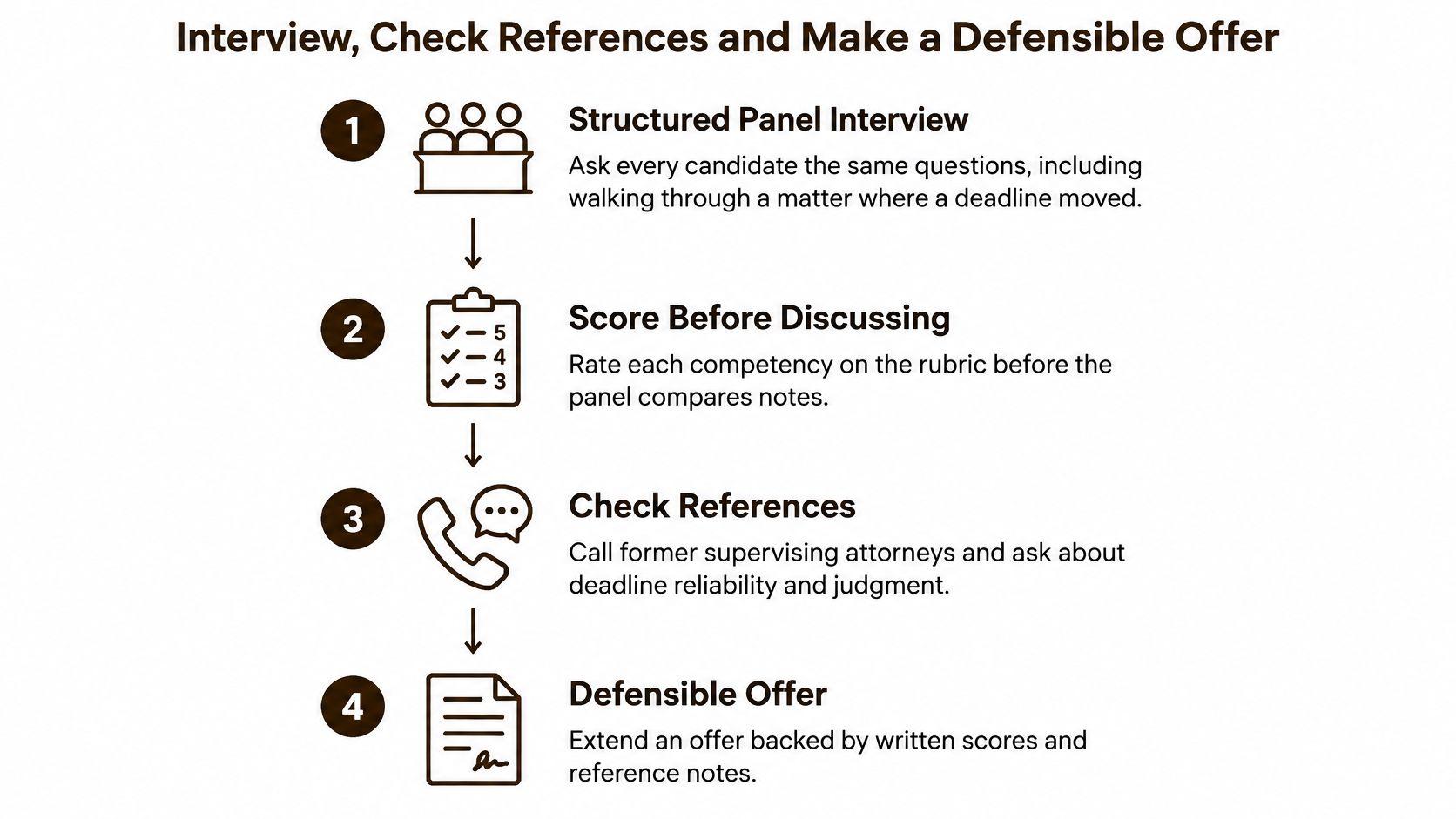
The process below keeps the panel's impressions separate from verification and offer approval.
Move from questions to verified evidence
-
Run a structured panel interview. Ask every finalist the same core questions, with follow-ups tied to their answers. Ask them to walk through a matter where a deadline moved: how they confirmed the change, updated the calendar, notified others, and checked dependent tasks. Tell candidates not to disclose client identities or confidential facts.
-
Score independently before discussing. Each interviewer should connect ratings to specific answers or assessment evidence. Then discuss disagreements. If someone favors a candidate because they'd fit in, require an explanation in job-related terms, such as responsiveness to feedback or clarity of handoffs.
-
Verify relevant credentials and employment. Confirm program completion, employment dates, and the responsibilities that matter to this position. Distinguish between assisting with a discovery production and owning its organization, tracking, and attorney-review process. Don't inflate a candidate's scope because their former firm had a recognizable name.
-
Obtain permission and check references. Ask before contacting a current employer. Our applications are confidential, and we won't contact an applicant's employer without permission. Where possible, speak with a former supervising attorney and ask about accuracy, deadline reliability, handling of sensitive files, and response to correction.
A useful reference question asks what work required the closest review and what the candidate could reliably prepare for approval. Avoid asking only whether the referee liked the person. If an employer will confirm nothing beyond dates and title, record that limitation rather than treating silence as a negative assessment.
Close without improvising the offer
-
Confirm acceptance expectations. Ask about compensation expectations, notice obligations, work arrangement, and any unresolved conditions before seeking final approval. We tell clients what the candidate is likely to accept before an offer goes out. That helps identify a mismatch, but it doesn't guarantee acceptance.
-
Approve and issue the written offer. Place the figure inside the authorized band and record the job-related reason for it. Specify duties, reporting line, schedule, benefits, start arrangements, and applicable conditions through your approved employment documents. Don't promise autonomy, flexibility, or advancement that the supervising partner hasn't approved.
-
Manage the remaining finalists. Keep the next-ranked candidate informed while the offer is outstanding, without suggesting they have an offer themselves. After acceptance and completion of your required process, promptly close the loop with unsuccessful finalists. Preserve a concise decision record showing why the selected candidate best met the role's requirements.
Decide In-House or Recruiter and Start This Week
Run the search in-house when someone has the time and authority to manage it, the specialty is reasonably accessible, and an attorney can review assessments promptly. A strong posting won't compensate for unanswered applications or a partner who can't make time to evaluate finalists.
Use a legal recruiter when the specialty is difficult to source, the role is senior, or your team can't sustain outreach and follow-up. Keep the substantive evaluation with the supervising lawyer. Outsourcing candidate introductions doesn't outsource responsibility for deciding whether the person can perform your work.
Assign owners and calendar commitments
Put these actions on the calendar this week:
- Today: Approve the role description, compensation band, required competencies, and named supervising attorney. Resolve whether you need a practice-ready specialist or someone you can train.
- Next working day: Launch complementary sourcing channels and reserve reviewer time. Prepare the assessment materials before inviting candidates to complete them.
- Before the week ends: Set a decision checkpoint about a fortnight ahead. Use it to evaluate qualified candidates and sourcing progress, not to force a hire from an unsuitable pool.
If you use a recruiter, send the assessment criteria at the start. Otherwise, you risk receiving candidates selected for impressive résumés rather than the work your attorneys need done. Clarify who schedules interviews, communicates decisions, and resolves feedback delays.
Test the hiring decision after the start date
Review the new hire's initial deliverables with the supervising attorney. Record whether the work meets the same accuracy, source-verification, organization, and escalation standards used during selection. Note which gaps reflect missing training and which reflect a capability the assessment failed to test.
Use those observations to improve the next search. If a candidate passed a filing exercise but struggles with your document-management system, the fix may be onboarding rather than a different hiring standard.
Don't keep adding requirements after each disappointing applicant. Change the rubric only when you can explain how the requirement relates to the job, and apply the revised standard consistently.
A defensible paralegal hire connects the work you need, the evidence you assessed, and the supervision you'll provide.
Five Star Placements offers permanent recruitment for paralegals and other legal support professionals, with screening aligned to practice needs and organizational fit. Visit Five Star Placements to schedule a call about your role, compensation band, and the capabilities your next paralegal needs to demonstrate.
Need help filling a legal role?
Five Star Placements partners with law firms and legal departments nationwide.
Schedule a Call