
How to Find a Legal Recruiter: A Step-by-Step Guide
November 10, 2026 · 13 min read · Five Star Placements

Table of contents
You've got a partner retiring, a litigation group passing on matters it can't staff, or an in-house seat that's been open so long the business team has stopped asking about it. Someone suggests a recruiter, names start flying, and within a week you're holding resumes that look close on paper but miss on practice, jurisdiction, or seniority. That's usually not a sourcing failure. It's a market coverage failure, and it starts before the first call. Learning how to find a legal recruiter who covers your market means testing evidence, not database size.
Table of Contents
- Where to Find a Legal Recruiter Who Covers Your Market
- Write the Role Brief Before You Call Anyone
- Vetting Questions That Separate Strong Recruiters From Weak Ones
- Test Market Coverage and Remote Fit Before You Commit
- Choose a Fee Model and Compare Costs Honestly
- Manage the Search, Feedback and First-Year Retention
- Confirm Your Shortlist and Book the First Call
Where to Find a Legal Recruiter Who Covers Your Market
| Channel | Best for | Main limitation |
|---|---|---|
| Referrals from peers or former colleagues | Partner and lateral searches | Narrow network, often limited to one practice area |
| Legal recruiting firms with a practice focus | Associate, counsel and staff roles | Placement records vary widely between firms |
| NALP member directory and career events | Finding firms with dedicated legal career specialists | Lists firms but does not show performance data |
| LinkedIn search for recruiters by practice area | A quick first list of names | Profiles are self-reported and need verification |
| In-house or firm recruiting team | Support staff and legal operations roles | Limited access to outside candidate markets |
Referrals are the fastest route, but check the referrer's own search first. A peer who placed a real estate partner can't vouch for a recruiter's reach into tax associates.
Practice-focused recruiting firms suit associate, counsel, and staff searches where volume and specialization overlap. Placement records vary widely, so don't treat the category as a credential. Verify the record.
Building the First List
The NALP member directory and career events help you find firms with dedicated legal career specialists. The directory lists firms without performance data, so use it to build a shortlist, not to rank one. If you're narrowing by city, a guide to legal recruiting in the Boston market shows the kind of local detail worth looking for in any market.
A LinkedIn search combining legal recruiter with your practice area and city produces a quick first list. Profiles are self-reported, so treat every claim as unverified until you've seen placements.
Your in-house or firm recruiting team handles support staff and legal operations roles well because it knows your systems and culture. Its limit is access. Internal teams rarely maintain live relationships with passive candidates at competing firms.
Demand isn't going away. In a 2024 Wolters Kluwer survey, 73% of participants said the ability to attract, recruit, and retain talent would affect law firms and legal departments over the following three years. That's why the channel matters less than the filter you apply to it.
Shortlist rule: Keep three to five firms. Drop any that can't name a relevant placement from the past two years.
Ask every firm for three recent placements in your practice area and seniority band before you discuss fees or timelines. If a recruiter can't produce them, the channel that produced the name doesn't matter.
Write the Role Brief Before You Call Anyone
A recruiter can only test the market against what you've defined. Complete this routine on paper before any call, and you'll hear the difference in the first conversation. Each step prevents a specific, expensive mismatch.
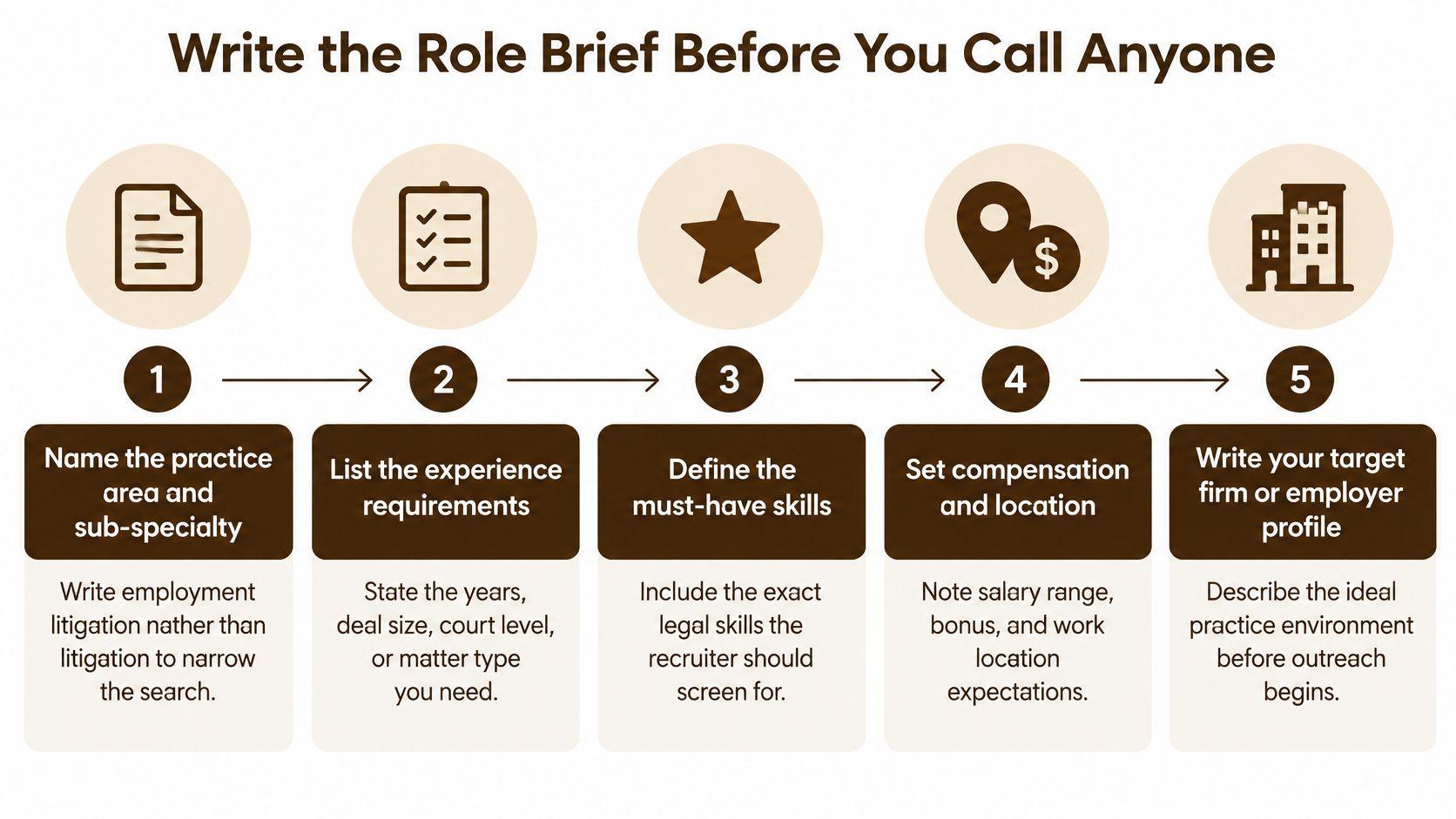
- Name the practice area and sub-specialty. Write employment litigation rather than litigation, or fund formation rather than corporate. This prevents matching on a broad label that covers lawyers you'd never interview.
- List required bar admissions. State every jurisdiction where the hire must be licensed, plus any court admissions the work requires. This prevents submissions you can't license for the matters waiting.
- Pick the seniority band. Choose associate, counsel, partner, staff attorney, or legal operations, and add the experience range inside that band. Unclear seniority is the most common reason a recruiter sends the wrong profile.
- State book expectations for partner roles. Name the portable business you expect and the evidence you'll require, such as originations history and client relationships that can move. According to Thomson Reuters research on lateral hiring, lateral partners bring an average of only 22% of their books of business to a new firm, with outcomes ranging from 0% to 100%.
- Set the compensation range and billing targets. Include base, bonus structure, and any billable or origination expectations tied to the seat. This prevents offers the genuine candidate pool won't accept.
- Specify the work arrangement. Write onsite, hybrid, or remote, and state whether remote is permanent or subject to later change. This prevents a mismatch that surfaces after the offer, when it's hardest to fix.
- Write the conflicts constraints. Name clients, industries, or matters the hire cannot bring or cannot work against. This prevents a late conflict killing a search you've spent months running.
- Add three culture criteria. Pick concrete ones, such as supervision style, team structure, and pace of work. This prevents a hire who's qualified on paper but a poor fit on an ordinary Tuesday.
Turn the Brief Into the First Call
The finished brief becomes the agenda for your first call with each recruiter. Walk it line by line and listen for pushback. A strong recruiter challenges a compensation range that's below market or a seniority band that's too wide. A weak one agrees with everything and starts sending resumes.
We ask clients to spend thirty minutes on a call about the role before the search starts, and every search starts this way. That half hour is where the brief gets tested against what's available, so the first shortlist reflects the market as it is, not as the job posting wishes it were.
Vetting Questions That Separate Strong Recruiters From Weak Ones
| Criterion | Strong answer | Red flag |
|---|---|---|
| Practice-area placements | Recent examples in your practice area and seniority band | Generic examples or a claim about database size |
| Funnel metrics | Qualified submissions, interview rate, offer rate and acceptance rate | Judges success by resumes sent |
| Retention | Retention at 12 and 36 months, split by role type | One aggregate 'high success rate' figure |
| Verification | Bar status, matters handled and conflicts checked before submission | Submits candidates before conflicts are cleared |
| Remote and multi-office work | Documented remote placements with licensing confirmed | Remote roles advertised but never tested |
| Consent and confidentiality | Submissions only with your permission | Contacts your employer without consent |
Practice-area placements come first. You want dated examples at your seniority band, not a number of resumes on file. A database is inventory, not evidence of access.
Funnel metrics show whether screening happens before or after submission. Ask how many candidates the recruiter presented in its last partner search and how many were invited to interview. That ratio tells you more than any pitch.
Retention and Verification
Retention must be split by role type, because a single figure hides real differences. The SurePoint 2025 State of the Legal Industry Report puts average three-year retention in the Am Law 200 at 76% for partners, 61% for counsel, and 52% for associates. Ask for 12 and 36 month numbers for the role type you're hiring.
Verification is where we draw a hard line. Every candidate we send has spoken with us on a call before the client sees them, and we vet credentials, bar status, matters handled, and fit, then confirm interest in the specific role. Applications to us are confidential, and we won't contact an applicant's employer without the applicant's permission. Hold every recruiter to that standard.
Scale explains why. U.S. Bureau of Labor Statistics projections for 2024 to 2034 estimate approximately 31,500 annual job openings for lawyers, with a 2024 median annual wage of $151,160. Demand that large isn't uniform across practices or cities, so broad reach alone proves little about your specific search.
A smaller, conflict-cleared shortlist with documented evidence beats a high-volume stack of resumes every time.
Test Market Coverage and Remote Fit Before You Commit
National reach doesn't prove local depth. A recruiter can run searches in twenty cities and still have no live relationships in yours, so test coverage directly with four questions.
Four Coverage Tests
First, ask for placements in your city, practice group, and seniority band over the past two years. Market averages conceal local weakness. NALP's 2025 lateral hiring research shows the 2025 U.S. lateral market expanded 16.4%, yet only 46.9% of reporting offices experienced lateral hiring growth of at least 16%. Your recruiter's market may not be the growing half.
Second, ask how the recruiter's activity held up in a downturn. Anyone can fill roles when demand surges. NALP's lateral hiring report recorded lateral hiring declining 11.5% in 2022 and 35% in 2023 before increasing 13.9% in 2024. A recruiter who only worked the recovery may not hold candidate relationships when hiring contracts.
Third, test remote fit operationally, not as a label. The 2026 NALP lateral and 3L hiring press release reports 52.1% of surveyed U.S. law offices allowed fully remote lateral hires in 2025, up from 49.2% in 2024. Ask how the recruiter tests licensing jurisdiction, court access, supervision expectations, time-zone compatibility, data security, and travel demands before submitting a remote candidate.
Fourth, for multi-office searches, ask which offices the recruiter filled in the last year. Follow up on how it handled different bar admissions across those offices. Vague answers here predict licensing surprises later.
Candidates should run the same test in reverse. Ask whether remote means permanently remote, office optional, or subject to policy change, and whether compensation, origination credit, and promotion are treated comparably across locations. A recruiter who can't answer hasn't placed into that structure.
I would take a documented placement in your exact market and jurisdiction over the broadest database in the country. Coverage you can verify is coverage you can use.
Choose a Fee Model and Compare Costs Honestly
Start with how each model shapes recruiter behavior, because the payment structure decides what gets prioritized when a search gets hard.

| Fee model | When you pay | Best use | Trade-off |
|---|---|---|---|
| Contingency | Only after the hire starts | Associate and staff roles with many candidates | Recruiter may prioritize speed over fit |
| Retained | Installments during the search | Partner and senior lateral searches | Larger commitment before any hire |
| Flat or milestone fee | Agreed milestones or a fixed price | Repeat hiring with a predictable scope | Requires a clearly defined scope and replacement terms |
| Monthly sourcing retainer | Monthly fee regardless of hires | Firms hiring continuously | Pays even when no hire is made |
Contingency aligns cost with results since you pay only after a hire starts. The risk is speed over fit, so ask how the recruiter screens before the fee is anywhere near triggered. Retained searches suit senior lateral moves that can run for months, and installments buy dedicated attention. If you're weighing that structure, this breakdown of how retained search works covers the commitment involved. Flat or milestone fees fit repeat hiring for paralegal, intake, or records roles with predictable scope. A monthly retainer suits firms hiring continuously, provided you accept paying in months without a hire.
The short video below walks through the practical differences between these structures.
Terms to Confirm in Writing
Whichever model you choose, confirm five terms before the search opens. Get the exact fee trigger date, whether the fee is calculated on base salary or total compensation, and the replacement terms if the hire leaves inside the guarantee period. Add confidentiality of candidate names and who owns the introduction if you later approach the candidate directly.
Compare total cost, not the fee alone. Total cost is the fee plus the cost of the open seat, so a higher fee that fills a role in four weeks can cost less than a cheaper search still running at six months.
Manage the Search, Feedback and First-Year Retention
A signed agreement doesn't run a search. These steps keep information moving to the right people and keep a good hire from becoming an early exit.
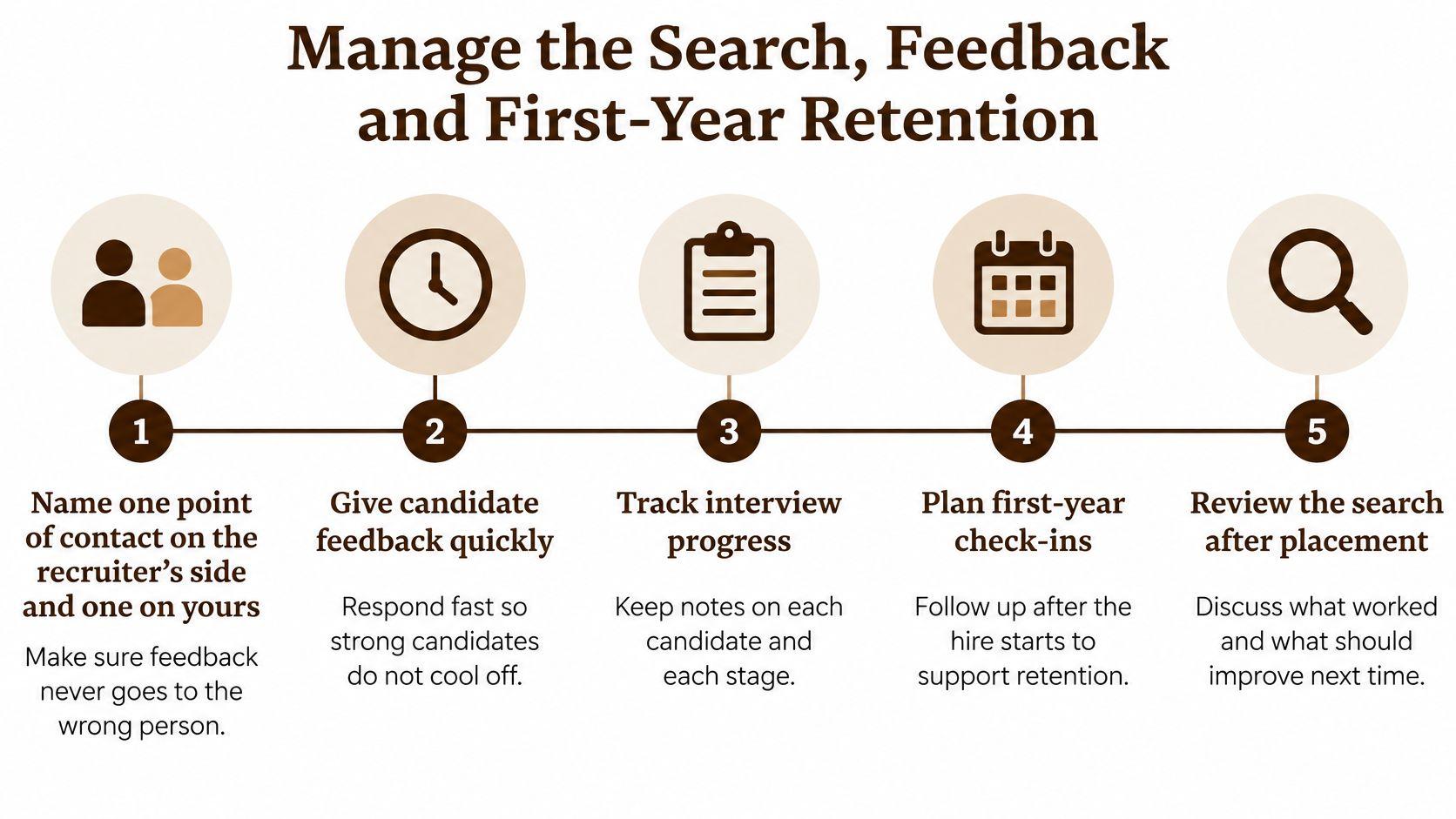
- Name one point of contact on each side. Feedback sent to whoever's available gets lost or contradicted. On our searches, Account Manager Sain Rhodes is the client's point of contact throughout, so nothing routes through a handoff.
- Give candidate feedback promptly and specifically. Say what worked, what didn't, and why, while the interview is fresh. We ask clients for prompt, candid feedback on each candidate and adjust the search based on it, because silent weeks let strong candidates accept other offers. These habits for working productively with a recruiter keep that loop tight.
- Revisit the role brief after the first three candidates. Update criteria in writing when real profiles expose a bad assumption about compensation, seniority, or sub-specialty. This prevents later candidates being judged against a need you've already outgrown.
- Agree a written 30, 60, and 90 day post-placement plan. Cover stakeholder check-ins, workload alignment, mentoring, introductions, performance expectations, and early-warning escalation. Write each checkpoint as a dated step with an owner in the agreement, not as a diagram nobody's responsible for.
- Confirm what happens if the hire leaves early. Settle who pays for a replacement search and how long the guarantee runs before the offer goes out. This keeps an early exit from becoming a fee dispute on top of a staffing problem.
Why the Checkpoints Earn Their Keep
Most early exits announce themselves through workload mismatches or a partner who never got introduced to the clients they were hired to serve. Dated check-ins surface those problems while they're still cheap to fix. Skipping them saves an hour and risks the placement.
Confirm Your Shortlist and Book the First Call
Score each recruiter against the vetting criteria and keep the top three. Weight each criterion from your role brief rather than scoring every factor the same, so a partner search weights portability evidence and retention heavily while an associate search weights funnel quality and time to shortlist. A recruiter who's excellent for one can be mediocre for the other, and your scoring should say so.
Run the First Call as a Test
Book a first call with each of the three and use your brief as the agenda. Ask the red-flag questions on the spot and note who answers with examples and who answers with adjectives. Watch what they ask you. Recruiters who probe conflicts, compensation realism, and decision timelines are screening your search the way they'll screen candidates.
Fit runs both directions. We're a legal-only firm placing attorneys, partners, legal support staff, and in-house counsel for law firms and legal departments, and we don't place non-legal roles. If your opening is a marketing director or an IT manager, we're the wrong call, and any recruiter who claims every category should make you suspicious.
Law firms and legal departments can schedule a call with us to discuss their legal recruitment needs, and every search we run starts the same way: a thirty-minute call about the role before the search begins. Attorneys considering a move can browse current openings or tell us what they're looking for, and we'll contact them when a strong fit in our network opens up. Applications stay confidential, and we won't contact an applicant's employer without permission. Either way, hold us to the same evidence standard you'd apply to any firm on your list.
Before you book, run one final check on each finalist:
- Recent placements: named by practice, seniority, and city, within two years.
- Process in writing: verification, consent, and confidentiality terms you can read.
- Guarantee terms: replacement conditions settled before the first submission.
A recruiter who passes all three has earned the search. One who resists any of them has told you how the search will go.
The right recruiter is the one whose documented evidence matches your specific role, seniority, and location.
That's the whole method for how to find a legal recruiter who performs. Channels produce names, your brief produces focus, and verified evidence produces the hire. Book the calls this week while the brief is current, because a stale brief restarts the process you're trying to finish.
If you're ready to put your brief in front of a search team, Five Star Placements places attorneys, partners, in-house counsel, and legal support staff for law firms and legal departments across the United States. Bring your role brief to a first call and we'll walk through the requirements with you and outline how we would approach the search. Attorneys exploring a move can browse openings or tell us what you're looking for, and we'll reach out when a strong fit opens up.
Need help filling a legal role?
Five Star Placements partners with law firms and legal departments nationwide.
Schedule a Call