
How to Attract Lateral Partners: A Proven Playbook
August 6, 2026 · 15 min read · Five Star Placements

Table of contents
The lateral partner market isn't small, and it isn't new. Industry publications citing Decipher-referenced data point to about 3,000 annual lateral partner moves among Am Law 200 firms, roughly 15 partners per firm per year, with nearly 20% of Am Law 200 partners making some type of professional transition each year, and one Am Law 200 presentation estimated $5.8 billion in client revenues at stake from partner moves (Decipher lateral hire stats). That scale changes the question from “Should we recruit laterals?” to “How do we do it without overpaying for portable revenue that never really transfers?”
The firms that win at how to attract lateral partners understand a hard truth. A lateral move is not just a sourcing exercise, it's a trust exercise wrapped around integration, sponsorship, and client migration. Compensation matters, but it doesn't carry the deal by itself, and the market punishes firms that confuse a strong résumé with a workable transition.
Table of Contents
- Why Lateral Partner Attraction Matters Now
- Defining the Precise Partner Profile You Need
- What Actually Attracts Top Lateral Partners
- Sourcing Channels and When to Engage a Recruiter
- Interview and Diligence Checklists That Catch Real Risk
- Structuring Compensation and Equity Offers
- Effective Onboarding and Retention Strategies
Why Lateral Partner Attraction Matters Now

The lateral market is no longer a side channel for growth. It is part of how firms win work, protect client relationships, and keep pace when competitors move first. That makes partner recruiting less about filling a seat and more about deciding whether the firm can absorb a new rainmaker, support a portable team, and keep the hire productive after the announcement fades.
A common mistake is treating every partner search as a sourcing exercise. A partner move succeeds only when the candidate trusts the platform, sees internal sponsorship, and believes the firm can integrate the practice without friction. Portable revenue matters, but it does not close the deal by itself, and it does not save a weak internal process.
Growth hire or capacity hire
Most firms get into trouble when they blur those two categories. A capacity hire helps with workload, staffing, or coverage. A growth hire needs to move client work, deepen a market position, or create cross-sell opportunity. If the firm never names which one it wants, every later discussion becomes mushy, and the candidate senses it immediately.
Practical rule: if the firm cannot explain how the lateral changes the business, the market will assume the offer is thin.
That is why attraction has to start before outreach. The firm needs a clear internal story, a sponsor who can open doors, and a plan for how the hire will be introduced to the rest of the platform. Compensation still matters, but it rarely fixes a weak integration plan or a practice group that cannot make room for a new partner.
For firms that need a confidential market read before they approach candidates, a legal recruiting shop such as Five Star Placements can help identify who is likely to move, who has real fit, and where the firm's story will land.
Defining the Precise Partner Profile You Need
A precise partner profile beats a broad mandate every time. “We need a litigation partner” sounds decisive, but it usually creates a stack of mismatched resumes, vague conversations, and internal disagreement the moment a strong candidate shows interest. The better move is to translate strategy into a written profile that names the exact practice need, the target client type, the expected revenue shape, and the cultural behaviors that matter on day one.
Start with the business need, not the title
The profile should answer a few direct questions. What practice area are we really building? Which clients or industries matter? Is the firm looking for a portable business generator, a relationship bridge, or a platform builder who can deepen an existing niche? If those answers are hazy, the search will drift.
The profile should also define the revenue pattern the firm wants to see. Legal-market guidance recommends evaluating a candidate's portability and revenue quality through a three-year history of portable-client collections, billable and non-billable hours, current billing rates, and key-client and conflict information (MLA Global guidance). That is not paperwork for its own sake. It tells the firm whether the candidate fits the economics of the platform and whether the business is likely to hold up after the first round of client introductions.
A narrow profile also changes how candidates respond. Senior partners can tell within minutes whether a firm understands the job or is just collecting names. If the conversation starts with title instead of need, the strongest people often assume the firm has not done the internal work and keep moving.
Get the committee aligned before outreach
Executive committee alignment matters before a single candidate call happens. If the committee does not agree on the profile, one partner will push for prestige, another will focus on revenue, and a third will worry about culture. The search then becomes a referendum instead of a process.
A solid profile usually includes:
- Target client profile. Industry, geography, and matter type.
- Practice expectations. What work is portable, what work is strategic, and what work is just nice to have.
- Leadership expectations. Client development, mentoring, cross-selling, or committee work.
- Cultural signals. Collaboration style, responsiveness, and appetite for integration.
- Conflict tolerance. Which client overlaps are acceptable and which are deal-killers.
A strong lateral profile reads like a business brief, not a job description.
That level of clarity also helps the people who will have to sponsor the hire internally. A partner who can open doors in the first month is far more valuable than a committee member who approves the offer after the fact. Firms that want a confidential market read before they approach candidates can also use Five Star Placements' blog to pressure-test who is likely to move, who has real fit, and where the firm's story will land.
A mid-sized firm can sharpen this fast. A generic “litigation partner” search often goes nowhere because too many candidates fit the label. When that firm narrows the target to an insurance coverage partner with a clearly defined portable base and existing carrier relationships, the shortlist gets better and the conversations get shorter because both sides know what success looks like.
That discipline lowers internal friction later. When the committee already agreed on the profile, it is easier to evaluate trade-offs in real time, especially when the candidate is strong in one dimension and merely adequate in another. The goal is not to find a perfect partner. It is to find the partner whose business, behavior, and future contribution fit the firm's actual plan.
What Actually Attracts Top Lateral Partners
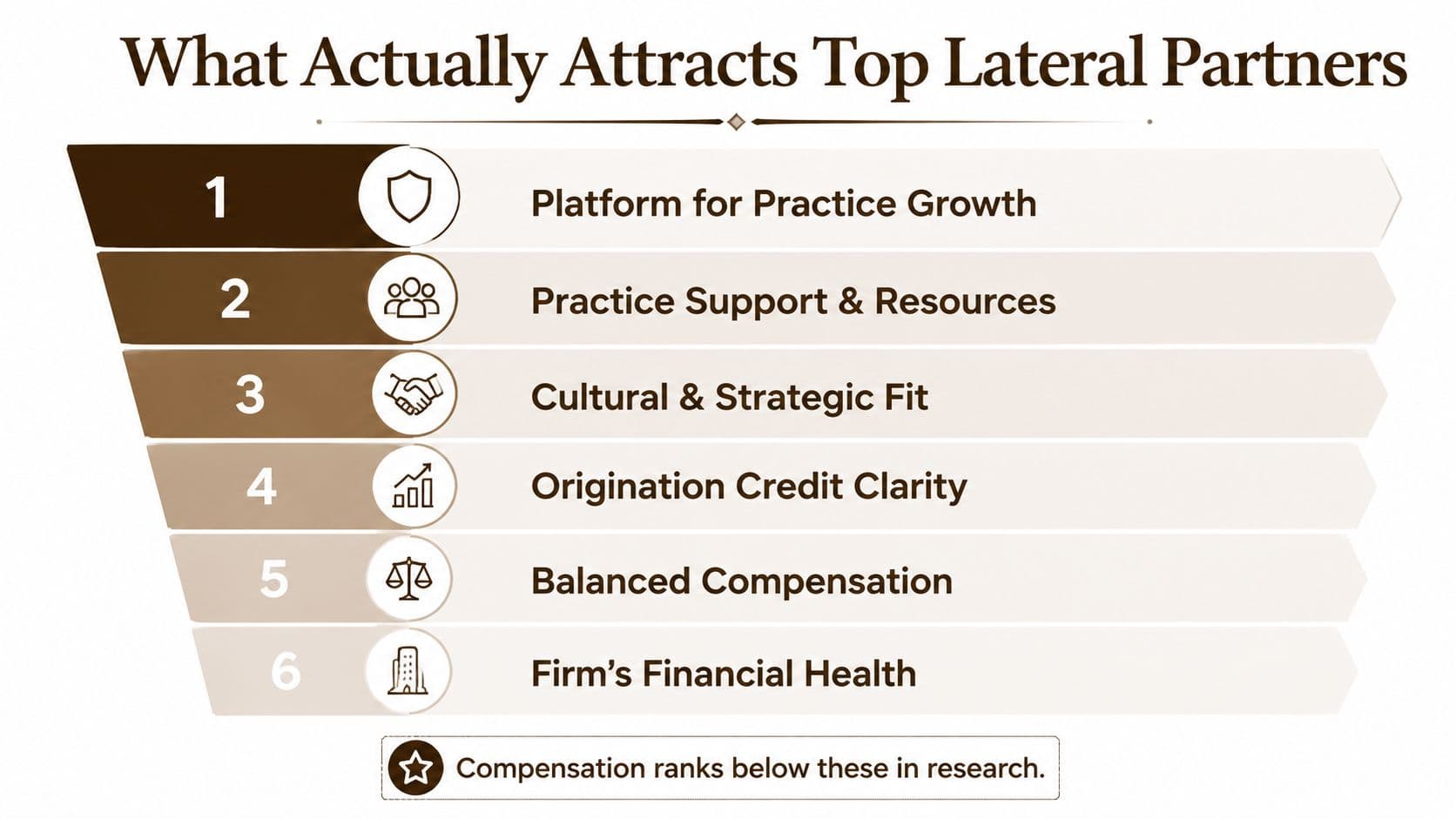
The biggest mistake in lateral recruiting is treating compensation like the headline and everything else like decoration. Research summarized in industry materials paints a different picture. NALP-related guidance says the top reasons laterals are attracted are firm support for their practice, culture and reputation, leadership and direction, and financial health, while compensation ranks only sixth (Totum Partners summary of lateral attraction drivers). That ranking should shape every pitch deck, introductory call, and partner visit.
The message has to sound like a platform plan
Top laterals want to know how the firm will help them serve clients, expand relationships, and build something durable. A good message sounds like, “Here's how your practice gets supported here,” not, “Here's our compensation grid.” The strongest firms talk about staffing access, client service depth, marketing support, and how the partnership collaborates.
The language matters. Instead of saying a candidate will “fit in,” say the firm has a track record of integrating partners into cross-office matters, introducing them to internal rainmakers, and making sure their clients meet the people who can help extend the relationship. That is a platform story, and laterals can tell the difference.
What the best candidates weigh
The same ranking explains why some offers fall flat even when the economics look strong. A partner who is respected in market will ask whether the firm backs the practice, whether leadership is stable, and whether the culture supports shared success. Compensation still matters, but it works as a tie-breaker or a confidence builder, not a substitute for trust.
Use the talking points below to shape outreach:
- Practice support. Explain the team, resources, and internal advocates the candidate will have.
- Culture and reputation. Show how the firm behaves with clients and among partners.
- Leadership and direction. Be specific about strategy, not just aspiration.
- Financial health. Give enough context for a partner to trust the platform without making the pitch sound like a balance-sheet lecture.
- Compensation clarity. State the economics plainly, without pretending they're the whole story.
The strongest narrative reads like a development plan. It tells the candidate where the firm is going, how their practice fits, and why the move would make their client work easier instead of harder. That's the kind of position that travels well in partner-to-partner conversations.
Five Star Placements blog is a useful place to see how legal recruiting content frames search, screening, and candidate fit from a practitioner's point of view.
Sourcing Channels and When to Engage a Recruiter
A lateral search works best when the firm uses multiple channels in sequence instead of leaning on one favorite source. Internal CRM mining, practice-group referrals, bar-association networks, alumni contacts, LinkedIn outreach, and outside legal search firms all have a place. The trick is knowing which channels are cheap but slow, which ones are discreet, and which ones are worth paying for when the search is sensitive or highly specialized.
Match the channel to the search difficulty
Start internally. Most firms have underused contact lists, old matter relationships, or partners who know the exact kind of lawyer they want. Practice-group referrals and alumni channels can produce warm introductions, especially in smaller markets or niche practices.
LinkedIn works well for broad mapping and early outreach, but it's rarely enough for a confidential partner move by itself. Bar networks and industry events help surface names, yet they still depend on who is visible and active. That means the harder the search, the more a firm benefits from a recruiter who already has trust with passive candidates.
When outside help makes sense
External recruiters become more attractive when confidentiality matters, when the practice area is narrow, or when the firm needs a more structured candidate screen. They also help when internal partners are too busy to run a disciplined search or when the firm wants a broader market view without broadcasting the opening.
If a firm wants a contingent model, it should compare fee risk against the cost of keeping the seat open and the opportunity cost of a delayed hire. A risk-based structure can align the recruiter with the hiring outcome and reduce upfront spend, which matters for firms with uneven hiring volume. For a confidential conversation about how that process is usually set up, Five Star Placements contact is one option among several legal search resources.
| Lateral Partner Sourcing Channels Compared | Typical Cost | Best For | Confidentiality |
|---|---|---|---|
| Internal CRM and partner referrals | Low | Known networks and warm leads | Medium |
| Bar-association and alumni outreach | Low to moderate | Relationship-driven searches | Medium |
| LinkedIn outreach | Low | Market mapping and broad prospecting | Low to medium |
| Outside legal recruiter | Variable, often contingent | Confidential, specialized, or time-sensitive searches | High |
A smart firm doesn't ask which channel is “best.” It asks which channel fits the level of complexity, secrecy, and speed the search requires. That answer usually changes by practice area and by how visible the firm wants the search to be.
Interview and Diligence Checklists That Catch Real Risk
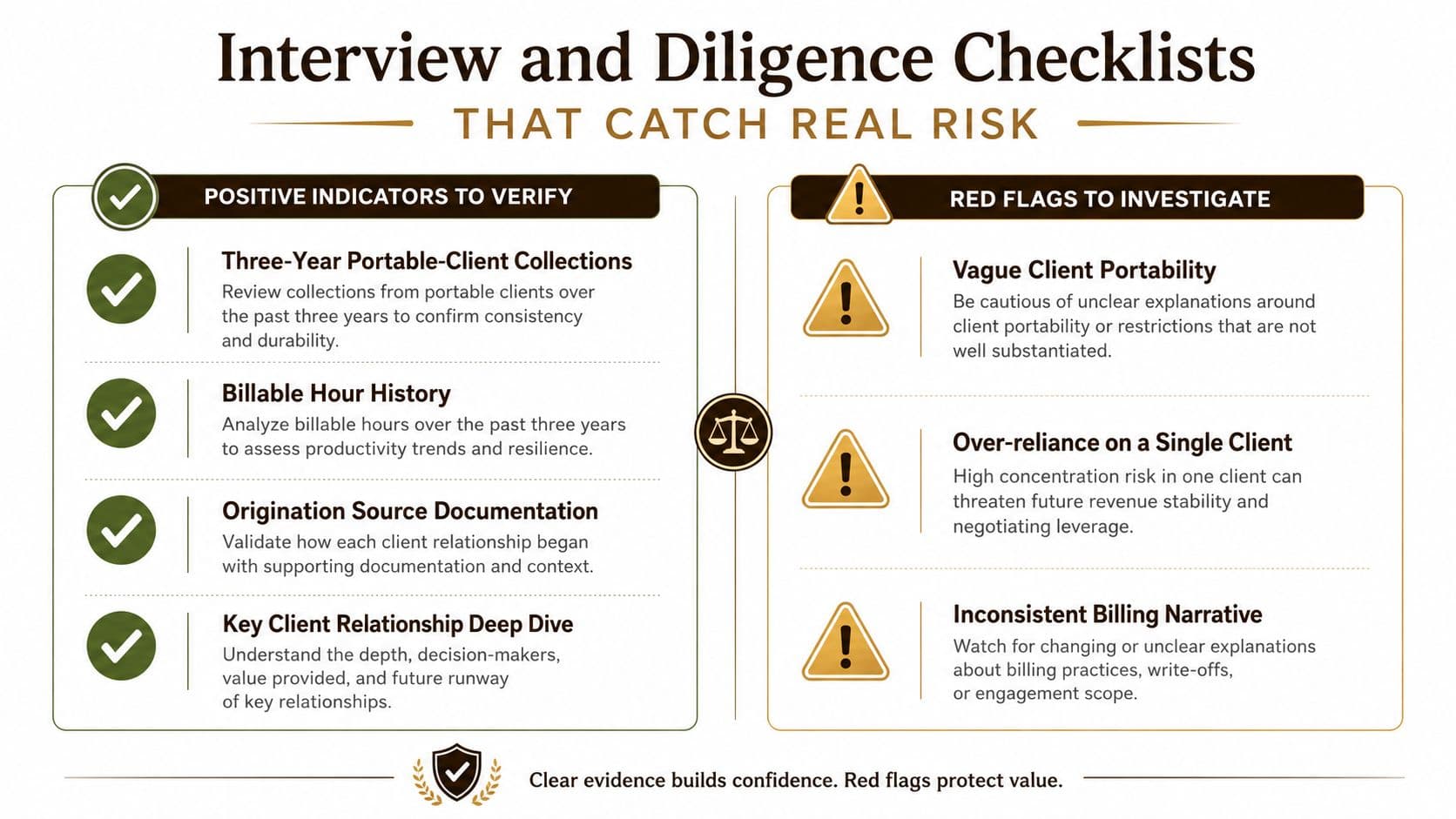
A lateral hire fails for predictable reasons. The business case looked fine on paper, but the firm never tested how the partner wins work, who supports that work internally, or what happens when conflicts and pricing pressure show up. A disciplined diligence process starts with the book, then pressure-tests relationship quality, conflict exposure, and the candidate's ability to build traction inside a new platform.
Ask for evidence, not anecdotes
Start with the hard material. Ask for a three-year history of portable-client collections, recent billable and non-billable hours, current billing rates, and key-client conflict information. That gives the firm a base for modeling revenue lift without depending on polished stories or optimistic projections.
The next layer usually tells you more. Ask whether the growth came from existing-client work or new-client acquisition. That split matters because it shows whether the partner is extending relationships they already have, or bringing in new business that may transfer less cleanly to a different firm.
Practical rule: a partner who grows by deepening existing clients can still be a strong hire, but the transition should be underwritten differently than one built on fresh origination.
Diligence the relationship, not just the ledger
Connectivity matters as much as portable revenue. Legal-industry commentary has repeatedly shown that trust, internal connectivity, and co-selling behavior often predict later success better than the raw size of the book, and that a firm should define success before the hire and measure client integration, practice synergy, and early relationship-building after arrival. Attorney at Work makes the same point plainly, portability does little if the partner cannot convert relationships inside the firm (Attorney at Work on trust and portability).
The interview should test more than business volume:
- Client transfer behavior. Which clients have followed the partner before, and why?
- Internal collaboration. Which partners, teams, or offices have they co-sold with?
- Relationship depth. Who else inside the client organization knows them well?
- Conflict reality. What will block transition even if the client likes them?
- Sponsor strength. Which internal partners are prepared to back the move?
These questions expose the gap between a good résumé and a durable lateral hire. A firm can overpay for a book that looks portable, then find that the relationships were personal, fragile, or tied to a prior platform that did more of the integration work than the candidate did. The better diligence process tests whether the partner can transfer trust, not just invoices.
Structuring Compensation and Equity Offers
Compensation should reflect the business case, not replace it. A lateral partner package has to match the candidate's book, the likely pace of transition, and the firm's tolerance for risk. When those pieces fit, the offer feels credible. When they do not, the candidate sees a number, but does not trust the platform behind it.
Compare the core structures
Different deal shapes solve different problems. Straight origination-based pay works when the firm wants transparency and wants the partner to feel direct ownership over their business. Guaranteed salary or draw structures can help with recruitment when the transition is uncertain or the book needs time to move. Bonus structures can reward firm performance, but they add complexity and require clear administration.
A practical comparison looks like this:
| Structure | Best Use | Strength | Trade-off |
|---|---|---|---|
| Straight origination-based pay | Strong portable business and clear attribution | Direct and easy to explain | Can discourage team collaboration |
| Guaranteed salary or draw | Recruitment support during transition | Stabilizes early-stage economics | Can create internal equity tension |
| Bonus structure | Broader firm contribution or shared goals | Ties reward to platform performance | Harder to administer cleanly |
Model from the firm's side first
Start with realistic revenue lift, not optimistic assumptions. Estimate the likely collections the portable work can support, then add transition timing, conflict friction, staffing needs, and the cost of integration. If the math only works under perfect transfer conditions, the package is too aggressive.
The same discipline applies to equity. If the candidate is a clear long-term fit, the firm can design an equity path that matches the person's contribution timeline. If that fit is still uncertain, keep the structure more flexible and avoid commitments that assume immediate culture alignment and immediate book transfer.
The offer also has to fit the broader hire strategy. A firm is not just buying revenue, it is paying for a person who must win trust inside the platform, work with existing teams, and stay long enough for those relationships to matter. A package that ignores that reality often looks generous on paper and expensive in practice.
One point from lateral recruiting guidance is easy to miss. Firms compete on portable business, reputation, and integration quality, not compensation alone. So the offer needs to signal seriousness, while also showing that the firm knows how to support the move after the signature is dry.
A strong package is specific. It says what gets paid, when it gets paid, what happens if the book arrives slower than expected, and how the firm will treat the partner during the transition. That kind of clarity builds trust faster than a bigger headline number with fuzzy terms.
Effective Onboarding and Retention Strategies
Weak integration causes more lateral departures than poor recruiting instincts do. The onboarding plan has to begin before the partner arrives and keep running after the welcome meeting is over. A firm needs a named sponsor, a client-transition plan, and scheduled check-ins that create accountability on both sides.
Build the first 365 days deliberately
The most useful guidance on lateral partner hiring treats the process as staged, starting with search ownership and executive buy-in, then moving through acceptance, transition, onboarding, and formal follow-up after the start date (NALP lateral recruiting handout). That order matters because the first months decide whether the lateral feels supported or merely admitted.
The practical pieces are direct:
- Before arrival. Set internal introductions, map key clients, and line up support for conflicts, billing, and staffing.
- At launch. Make sure the sponsor is visible and the client-transition plan is active.
- At 30, 90, 180, and 365 days. Review relationship progress, cross-selling activity, and any integration blockers.
Sponsor the relationship, not just the hire
A senior partner should own the lateral's success. That person needs to make introductions, open doors across offices, and stay involved long enough to see where momentum is slowing. If the sponsor is symbolic, the program will feel symbolic.
The deeper point is straightforward. Firms that win laterals do more than buy apparent portability. They underwrite connectivity, internal sponsorship, and client integration, which is what turns a move into a durable addition to the platform.
Track the program with practical metrics, not vanity numbers. Look at client introductions completed, internal meetings held, cross-sell conversations started, and whether the lateral is building real ties inside the firm. If those indicators stay flat, the problem is usually integration, not effort.
If your firm needs a sharper lateral strategy, Five Star Placements can help with partner and attorney search, screening, and confidential outreach that fits the practical demands of legal hiring. Visit Five Star Placements to discuss a lateral search built around trust, fit, and practical execution.
Need help filling a legal role?
Five Star Placements partners with law firms and legal departments nationwide.
Schedule a Call