
Wills Trusts Estates Attorney: Hiring Guide for 2026
October 31, 2026 · 13 min read · Five Star Placements

Table of contents
You're probably not reading this because you love legal documents. You're reading it because a parent is forgetting bills, a second marriage has made old beneficiary forms risky, or you've just realized no one could legally act for you after an accident. That's the normal entry point.
A Wills Trusts Estates Attorney helps with incapacity, caregiving, guardianship, tax exposure and administration, not just who gets the house. The right question isn't only will or trust. It's what stage your family is in, and what complexity that stage adds.
Table of Contents
- When You Need a Wills, Trusts and Estates Attorney
- How Wills, Trusts and Estates Attorneys Charge
- Tax Rules That Change High-Value Planning
- Credentials Worth Verifying
- How to Vet a Candidate or Hire for Your Firm
- How Estate Administration Works From Death to Distribution
- Common Client Questions Answered
- Choose Your Next Step on Estate Planning or Hiring
When You Need a Wills, Trusts and Estates Attorney
Say one parent owns one home in one state, has adult children, and wants everything split equally. A basic package may work. Say another parent is in a second marriage, owns rental property in two states, and wants a spouse supported without cutting out children from a first marriage. That's a different job.
Think handyman versus architect. A handyman can repair a door. An architect matters when you move a load-bearing wall. Most families plan mainly for incapacity, guardianship and probate, so you hire specialist help when family structure, property location or tax exposure changes the structure.
The Situations That Change the Answer
| Situation | Documents usually involved | Attorney need |
|---|---|---|
| Single adult, modest assets, no minor children | Will, durable power of attorney, health care directive | Optional; a basic document package can suffice |
| Parent of minor children | Will with guardian nomination, trust for minor beneficiaries | Recommended |
| Blended family or second marriage | Revocable living trust, marital provisions, beneficiary designation review | Strongly recommended |
| Business owner or property in more than one state | Trust funding, buy-sell coordination, ancillary probate planning | Strongly recommended |
| Estate near the federal filing threshold | Gift history review, Form 706, portability election | Strongly recommended |
| Adult child supporting an aging parent | Durable power of attorney, health care proxy, guardianship analysis | Recommended before a crisis |
These rows are starting points, not verdicts. State law where property sits can change execution rules, guardianship, powers of attorney and probate. A plan that works for your parent in one state may not work copied for you in another.
Tax history also explains why attorneys separate routine planning from transfer-tax planning. An Internal Revenue Service historical analysis found taxable estate-tax returns generally represented less than 2% of all adult deaths during most years from 1916 through 2004, with 1976 the major exception at nearly 8%. Most clients won't face federal estate tax, but a smaller group needs marital planning, irrevocable trusts, valuation, liquidity and generation-skipping advice, especially as exemptions and rates have moved sharply over time.
Ask yourself three questions. Who depends on you financially? Do you own property in more than one state? Who would make decisions for you if you couldn't?
Practical rule: If two or more rows match your situation, book a consultation before drafting anything.
How Wills, Trusts and Estates Attorneys Charge
What will this cost? The honest answer is that the fee follows scope. A flat fee for a simple document package behaves very differently from open-ended administration of a contested estate, and the cheapest quote can hide the most expensive omission.
| Fee model | How it is billed | Best fit | Watch for |
|---|---|---|---|
| Flat fee for a document package | One set price for named documents | Simple wills, powers of attorney, health care directives | Revisions, added trusts or deed work often billed extra |
| Hourly rate | Time recorded per task | Complex trusts, unclear scope, tax-sensitive planning | Open-ended totals; ask for an estimate and an hours cap |
| Retainer with hourly billing | Upfront deposit drawn down against hourly time | Ongoing fiduciary or trustee advice | Replenishment requests; refund terms for unused balance |
| Statutory or reasonable-fee probate work | Set by state statute or a reasonable-fee standard, often with court review | Court-supervised estate administration | Beneficiaries can review or challenge the amount |
| Contingency | Percentage of recovery | Contested claims and litigation | Rarely used for planning or routine administration |
Five Questions Before You Sign
- What's included: Ask which documents, meetings, deed transfers and beneficiary reviews the quoted fee covers.
- What's extra: Ask which items are billed separately, especially trust funding, added trusts and later revisions.
- Who pays costs: Confirm who pays court, filing, recording and appraisal costs.
- How revisions work: Ask how amendments are charged after marriage, divorce, a birth or a move.
- What if it's contested: Ask what happens to fees if beneficiaries dispute the will or a fiduciary's actions.
For probate work, compensation often follows state statute or a reasonable-fee standard. Ask which rule applies in your state and whether a court must approve the amount. Beneficiaries may be able to review or challenge it, so clean time records protect everyone.
Get a written engagement letter that states scope, an estimate and a cap on hours where possible. It should also name who does the work. A low flat fee that leaves out funding, which is moving assets into a trust, can cost more later when those assets still land in probate.
Tax Rules That Change High-Value Planning
Many families assume a modest probate estate means no tax problem. Federal analysis doesn't start there. It starts with the gross estate.
The picture below captures why counsel inventories everything before giving a filing answer.

The IRS estate tax guidance includes real estate, securities, insurance, annuities, business interests, trusts and other assets at fair-market value on the date of death, and for decedents dying in 2026 the federal filing threshold and basic exclusion amount are $15 million, while the annual gift-tax exclusion is $19,000 per recipient. That's why life insurance or a business interest can change the answer even when probate assets look small.
How Gifts Change the Filing Decision
| Federal planning figure | Value | Why it matters |
|---|---|---|
| Basic exclusion and filing threshold, decedents dying in 2026 | $15 million | Estates below this may avoid Form 706 unless prior taxable gifts push them over |
| Annual gift-tax exclusion, per recipient | $19,000 | Gifts within this amount per recipient are not counted as adjusted taxable gifts |
| Federal exemption per decedent, 2024 | $13.61 million | Shows how quickly the threshold has moved, so plans need periodic review |
| Highest estate-and-gift-tax rate, 2013-2024 | 40% | Shows the stakes of missing exposure in a larger estate |
Adjusted taxable gifts enter the filing decision. An estate can owe no current federal estate tax yet still require Form 706 because prior gifts push it over the threshold. A timely return may also preserve portability, which lets a surviving spouse use the deceased spouse's unused exclusion.
This short video is a useful primer before you build the inventory your attorney will request.
Bring lifetime gifts, ownership structure, beneficiary designations, valuation discounts, insurance proceeds and prior taxable transfers. Also map residency and property location early, because state estate or inheritance taxes can apply at lower thresholds with different definitions of the taxable base. Don't rule out a return until that inventory is complete and counsel has reviewed it.
Credentials Worth Verifying
The word attorney alone says little. Estate work sits inside a large profession, and a capable litigator or real estate lawyer may rarely draft trusts, fund them or advise fiduciaries.
Start with the baseline. You want a professional law degree and admission to the bar in the state where the work happens. Then test what each specialist marker proves.
What Specialist Markers Prove
- LL.M. in taxation or estate planning: Shows advanced tax training beyond the basic law degree.
- Accredited Estate Planner: This designation from the National Association of Estate Planners and Councils signals focused estate-planning study.
- American College of Trust and Estate Counsel fellowship: Reflects peer selection and sustained practice in the field.
- State board certification: Where a state offers certification in estate planning, trust and probate, it indicates verified specialist experience.
Certifications signal training and commitment, not results. Pair each marker with evidence of recent work in your matter type, such as blended-family trusts, business succession or contested administration. A credential from years ago doesn't prove current drafting or fiduciary judgment.
Market figures need the same caution. The Bureau of Labor Statistics lawyer outlook reported approximately 863,700 lawyer jobs in 2025, with median annual pay of $159,670. Those figures cover all lawyers, not estate specialists, so they show market depth rather than what your candidate should charge.
Verify standing directly, and for firms, structured attorney background checks help confirm credentials, discipline and fit before interviews go further. Ask candidates directly about rates, fee models and who supervises the work.
How to Vet a Candidate or Hire for Your Firm
Two readers use this checklist differently. One is choosing counsel for their family. The other is a hiring partner or HR leader filling a seat. Both need evidence, not a polished bio.
Use this visual as a quick map, then work through the questions below.
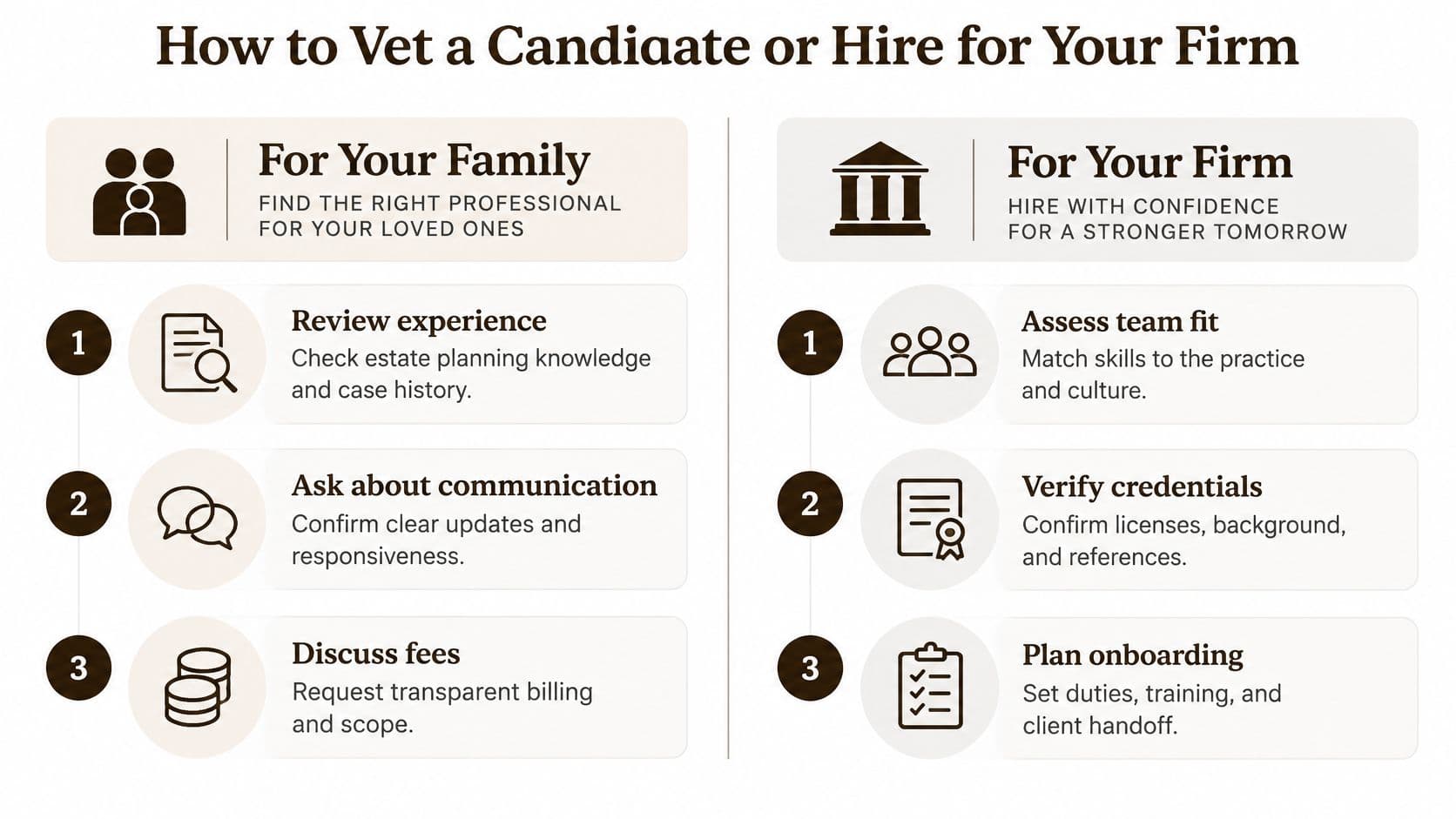
A Six-Step Vetting Checklist
- Verify bar standing: Check discipline history on your state bar's public records. Flag any discipline the candidate can't explain clearly.
- Ask practice share: Ask what share of the practice is trusts and estates. The WealthCounsel Industry Trends Report summary found that in 2024, 55% of surveyed trusts-and-estates professionals reported that most or all of their practice was dedicated to trusts and estates, so ask a generalist for recent estate matter counts.
- Request work product: Ask for a sample trust funding letter or fiduciary checklist with client details removed. Flag vague instructions or missing records.
- Use scenarios: Pose a blended family, a stepparent beneficiary or property in another state. Flag answers that ignore the governing state's law.
- Review the engagement letter: Check scope, conflicts and who will do the work. Flag unnamed staff or unclear supervision.
- Check references: Speak with two references from recent matters and ask about responsiveness, documentation and surprises on fees.
For structured interviews, consistent candidate screening questions keep comparisons fair across candidates. For a firm hire, first define must-have skills in drafting, tax, administration and client communication across generations. Don't score candidates against a role you haven't defined.
A strong candidate explains incapacity and caregiving choices in plain language, not just tax mechanics.
We're the right fit for a boutique or midsize law firm, or a company hiring in-house counsel, where our candidate network and placement record are concentrated. We may not be the right fit for an AmLaw firm, because we often place attorneys coming from AmLaw firms but rarely place into them. Ask any recruiter for its placement record in this practice area before signing.
How Estate Administration Works From Death to Distribution
The governing will or trust controls. The attorney's first job is confirming which document governs, because every later step depends on that answer.
California's Probate Code states that a fiduciary must administer a trust or decedent's estate in accordance with the governing trust or will, even when a different statutory provision exists. Counsel then reconciles those terms with mandatory duties, creditor rules, tax requirements, notice obligations and court procedures.
This flow shows the order that protects the fiduciary.
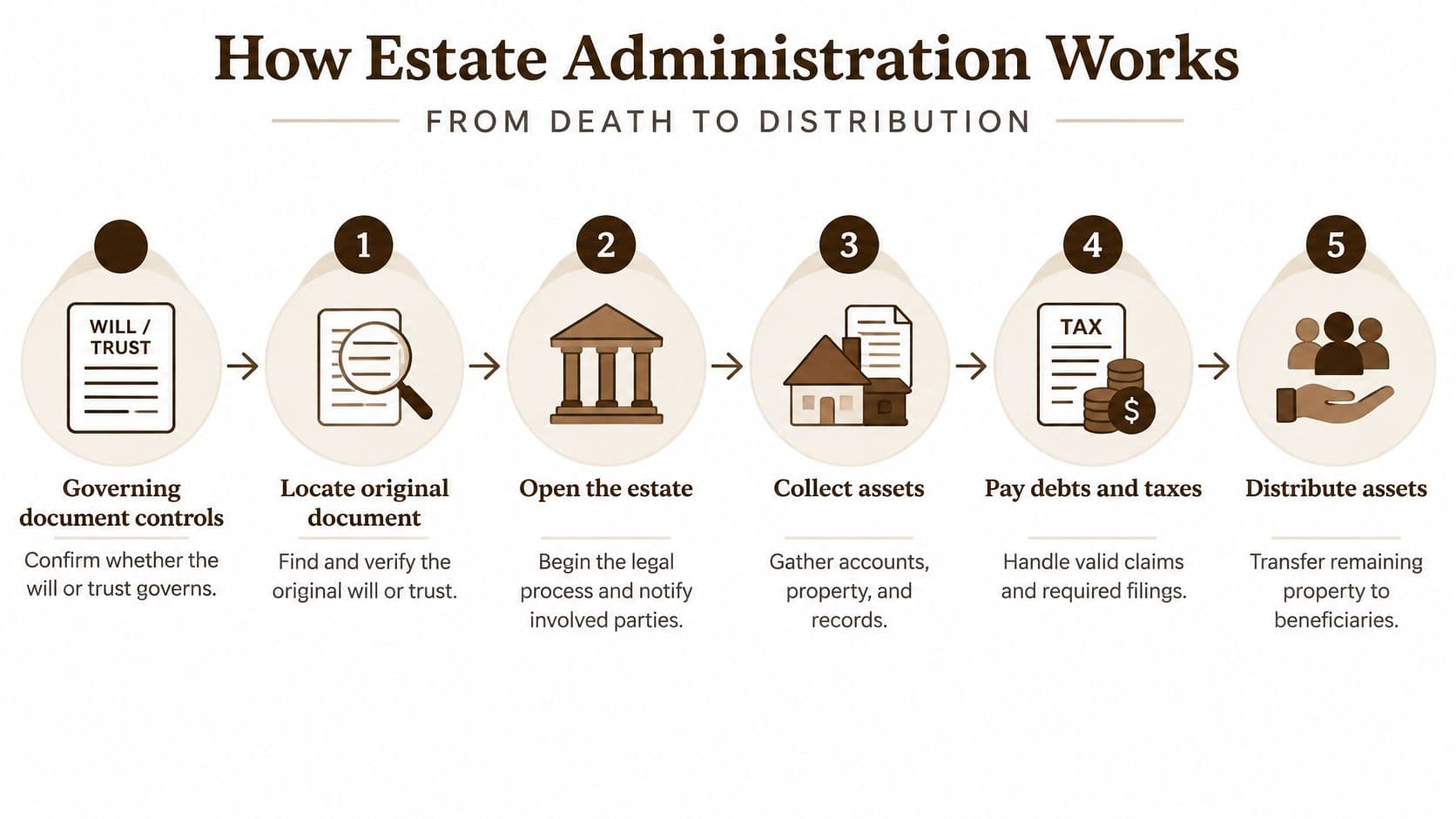
Seven Steps From Death to Distribution
- Locate and verify the original: Find the original will, trust and any amendments. Acting on the wrong document creates liability, so confirm signatures, dates and any later codicils.
- Open the estate and confirm authority: File with the court where probate is required and confirm who may act as executor or trustee. Don't move money before authority is clear.
- Marshal assets and record values: Collect bank and brokerage accounts, real estate, business interests and digital accounts, and record date-of-death values. List which digital accounts can transfer, check platform terms, store credentials securely and confirm what the executor can access, since private messages may be restricted and platform terms often override family expectations.
- Notify creditors: Give required notice and run the statutory claim period before paying claims. Missing a deadline or paying the wrong claim first can expose the fiduciary personally.
- Resolve taxes: Handle the final income tax return, any estate return and state requirements. Keep appraisals and gift records with the return file.
- Keep separate fiduciary accounting: Use a separate estate or trust account and document every transaction. Mixing personal and estate funds is a common, avoidable error.
- Distribute last: Distribute only after debts, taxes and disputes are settled, then collect receipts or releases. Paying a beneficiary early can force clawback litigation if money is later needed.
Because state probate codes differ, map domicile, real-property location, situs, governing law and ancillary-probate requirements for multistate estates. Administration can run long, so records must stay complete well beyond the first months. Finish with a practical test. Can you show a paper trail for every dollar that moved?
Common Client Questions Answered
Can I Write My Own Will
Yes, in many states you can. A self-drafted document becomes risky when you have minor children, blended-family ties or property in several states. Execution mistakes, unclear guardianship choices and stale beneficiary forms are where simple plans fail.
Does a Will Avoid Probate
Not by itself. A will typically guides probate rather than avoiding it. Assets held in a funded trust or passing by beneficiary designation typically avoid probate, while probate assets go through court.
How Long Does Probate Take
Trust & Will's 2024 Probate Study found that in 2024, probate took an average of 20 months to complete, although only 2% of survey respondents expected it to take that long. Plan cash flow for taxes, insurance and property upkeep during that delay. Don't promise beneficiaries a quick payout.
Who Can Be Executor or Trustee
Generally, an adult with legal capacity who isn't disqualified under state law can serve. Legal eligibility isn't the same as suitability. Don't choose someone who can't keep records, meet deadlines or stay neutral during family conflict.
Can an Online Will Replace an Attorney
It can work for a simple single-adult plan with modest assets and clear beneficiaries. It can't replace review of tax exposure, trust funding, guardianship, special-needs concerns or multistate property. If your situation needs judgment, software alone won't supply it.
Choose Your Next Step on Estate Planning or Hiring
Pick one track this week. Don't try to solve personal planning and a hiring search in the same meeting.
For personal planning, gather your existing will, trust, beneficiary designations and insurance policies. Write a one-page asset inventory. Include property in other states. Shortlist two or three attorneys whose practice matches your situation. Request a written fee estimate. Book a consultation. Keep notes on each answer so comparisons stay fair.
For hiring, define the role and practice mix first. Don't open the search until the role is defined. Use consistent candidate selection methods so each Wills Trusts Estates Attorney candidate is judged on drafting, tax, administration and communication.
Law firms and legal departments can schedule a call with us to discuss legal recruitment needs. Attorneys considering a move can browse current openings or tell us what they're looking for, and we'll contact them when a strong fit in our network opens up. We charge a contingent fee, with nothing due until the attorney starts.
If two or more situation rows match, start with a consultation. If you're hiring, define the role first.
If you need a trusts and estates attorney for your firm or you're an attorney weighing your next move, Five Star Placements can help you compare practice fit, credentials and role requirements before you commit. Visit us to discuss your hiring needs or explore current openings with a team focused only on legal placements.
Need help filling a legal role?
Five Star Placements partners with law firms and legal departments nationwide.
Schedule a Call