
Time to Fill in Recruitment: Legal Benchmarks and Fixes
November 1, 2026 · 12 min read · Five Star Placements

Table of contents
Time to fill in recruitment counts calendar days from the date a requisition opens to the date a candidate accepts the offer, and the 2025 nonexecutive median is 45 days, according to the SHRM Talent Access Report. That number surprises many firm leaders because interviews usually take only a small part of it. Approval, posting, conflicts checks, screening, feedback and offer authorization consume the rest, often before a strong candidate ever meets a partner.
Read the metric as a diagnostic. Split it by stage and role family, and each vacancy points to the step or team that owns the delay: a thin lateral market, a selective standard, or a hiring partner who has not returned feedback. That distinction determines the fix, and it stops you from pressuring interviewers to rush when the holdup sits in budget sign-off.
Table of Contents
- How to Calculate Time to Fill Step by Step
- Time-to-Fill Benchmarks for Legal Roles
- Where the Days Go in a Legal Search
- Why Legal Searches Run Longer Than Expected
- Process Fixes That Shorten Approval and Feedback
- Sourcing and Screening Moves That Cut Search Time
- Set a Time-to-Fill Target You Can Track
How to Calculate Time to Fill Step by Step
Time to fill counts calendar days from the date a requisition opens to the date a candidate accepts the offer.
Use one formula every time. Days to fill = date candidate accepts offer − date requisition opens. The SHRM Talent Access Report defines time-to-fill as a standardized recruiting metric that measures calendar days from the opening of a job requisition to the candidate's acceptance of an offer.
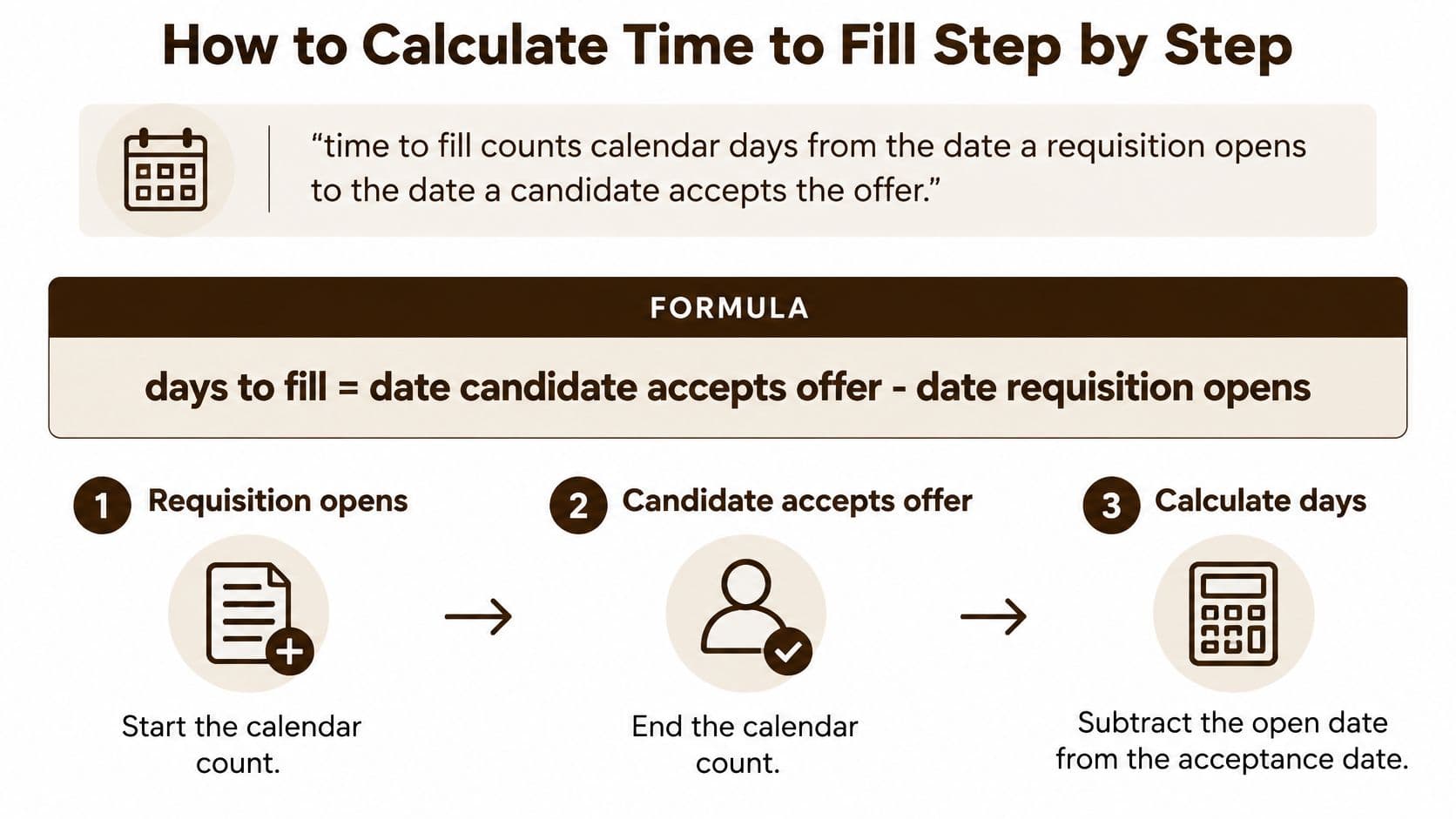
Four steps
-
Record the open date. Use the date the requisition is approved to open, not the date someone first mentions the role in a meeting. A vague start date makes every later comparison unreliable.
-
Record the acceptance date. Use the date the candidate signs the accepted offer. Don't use the start date, because notice periods would inflate a process you no longer control.
-
Subtract and count calendar days. Subtract the open date from the acceptance date, including weekends. For example, a partner requisition opened on March 3 with an offer accepted on April 14 gives 42 days.
-
Group results by role family. Repeat the calculation for each search and group partners, associates, in-house counsel and support staff separately. A single firm-wide average hides the searches that need attention.
Don't confuse it with time to hire
Time to hire starts only when a candidate enters the pipeline. Your firm can therefore show a short time to hire while time to fill stays long, if requisitions wait for approval or postings wait for a finished job description.
That's not a rounding issue. It's the difference between measuring candidate speed and measuring total vacancy duration.
By the end of this exercise you should have a dated log of open and acceptance dates for your last five searches. That log is enough to calculate a median, spot outliers and start asking which stage owns the delay.
Time-to-Fill Benchmarks for Legal Roles
A benchmark only helps when the comparison is fair. The figures below come from SHRM's 2021 and 2025 time-to-fill studies, which segment roles by seniority. No legal-sector median is published, so map each legal role to the closest row and treat the result as a reference point for your own role families.
| Benchmark | Median days | 25th percentile | 75th percentile |
|---|---|---|---|
| Nonexecutive roles, 2021 SHRM study | 44 | 28 | 73 |
| Executive roles, 2021 SHRM study | 60 | 30 | 90 |
| Nonexecutive roles, 2025 SHRM benchmark | 45 | 30 | 69 |
| Executive roles, 2025 SHRM benchmark | 60 | 30 | 90 |
How to read the table
Across both study years, executive searches cluster around a 60-day median while nonexecutive searches sit at 44 to 45 days. Read the 2025 executive row as a typical range of 30 to 90 days: half of such searches close inside that band and roughly a quarter run longer.
Use the executive row as your reference for partners, general counsel and legal operations leaders. Use the nonexecutive row for associates, paralegals, legal assistants and support staff. A lateral partner measured against the nonexecutive median will always look slow, and a paralegal measured against the executive row will always look fast. Both readings would send your diagnostic to the wrong stage.
Market-wide movement is context for your target, never a substitute for it. In SHRM's recruiter outlook for 2025, average time to fill fell from 48 days in 2023 to 41 days in 2024, a reduction of 7 days, or approximately 14.6%, while the interview-to-offer ratio remained relatively flat. A market average that improves by a week does not change what a partner search should take.
Why legal searches can sit above the average
Senior or specialized legal searches often exceed general medians for structural reasons: narrow qualifications, conflicts checks, compensation alignment and sign-off from multiple decision-makers. A conflicts flag on a lateral candidate can add days that no interview-scheduling fix will recover, so a well-run search can still land above the cross-industry median.
Practical rule: Compare each vacancy with its own role family, and treat the 75th percentile as the trigger for investigation.
If your associate searches repeatedly pass the nonexecutive 75th percentile, investigate the process before you blame candidate supply. If only one partner search does, look for role-specific causes such as book-of-business expectations or compensation approval.
Where the Days Go in a Legal Search
Time to fill isn't mainly an interview problem. The stage table below uses 2025 SHRM nonexecutive stage medians from the SHRM Talent Access benchmarking report for large organizations, which defines time-to-fill as calendar days from requisition opening to candidate offer acceptance.
| Stage | Median days | Typical cause of delay |
|---|---|---|
| Requisition approval | 7 | Budget and headcount sign-off |
| Job posting after approval | 2 | Drafting and approving the job description |
| Screening start after posting | 5 | Application queue and early review |
| Screening applicants | 5 | Resume and screening call backlog |
| Interviews | 7 | Scheduling and panel availability |
| Final decision and offer | 4 | Internal feedback and offer authorization |
| Offer acceptance | 2 | Negotiation and candidate notice periods |
Read each stage on its own
Stage medians aren't additive, so don't add them up and treat any gap to the 45-day nonexecutive median as handoff time. Each median comes from its own distribution. Report the total separately and judge each stage against its own benchmark.
For your last five searches, list the actual days for each stage beside this table. Circle the stage that runs longest compared with its benchmark. That stage, not the total, tells you who needs to change what.
Say requisition approval takes 20 days against a 7-day median. That search has lost about two weeks before any candidate is seen, and faster interviews can't recover it. The owner is whoever controls budget and headcount approval.
The stages firms underestimate
Final decision and offer acceptance look short in the table. They stretch quickly when several partners must sign off, compensation needs another conversation, or the candidate needs time to consider notice obligations.
Separate approval delay from candidate-cycle delay in your reporting. They have different owners, different causes and different fixes, and combining them lets both hide.
Why Legal Searches Run Longer Than Expected
Say a mid-size firm opens a corporate tax partner search, three partners interview, and the chosen candidate must give extended notice. That search can run about 90 days in a hypothetical timeline even if screening is fast. Nothing has gone wrong in sourcing. The structure of the decision creates the duration.
The image below reflects the unglamorous work behind that timeline, careful review before anyone reaches an interview room.

Five causes and their owners
-
Narrow candidate pool. A specific practice area, bar admission, jurisdiction or established book of business shrinks supply fast. The hiring partner owns the criteria, so broadening the search means changing a requirement, not asking for more resumes.
-
Conflicts checks. A candidate can't move forward until conflicts clear, and that review can take several days. Start it as early as confidentiality allows instead of waiting for final interviews.
-
Compensation and billing alignment. Partner compensation, origination credit and billing expectations often need group agreement or a vote. If those terms aren't settled before candidates appear, the offer stage absorbs the argument.
-
Several decision-makers. A managing partner, practice group leaders and a compensation committee may all need to agree. Each added approver adds scheduling risk, even when everyone supports the hire.
-
Notice periods. An accepted offer ends time to fill, but it doesn't put the lawyer in the seat. Plan client coverage and matter staffing for the gap between acceptance and start date.
The short video below is useful background on how these process pressures show up in day-to-day hiring decisions.
General hiring has become faster since 2023, so a long legal search stands out more clearly against the wider market. Diagnose each delay by asking whether the cause is scarcity, selectivity or internal approval. Scarcity needs a wider channel, selectivity needs a criteria decision, and approval needs a named owner with a deadline.
Process Fixes That Shorten Approval and Feedback
Fix the stages you control before you demand more candidates. These changes target waiting time, not screening standards, and they pair well with practical steps to hire lawyers faster without lowering the bar.
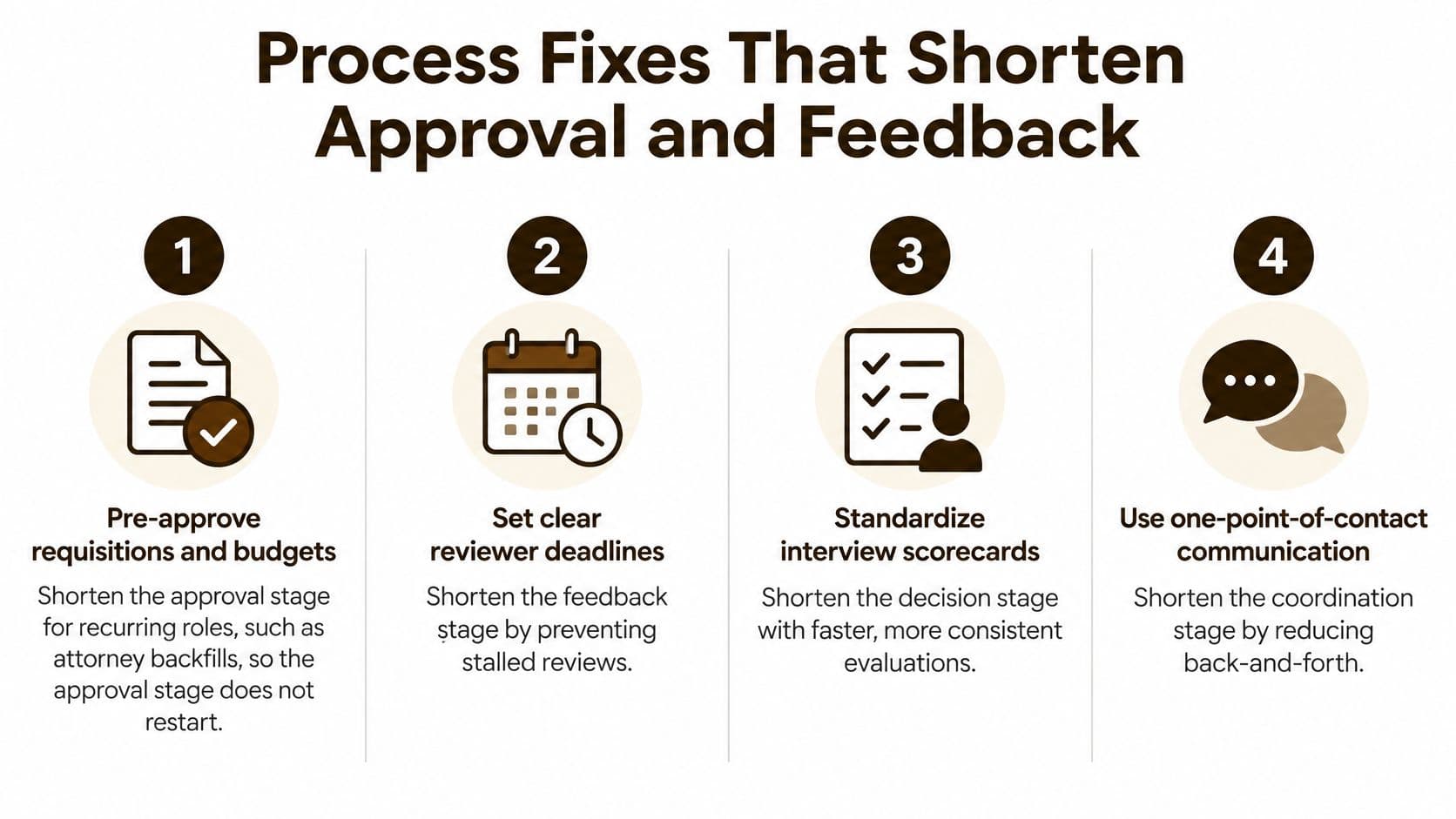
-
Pre-approve recurring requisitions [approval]. Set standing budgets for predictable backfills, such as associate or paralegal replacements. The approval stage shouldn't restart from zero every time a known role opens.
-
Set a feedback deadline [interviews]. Require panel feedback within 48 hours after each interview in this example process, and name who follows up when it's missed. A deadline without an owner is only a preference.
-
Align terms before presentation [decision]. Agree the compensation range, billing expectations, practice requirements and decision authority before the first candidate is presented. Candidates shouldn't discover that the firm is still debating the role.
-
Name one final decision-maker [decision]. Give each search a single person who can resolve disagreement and commit to a response time. Committees can advise, but one person must close.
-
Pre-approve offer parameters [offer]. Authorize a range in advance so a within-range offer doesn't wait for another meeting. Reserve committee review for exceptions.
-
Use structured panels and scorecards [interviews]. Fixed criteria make debriefs shorter because partners compare the same evidence. They also reduce repeat interviews held only to fill gaps in earlier notes.
For illustration, a firm that cuts approval from 20 days to 7 days by using a standing backfill budget removes nearly two weeks before sourcing begins. That's a cleaner gain than rushing final interviews.
Speed without a quality check creates expensive confidence. Track 90-day retention beside time to fill so faster hiring doesn't quietly increase mis-hires.
Run a 30-day test. Apply two changes to one role family, then compare its stage durations with the prior quarter before rolling them out firm-wide.
Sourcing and Screening Moves That Cut Search Time
Process fixes remove waiting. Sourcing and screening fixes remove wasted interviews. Compare the channels below and decide which one leads for each role family, using sound candidate selection methods rather than resume volume as your standard.
| Channel | Best use | Main constraint | Cost model |
|---|---|---|---|
| Direct outreach and alumni networks | Passive candidates by practice area and seniority | Needs owner time and a narrow pool | Internal time, no placement fee |
| Internal referrals | Known candidates with specific practice fit | Limited to existing contacts | Internal time, possible referral bonus |
| Skills-based screening | Early check on bar status, jurisdiction and matters handled | Criteria must be set before the role opens | Internal effort |
| Contingency search | Added channel running alongside internal posting | Slow channel does not hold the whole vacancy | Fee charged only when a hire is made |
Sourcing for a narrow pool
Specialized candidates often aren't applying. Reach them through direct outreach by practice area and seniority, internal referrals and alumni networks. Write to the individual lawyer's practice and matters, because a generic blast signals that you haven't read their profile.
Screening before interviews
Set must-have criteria before the role opens. Check bar status, jurisdiction, matters handled and genuine interest in the specific role during the first call. In a litigation search, confirming bar status and matter type up front removes unqualified candidates before partners spend interview time.
Ask any search partner for a vetting checklist you can review. Ours covers credentials, bar status, matters handled, fit and confirmed interest in the specific role, and every candidate we send has spoken with us on a call before the client sees them.
When to add a second channel
A contingency model charges only when a hire is made, so you can add a channel without upfront cost and run it beside internal posting. Set a trigger in advance. I would add a second channel after 15 days without a qualified shortlist, rather than waiting until the vacancy becomes urgent.
Set a Time-to-Fill Target You Can Track
A target only helps if it shows which stage owns the delay. Build it from your own searches first, then use outside numbers as a sanity check. As a broad reference only, 2025 Employ platform data cited by StaffingHub puts the average time from job posting to accepted offer at 63.5 days, which measures a different window from time to fill.
A seven-step routine
-
Choose three role families. Start with the families that drive most hiring, such as partners, associates and support staff.
-
Pull the last five searches in each family. Record open and acceptance dates for each one.
-
Calculate the median and 75th percentile. The median shows your typical result, while the 75th percentile shows the slow tail you need to shrink.
-
Compare against the benchmark table by role type. Match partners and general counsel to the executive reference and other roles to the nonexecutive reference.
-
Review searches above the 75th percentile by stage. Use the stage table to assign each delay to approval, sourcing, interviews, decision or offer.
-
Set one quarterly target. For example, reduce the 75th percentile by 10 days for one family. A narrow target is easier to own and verify.
-
Track 90-day retention alongside speed. Pair the metric with quality of hire measurement so a faster process still produces lawyers who stay and perform.
Keep the target narrow enough that one team can own it. If partner searches sit above the 75th percentile because offers wait for signoff, the fix belongs to the decision stage rather than sourcing.
Five Star Placements starts every search with a thirty-minute call about the role before the search starts, which gives both sides a defined start point and clear criteria. In 70% of searches, the first candidate is sent within two weeks, based on placement records since January 2025.
Bring your last five open and acceptance dates to that call so the conversation can start from your actual results. If a partner, associate or support vacancy is sitting open while approval, feedback or sourcing stalls, visit Five Star Placements to schedule a thirty-minute call about the role and set a time-to-fill target based on your own recent searches.
Need help filling a legal role?
Five Star Placements partners with law firms and legal departments nationwide.
Schedule a Call