
10 Interview Coaching Tips for Legal Candidates
October 4, 2026 · 20 min read · Five Star Placements
Table of contents
A qualified legal candidate can walk into an interview with strong experience and still struggle to explain why that experience matters. An associate may describe the matters they handled without showing judgment, a paralegal may list software skills without connecting them to accuracy and client service, or an in-house counsel candidate may discuss legal analysis without explaining how it supported a business decision. The resume got you into the room. It won't make the case for you.
Effective interview coaching tips should follow the full legal interview journey, from positioning your background and researching fit to answering difficult questions, presenting yourself professionally, and creating a clear next step. The system below focuses on structured examples, role-specific preparation, credible delivery, and disciplined follow-up. Candidates who want individualized support can also explore a legal recruiting firm such as Five Star Placements, which provides interview coaching aligned with law firm and corporate legal department processes.
Table of Contents
- 1. Master the STAR Method for Behavioral Questions
- 2. Research the Firm or Corporate Legal Department Thoroughly
- 3. Prepare Thoughtful Questions That Demonstrate Strategic Thinking
- 4. Practice Answering Challenge and Failure Questions
- 5. Develop a Compelling 30-Second Personal Elevator Pitch
- 6. Prepare Specific Examples of Client or Stakeholder Management Success
- 7. Understand and Articulate Your Compensation Expectations Confidently
- 8. Master Body Language, Tone, and Non-Verbal Communication
- 9. Develop Authentic Responses About Motivation and Career Goals
- 10. Plan Interview Logistics and Follow-Up
- 10-Point Interview Coaching Comparison
- Convert Preparation Into a Confident Next Step
1. Master the STAR Method for Behavioral Questions
Behavioral questions ask what you did in a difficult or important situation. The STAR framework, Situation, Task, Action, and Result, gives your answer a clear legal narrative. It keeps you from reciting a case summary and helps the interviewer understand your judgment, ownership, and contribution.
Prepare five to seven stories that cover different competencies relevant to the role. An associate might explain how they organized discovery in a complex commercial dispute, while a paralegal could describe supporting a new case management process and improving document accuracy. In-house counsel should prepare an example involving contract risk, business collaboration, or a time-sensitive transaction. A legal operations candidate might discuss redesigning billing workflows or leading a technology implementation.
Build stories that show your individual judgment
Keep each story focused on your own actions, even when the work involved a large team. Explain the context briefly, identify the responsibility you carried, describe the decisions you made, and close with the outcome or lesson. If the result isn't measurable, describe the practical effect, such as a clearer process, a resolved client concern, or a matter that stayed on track.
Research from Adobe on interview preparation found that company and role research produced a 17% greater confidence lift than practicing answers aloud. Use that insight to tailor every story to the employer's needs rather than memorizing generic responses.

Practical rule: Practice the structure, not a script. Interviewers should hear clear thinking, not a speech you memorized word for word.
For more targeted preparation, review interview coaching for lawyers, especially if you need feedback on story selection, answer structure, or delivery.
2. Research the Firm or Corporate Legal Department Thoroughly
A legal interview is not a generic conversation about your career. It's an assessment of whether your experience fits the organization's clients, matters, working style, and current direction. Research should therefore go beyond the employer's homepage.
For a law firm, review practice areas, leadership biographies, recent lateral hires, notable client work, office locations, and public announcements about expansion or new capabilities. Look at legal directories, professional publications, LinkedIn, and recent news coverage. For a corporate legal department, study the company's business model, industry pressures, regulatory environment, leadership structure, investor materials, and recent transactions or legal developments.
Turn research into interview evidence
Your research matters only when it changes what you say. An environmental attorney could explain why a firm's expanding regulatory practice is relevant to their background. A paralegal might ask which case management system the firm uses and connect that question to previous experience with litigation technology. An in-house counsel candidate should be ready to explain how their contract, compliance, or employment experience relates to the company's commercial priorities.
Don't mention every negative item you find during research. Use public information to decide whether the opportunity fits and to prepare thoughtful questions, not to ambush the interviewer. You should sound informed and curious, not as if you're delivering an investigative report.
Create a one-page research sheet with:
- Business context: What does the firm or company sell, defend, advise on, or manage?
- Legal priorities: Which practice areas, transactions, risks, or operational needs appear most important?
- Decision-makers: Who will interview you, and what does their background suggest about their priorities?
- Your connection: Which two or three parts of your experience directly address those priorities?
The strongest candidates don't say they're interested in the organization because it has a good reputation. They explain what they learned, why it matters to their practice, and how they could contribute.
3. Prepare Thoughtful Questions That Demonstrate Strategic Thinking
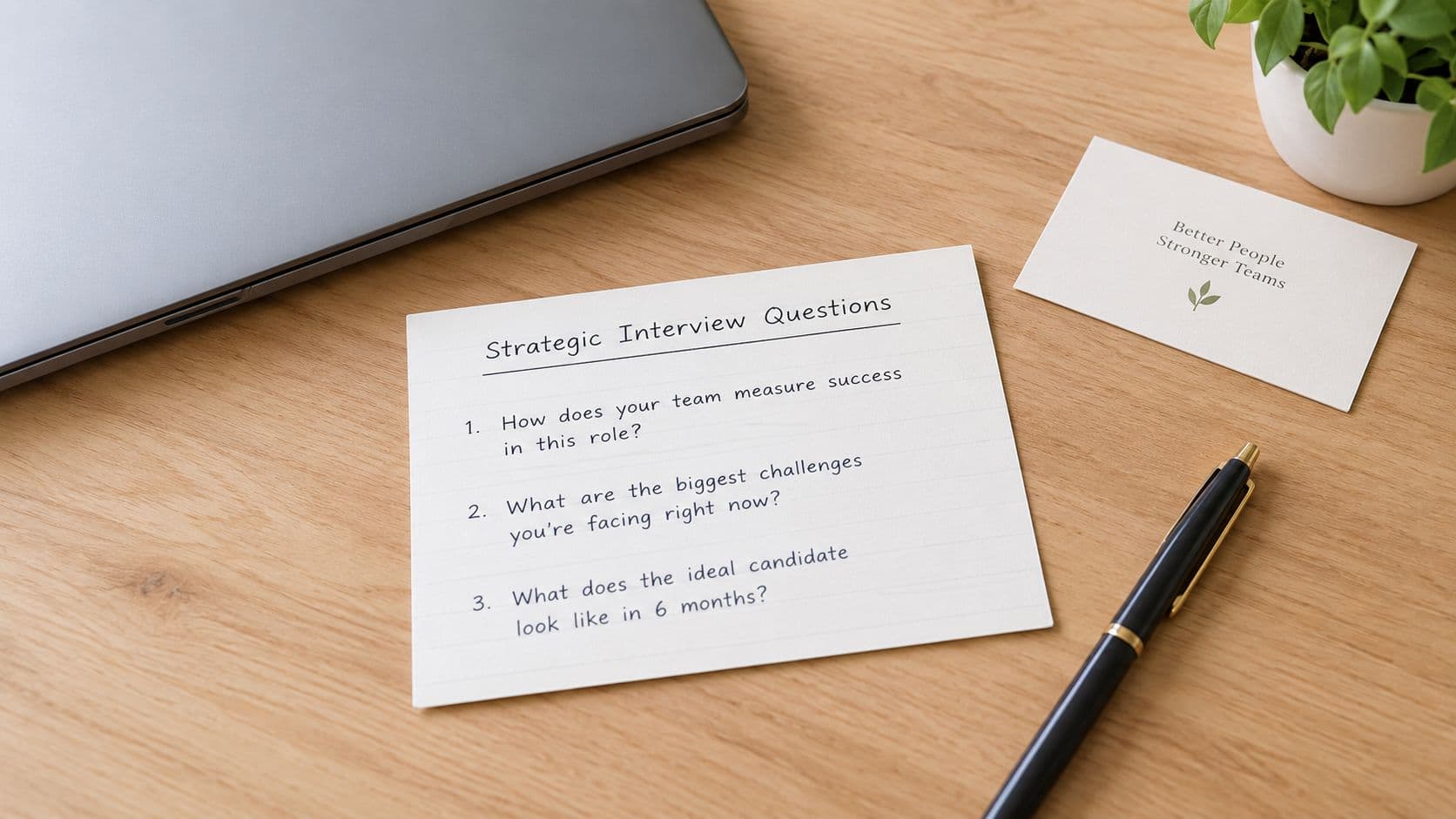
The questions you ask reveal how you think about legal work. A candidate who asks only about vacation and remote work may appear focused on terms before understanding the role. A candidate who asks how the team measures success, serves clients, or handles growth signals a broader professional perspective.
Prepare two or three questions for each interview, then listen closely enough to adapt them. An associate might ask how junior lawyers develop client relationships. A partner candidate could ask how recent lateral partners have integrated into the firm. A paralegal may want to understand the team's case management tools and workflow expectations. A legal operations professional should ask which operational problems require attention first.
Match the question to the role
For in-house counsel, ask how the legal department works with commercial leadership and when legal becomes involved in transactions. For support staff, ask how attorneys communicate priorities, how urgent matters are triaged, and what accurate work looks like in the first months. For legal operations candidates, ask how the organization evaluates technology investments, billing performance, staffing, or process improvement.
Independent interview research cited by QCard AI's interview coaching guidance found that 84% of interviewers said thoughtful, role-specific questions demonstrate engagement and interest. The same source reported that 81% of candidates who received offers had asked at least one meaningful question. Those findings support a simple coaching priority, prepare questions before the interview and treat them as part of your evidence of fit.
Avoid questions answered clearly on the employer's website. Better questions explore the gap between public information and day-to-day work:
- Success expectations: What would make someone in this role successful after the first year?
- Current pressure points: Which challenges are consuming the team's attention now?
- Working relationships: How do attorneys, business leaders, and support professionals divide responsibility?
- Future direction: Where is the practice or department investing its energy?
You can find additional role-specific prompts in this guide to in-house lawyer interview questions.
4. Practice Answering Challenge and Failure Questions
Questions about failure test more than your ability to confess a mistake. Legal employers want to understand how you respond when a deadline moves, a client disagrees with your recommendation, a process breaks, or a matter develops in an unexpected direction.
Choose a genuine example that demonstrates accountability without creating an ethical or competence concern. An associate might discuss a missed internal deadline and the tracking system they adopted afterward. A paralegal could explain how they identified an error in a filing package, corrected it, and improved the review process. In-house counsel might describe a contract negotiation that stalled because stakeholders had different assumptions, then explain how they changed their intake and communication process.
Own the lesson without oversharing
Use STAR, but give the Action section enough space to explain what you did after the problem emerged. Don't blame a former supervisor, client, opposing counsel, or inadequate technology. You can describe the surrounding circumstances, but the answer should focus on what you controlled.
A 2020 survey of 2,018 Americans found that 93% had experienced interview anxiety, while 70% practiced answers aloud and 62% prepared anecdotes in advance, according to JDP's interview preparation research. Rehearsal matters because an honest answer can become defensive or overly detailed when nerves take over.
Prepare two or three examples so you aren't forced to use the same story for every difficult question. Avoid the artificial weakness, such as saying you care too much or work too hard. A more credible answer identifies a manageable professional limitation and shows the concrete adjustment you made.
“That experience changed how I manage competing deadlines. I now confirm dependencies earlier, document ownership, and escalate conflicts before they become urgent.”
The goal isn't to make failure sound positive. The goal is to show mature judgment, learning, and reliable behavior after a setback.
5. Develop a Compelling 30-Second Personal Elevator Pitch
“Tell me about yourself” is often the first opportunity to establish your professional identity. Don't answer by reading your resume from law school forward. Give the interviewer a concise explanation of what you do well, where you've built that capability, and why this opportunity makes sense.
A litigation associate could say:
“I'm a commercial litigation associate whose work has centered on discovery strategy, motion practice, and client communication. I'm strongest when a matter has complex facts and multiple deadlines because I can organize the work while keeping the client informed. I'm interested in this role because it would let me deepen that practice in a team with significant business litigation experience.”
An in-house counsel candidate should connect legal work to business decisions. A paralegal can emphasize matter organization, filing accuracy, client communication, and technology fluency. A legal operations candidate should describe the processes, systems, and teams they help improve.
Make the pitch sound like you
Write two or three versions for different opportunities, then practice until the delivery feels conversational. Include your title or professional focus, relevant experience, one or two strengths, and a specific reason the role interests you. Don't overload the opening with technical terms or every accomplishment you have ever earned.
Your pitch should also reflect seniority. A partner needs to communicate practice leadership, client relationships, and business development in a credible way. A legal assistant or case manager should focus on responsiveness, organization, judgment, and the ability to make attorneys' work easier. A legal operations leader should show how they translate business needs into repeatable processes.
End with the opportunity, not a vague desire to grow. “I'm excited about helping this department build a more consistent contract process” is stronger than “I'm looking for a new challenge.”
6. Prepare Specific Examples of Client or Stakeholder Management Success
Legal employers rarely hire only for technical knowledge. They need people who can communicate with clients, partners, business leaders, witnesses, vendors, opposing counsel, and colleagues without losing clarity or composure. Saying you're a strong communicator isn't enough. Bring evidence.
An associate might describe how they translated a complex litigation risk into clear options for a client contact. A partner should be ready to explain how they retained trust during disagreement over strategy or developed a new client relationship. In-house counsel needs examples of influencing non-lawyers while protecting the business from avoidable risk.
Show the relationship and the work
Paralegals and legal support professionals can use examples involving realistic timelines, difficult information requests, document coordination, or communication with anxious clients. Explain how you set expectations, escalated issues, or made the attorney's work more efficient. A legal operations candidate might discuss gaining adoption for a new billing or matter-management process across teams with competing preferences.
Strong examples usually contain four elements:
- The stakeholder's need: What did the client, attorney, department, or business leader need from you?
- The tension: What made the situation difficult, urgent, or sensitive?
- Your communication: How did you explain options, manage expectations, or resolve disagreement?
- The outcome: What changed for the relationship, matter, process, or decision?
Give credit to the team while making your contribution clear. “We handled the client escalation” hides your role. “I prepared the decision summary, clarified the timeline with the client, and coordinated the attorney's response” shows exactly how you added value.
Avoid claiming that every stakeholder was delighted. Credibility improves when you describe a realistic resolution, such as a client accepting a revised timeline, a business leader choosing a lower-risk option, or an attorney receiving the information needed to make a decision.
7. Understand and Articulate Your Compensation Expectations Confidently
Compensation conversations become easier when you separate preparation from negotiation. Before the interview, research the role, practice area, seniority, geographic market, organization size, and total compensation structure. Don't assume that a lawyer, paralegal, legal assistant, and legal operations professional should evaluate an offer in the same way.
If the question comes early, you can ask what range the employer has budgeted and explain that your expectations depend on the full scope of the role. If the interviewer presses you, provide a considered range or target grounded in your experience and the overall package. Avoid choosing a number impulsively because you feel nervous.
Discuss the whole package
For a partner, compensation may involve base pay, profit participation, origination credit, collections expectations, and transition support. For in-house counsel, consider bonus structure, equity where applicable, benefits, reporting level, flexibility, and scope of decision-making. Support professionals should evaluate workload, overtime practices, advancement, supervision, and the stability of the team alongside base compensation.
Use your preparation to set boundaries rather than to create a rigid script. You might say, “I'm most focused on a role where I can support complex commercial work and work closely with the business. I'm flexible within a reasonable range, depending on the total package and expectations.”
Review average lawyer starting salary information as one part of your research, then compare the information with the actual role and market. Don't negotiate against yourself in the first conversation. Once you receive a formal offer, ask for the terms in writing and evaluate the trade-offs calmly.
8. Master Body Language, Tone, and Non-Verbal Communication
An interviewer's impression forms through your complete presentation, not only your legal answers. A candidate who gives strong analysis while speaking too quickly, avoiding eye contact, or appearing closed off may leave the interviewer uncertain about client readiness or team fit.
Practice on video and review the recording without judging every movement. Look for rushed answers, repetitive filler words, a flat tone, or a tendency to look away when discussing an accomplishment. The purpose isn't to create artificial polish. It's to remove habits that obscure your actual judgment and experience.

Adjust for the interview format
In person, arrive early enough to settle yourself, silence your phone, and enter with a professional greeting. Sit upright, keep your posture open, and use natural eye contact while speaking and listening. You don't need to maintain constant eye contact. A thoughtful pause is better than filling every silence with “um” or “like.”
For video interviews, test the camera, lighting, microphone, background, and connection in advance. Look at the camera when answering so your attention feels direct, then look at the screen while listening. For a phone interview, sit upright and smile when appropriate because posture and expression influence vocal energy even when the interviewer can't see you.
The 2025 hiring environment increasingly includes structured and AI-assisted screening, according to Acedit's discussion of AI interview practice trends. That makes clear speech, organized answers, and natural delivery even more important in recorded or time-limited formats.
Use this interview communication video as a prompt for reviewing your own presence, then practice answering without sounding memorized.
9. Develop Authentic Responses About Motivation and Career Goals
Hiring partners want to know why you chose this role, not just why you want to leave your current one. Generic answers about growth, teamwork, or professional development don't explain why this firm or department deserves your commitment.
Your answer should connect three points: the work you want to do, the environment where you do your best work, and the specific reason this opportunity fits. An environmental associate might discuss the employer's regulatory practice and their interest in deepening that work. An in-house counsel candidate could explain a desire to engage with commercial teams earlier in the decision process. A paralegal might be drawn to a litigation team where organization and client contact are central to the role.
Be candid about what you need
Authenticity doesn't mean disclosing every frustration from your current job. It means giving a truthful explanation that is relevant to the opportunity. If sustainability matters, describe it as a condition that supports consistent contribution. If mentorship matters, ask how attorneys receive feedback and demonstrate that you've considered the role's actual development path.
Career goals should be realistic for the position. A junior candidate can discuss building technical depth and taking on more responsibility. A partner should explain the practice, client, and team they intend to build. A legal operations leader should connect their goals to process maturity, technology adoption, financial performance, or organizational scale.
Don't promise indefinite loyalty or pretend that compensation has no relevance. Explain what makes the role attractive and what you hope to contribute. Employers respond better to a specific professional direction than to exaggerated enthusiasm.
10. Plan Interview Logistics and Follow-Up
Small logistical failures can distract from a strong interview. Confirm the time, location or video link, participants, format, and requested materials in advance. For an on-site meeting, plan the route and allow enough time to handle delays. For a video interview, test the camera, microphone, lighting, background, and backup contact method.
Bring or prepare what the employer requested, including a resume, references, writing sample, deal sheet, or work product where appropriate. Attorneys should check that any writing sample protects confidentiality and complies with instructions. Legal support candidates should have a clear explanation of the systems and workflows they've used. Legal operations candidates may need to discuss implementation documents, process maps, or metrics without disclosing confidential information.
Follow up with substance
Send a concise thank-you email within 24 hours that references a specific discussion point and reinforces one relevant qualification. A candidate for an in-house role might mention the department's need to partner with procurement. A paralegal could refer to the firm's litigation workflow and explain how their case organization experience fits. If you promised references or additional materials, send them promptly.
If the interviewer gave a decision timeline and it passes without an update, send a brief status inquiry. Don't send repeated messages without new information. A professional follow-up keeps your interest visible while respecting the hiring team's process.
Follow-up formula: Thank the interviewer, mention a specific topic, connect your experience to that priority, and state that you remain interested in the role.
The interview continues after you leave the room. Scheduling staff, recruiters, attorneys, and department leaders all notice whether you communicate clearly and handle details responsibly.
10-Point Interview Coaching Comparison
| Item | Implementation Complexity 🔄 | Resource Requirements ⚡ | Expected Outcomes ⭐📊 | Ideal Use Cases 💡 | Key Advantages |
|---|---|---|---|---|---|
| Master the STAR Method for Behavioral Questions | Moderate, structured framework to learn and apply | Moderate time (prepare 5–7 stories; practice 2–5 hrs) | High, concise, measurable answers that demonstrate competency ⭐📊 | Behavioral/competency interviews across all seniority levels | Produces memorable, organized responses; reduces rambling |
| Research the Firm or Corporate Legal Department Thoroughly | High, multi-source, targeted investigation 🔄 | Significant time (2–4+ hrs) and access to industry sources ⚡ | High, tailored answers and better fit assessment ⭐📊 | Tailoring applications, preparing questions, assessing culture | Demonstrates genuine interest; uncovers alignment or risks |
| Prepare Thoughtful Questions That Demonstrate Strategic Thinking | Low–Moderate, craft and tailor 2–3 strategic questions | Low time (30–90 mins) plus firm research ⚡ | High, signals business acumen and long-term fit ⭐📊 | Mid/late-stage interviews, senior or partnership-track roles | Turns interview into two-way evaluation; impresses senior interviewers |
| Practice Answering "Tell Me About a Challenge/Failure" Questions | Moderate, requires honest reflection and framing 🔄 | Moderate time to select 2–3 examples and rehearse ⚡ | Medium–High, shows resilience, accountability, and growth ⭐📊 | Behavioral questions assessing maturity and leadership potential | Builds trust through authentic, constructive responses |
| Develop a Compelling 30-Second Personal Elevator Pitch | Low, craft concise, tailored script | Low (1–2 hrs to write and rehearse) ⚡ | High, strong first impression and clear framing ⭐📊 | Openings, networking, "Tell me about yourself" prompts | Controls narrative; communicates value quickly and clearly |
| Prepare Specific Examples of Client or Stakeholder Management Success | Moderate, prepare discreet, quantified examples 🔄 | Moderate time; may require metric collection and redaction ⚡ | High, differentiates candidates on revenue/relationship impact ⭐📊 | Client-facing roles, business development, partnership track | Demonstrates relationship management and commercial awareness |
| Understand and Articulate Your Compensation Expectations Confidently | Moderate, market research and negotiation strategy 🔄 | Moderate time (survey sources, recruiter input) ⚡ | Medium–High, better offers and realistic negotiation outcomes ⭐📊 | Offer stage, screening calls, senior hires with complex comp | Signals maturity; enables strategic, data-driven negotiation |
| Master Body Language, Tone, and Non‑Verbal Communication | Moderate, practice and self-monitoring required 🔄 | Moderate (mock interviews, recordings, coaching) ⚡ | High, improves perceived confidence and persuasiveness ⭐📊 | All interviews, especially client-facing and senior roles | Enhances credibility and rapport beyond verbal content |
| Develop Authentic Responses About Motivation and Career Goals | Low–Moderate, self-reflection and tailoring | Low time to reflect and align with firm (30–90 mins) ⚡ | High, signals fit and retention potential ⭐📊 | "Why us?" questions, cultural-fit assessments | Builds trust through specificity and alignment with role |
| Plan Interview Logistics and Follow‑Up | Low, checklist-based preparation | Low (confirm details, test tech, write thank-you notes) ⚡ | Medium, avoids administrative errors and keeps you top-of-mind ⭐📊 | All interview formats (video, phone, onsite, travel) | Demonstrates professionalism and timely responsiveness |
Convert Preparation Into a Confident Next Step
Interview preparation works best when it becomes a role-specific working document rather than a collection of motivational phrases. Before the interview, create a preparation sheet that you can review quickly without reading from it during the conversation. Keep it focused on evidence, fit, and the decisions you want the interviewer to make about you.
Start with a concise personal pitch. It should identify your legal function, strongest capabilities, and reason for pursuing the opportunity. Then prepare five to seven STAR stories across the competencies the employer is likely to value. Attorneys should include examples involving legal judgment, client service, matter strategy, collaboration, and pressure. Paralegals and legal support professionals should emphasize accuracy, organization, responsiveness, technology, and communication. Legal operations candidates should show process ownership, stakeholder management, implementation judgment, and business awareness.
Add research notes that connect the employer's work to your background. A law firm candidate might record practice priorities, leadership observations, client industries, and recent growth signals. An in-house candidate should note the company's business model, regulatory environment, and relationship between legal and commercial teams. Keep the notes short enough to use before the interview, and turn each important observation into a possible answer or question.
Your sheet should also include two or three strategic questions. Choose questions that reveal how the team works, how success is evaluated, and which challenges the new hire will address. Listen during the interview and adjust your questions rather than asking them mechanically. The best question is often a follow-up to something the interviewer has just explained.
Set compensation boundaries before anyone asks. Know which aspects are essential, where you have flexibility, and what information you still need about the total package. This preparation helps you avoid either accepting terms too quickly or making an unsupported demand. Compensation should reflect the actual role, your experience, and the value you can credibly demonstrate.
Finally, complete the practical details. Confirm the format, test technology, prepare materials, plan travel, and decide when you'll send your follow-up. These actions may seem minor, but they protect the time you invested in preparing your stories and research.
Don't imimate another legal role during the interview. An attorney doesn't need to answer like a legal operations executive, and a paralegal shouldn't try to claim strategic authority that belongs to the supervising attorney. Show the value of the work you perform, explain how you make other people more effective, and connect your experience to the employer's needs.
Candidates who want individualized preparation can explore Five Star Placements' candidate interview coaching and legal placement services. The firm provides permanent placement for attorneys, partners, in-house counsel, legal support professionals, and legal operations leaders, with coaching and training aligned to law firm and corporate legal department processes.
The purpose of interview coaching isn't to make every candidate sound the same. It's to help you communicate your own experience with enough structure, relevance, and confidence that the interviewer can evaluate it fairly. Prepare the evidence, understand the audience, practice the delivery, and leave the conversation with a clear professional next step.
Five Star Placements offers candidate interview coaching and permanent legal placement support for attorneys, paralegals, legal support professionals, in-house counsel, partners, and legal operations leaders. If you want role-specific preparation aligned with law firm or corporate legal hiring, visit Five Star Placements to explore the available services.
Need help filling a legal role?
Five Star Placements partners with law firms and legal departments nationwide.
Schedule a Call