
How Much Do Paralegals Make in Texas? 2026 Salary Guide
July 22, 2026 · 13 min read · Five Star Placements

Table of contents
How much do paralegals make in Texas? A realistic 2026 midpoint is about $63,240 a year, and the market stretches from roughly $41,000 on the low end to more than $96,000 at the top. That spread matters because Texas doesn't have one paralegal salary, it has several, depending on city, practice area, and employer type.
Texas is one of the biggest legal support markets in the country, so the salary question isn't just about one paycheck. It's about where you sit in a broad labor pool, how specialized your work is, and whether you're evaluating base pay or the full value of an offer. For paralegals, that difference can be material. For hiring managers, it's the difference between posting a role that attracts qualified candidates and posting one that sits open.
Table of Contents
- The Texas Paralegal Salary Market in 2026
- How Location Shapes Your Paycheck a City-by-City Breakdown
- Key Factors That Drive Paralegal Compensation
- Comparing Employer Types Law Firm vs Corporate vs Government
- Beyond the Base Salary Understanding Total Compensation
- Practical Salary Negotiation Strategies for Texas Paralegals
- Navigating the Texas Market Insights for Candidates and Employers
The Texas Paralegal Salary Market in 2026
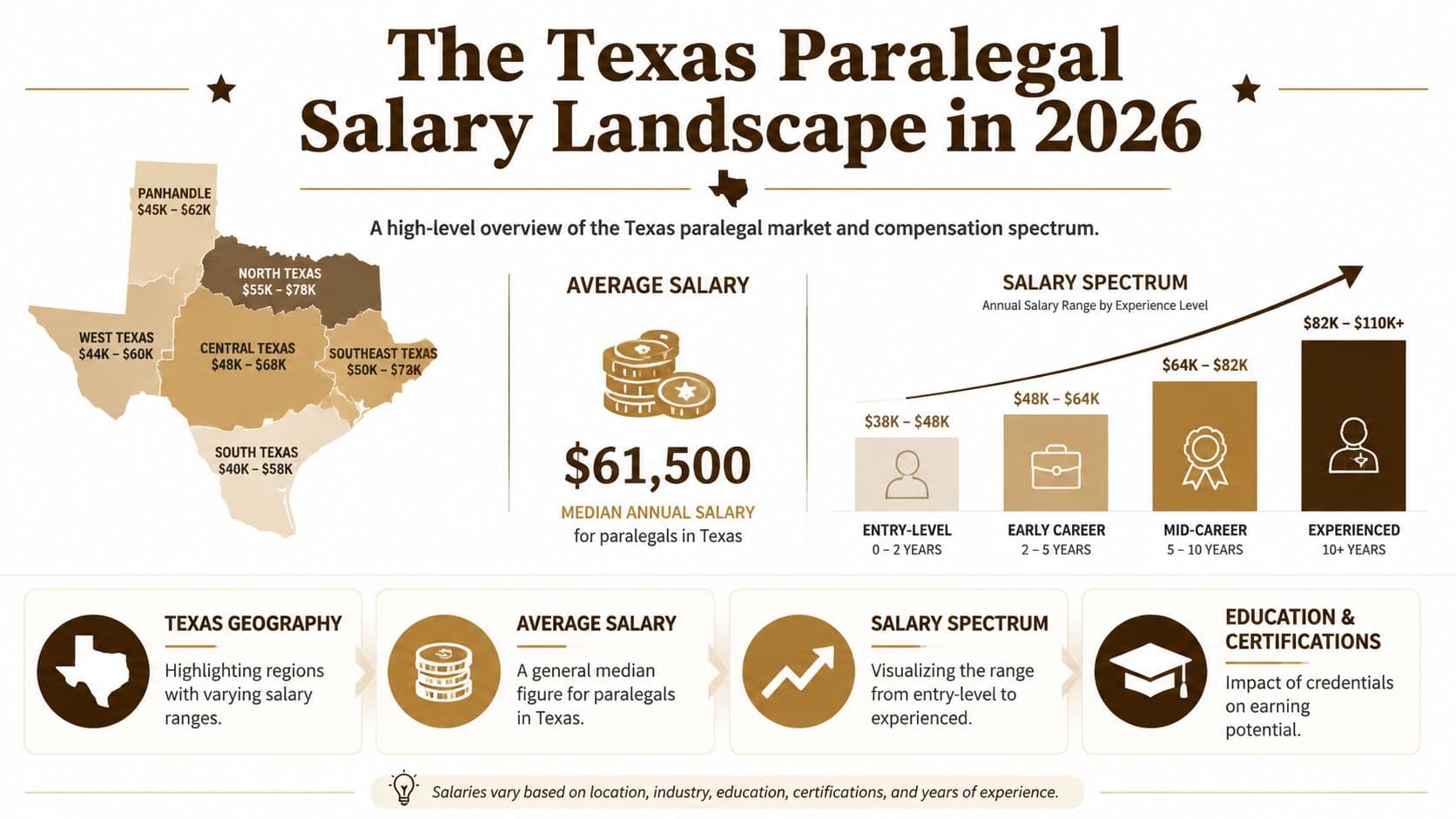
Texas is not one uniform pay scale. BLS-based Texas summaries place the median annual wage at $59,700, with median hourly pay at $29, while one Texas-focused salary source puts the 2026 median at $63,240, about 2% above the U.S. median of $62,000 Texas salary benchmark. That difference is small on paper, but it changes how hiring managers should frame offers and how candidates should evaluate them.
The spread is wide enough to shape real career decisions. Lower-end roles can start around $37,850 to $41,106, while experienced or top-market positions reach roughly $96,530 to $104,346 annually Texas salary benchmark. That range points to a simple market reality. Employers do not price every paralegal the same way, and title alone does not explain compensation. The work, specialization, and setting do.
Texas also has scale. The state has an estimated 28,140 paralegal and legal assistant jobs, which keeps it among the country's largest legal support labor markets Texas salary benchmark. For candidates, that means more openings and more variation from one employer to the next. For law firms and corporate legal departments, it means pay has to be competitive enough to hold attention in a market with many alternatives.
For paralegals, the practical question is whether a salary matches the work, not just the title. A figure near the state median may fit a generalist position, but it can fall short for someone bringing litigation support, in-house experience, or another specialized skill set. Hiring managers should use the role's demands as the benchmark, not a broad statewide average.
Practical rule: benchmark the role you're hiring for, not the average paralegal role. The more specialized the workload, the less useful a single statewide midpoint becomes.
Recruiters who track Texas legal hiring see the same pattern in practice. Compensation moves with practice area, employer type, and metro demand, which is why Five Star Placements' legal hiring insights are useful for firms setting pay and candidates comparing offers.
How Location Shapes Your Paycheck a City-by-City Breakdown
Geography is one of the clearest reasons Texas paralegal pay looks so uneven. The state's major legal markets don't just differ in cost of living, they differ in client mix, employer concentration, and the kinds of matters that need support staff. That's why a candidate in one metro can see a very different offer than a similarly experienced peer elsewhere.
| Metro Area | Median Annual Salary | Typical Salary Range |
|---|---|---|
| Dallas-Fort Worth | Higher than the statewide midpoint | Broad, with stronger upside in large firms and corporate settings |
| Houston | Higher than the statewide midpoint | Broad, especially where litigation and complex commercial work are common |
| Austin | Higher than the statewide midpoint | Broad, with competition influenced by corporate and technology-adjacent legal work |
| San Antonio | Closer to the statewide midpoint | Broad, with more variation by practice area and employer size |
Dallas-Fort Worth and Houston usually reward breadth and intensity. Those markets support large law firms, heavy litigation practices, and corporate legal teams that need paralegals who can move quickly across document production, deadlines, and client-facing coordination. Austin's legal hiring often leans into business and technology-adjacent work, which tends to value strong process skills and adaptability. San Antonio remains important, but its pay patterns are often less aggressive than the largest metros, especially outside highly specialized practices.
The point isn't that one city is always best. It's that salary follows legal demand, and legal demand is shaped by the matters being worked, not just by office zip code. A candidate with experience in complex litigation or corporate support should look at metro concentration as much as base pay. A firm making an offer should expect competition from other employers in that same local market, not just from statewide averages.
Market insight: if a job description requires fast turnaround, high-volume drafting, and direct support for attorneys handling sophisticated matters, the offer usually has to move above a generic statewide benchmark.
Key Factors That Drive Paralegal Compensation
Compensation in Texas is shaped by more than title alone. Experience, specialization, skills, and location all affect pay in different ways, but employers do not weigh them equally in every office. Hiring managers usually start with reliability, then price speed, then pay more for niche knowledge that reduces attorney oversight. That is why two paralegals with the same title can receive very different offers.
Experience changes the pricing band
Texas pay data shows a market with clear tiers. One broader estimate places average Texas paralegal pay at $55,648, with the middle 50% between $44,700 and $63,800 and the 90th percentile at $74,532 Texas salary distribution. Another benchmark puts a Texas Paralegal I at $68,319 on average, with a typical range of $60,754 to $77,267 Texas Paralegal I benchmark. Read together, those figures show that early-career roles and more structured positions can sit in different pay bands, even before practice area enters the picture.
For candidates, that means tenure matters, but only within context. A paralegal who has repeated the same support tasks for years may not price the same way as someone who has taken on broader case ownership, faster drafting, or more attorney-facing responsibility. For employers, the implication is direct. If the role requires less supervision and faster turnaround, the offer should reflect that added value rather than rely on a generic title match.
Specialization matters more than title
Texas paralegals most often work in Litigation (47%), Personal Injury (23%), Commercial/Contract Law (22%), and Estate Planning/Probate (22%) Texas Bar survey. That mix helps explain why compensation often tracks practice area as closely as job title. A paralegal who can keep discovery moving in litigation, support dense contract work, or manage probate documentation becomes harder to replace, because the work is specific and operationally sensitive.
That specialization also changes how employers price risk. In practices where mistakes slow down a docket, delay closings, or create avoidable attorney review, paralegals who already know the workflow reduce friction for the firm. In compensation terms, that usually translates into stronger offers for candidates who bring directly relevant subject-matter experience instead of general support history.
Credentials and skills sharpen leverage
Certifications do not guarantee a raise, but they can strengthen a compensation request when paired with usable skills. Texas employers often respond to paralegals who can handle legal technology, heavy drafting, calendaring, and document management without constant supervision. In offices where attorneys want fewer handoffs and cleaner output, those abilities matter as much as formal credentials.
The market has also shown room for movement over time. The Texas Bar's survey reported a 13% median salary increase since 2014 Texas Bar survey. That does not mean every role now pays more by default, but it does point to a market that has rewarded stronger credentials and more complex work. For candidates, the practical lesson is to document the skills that reduce supervision. For hiring managers, the lesson is to pay for the capabilities that shorten training time and improve output quality.
Comparing Employer Types Law Firm vs Corporate vs Government
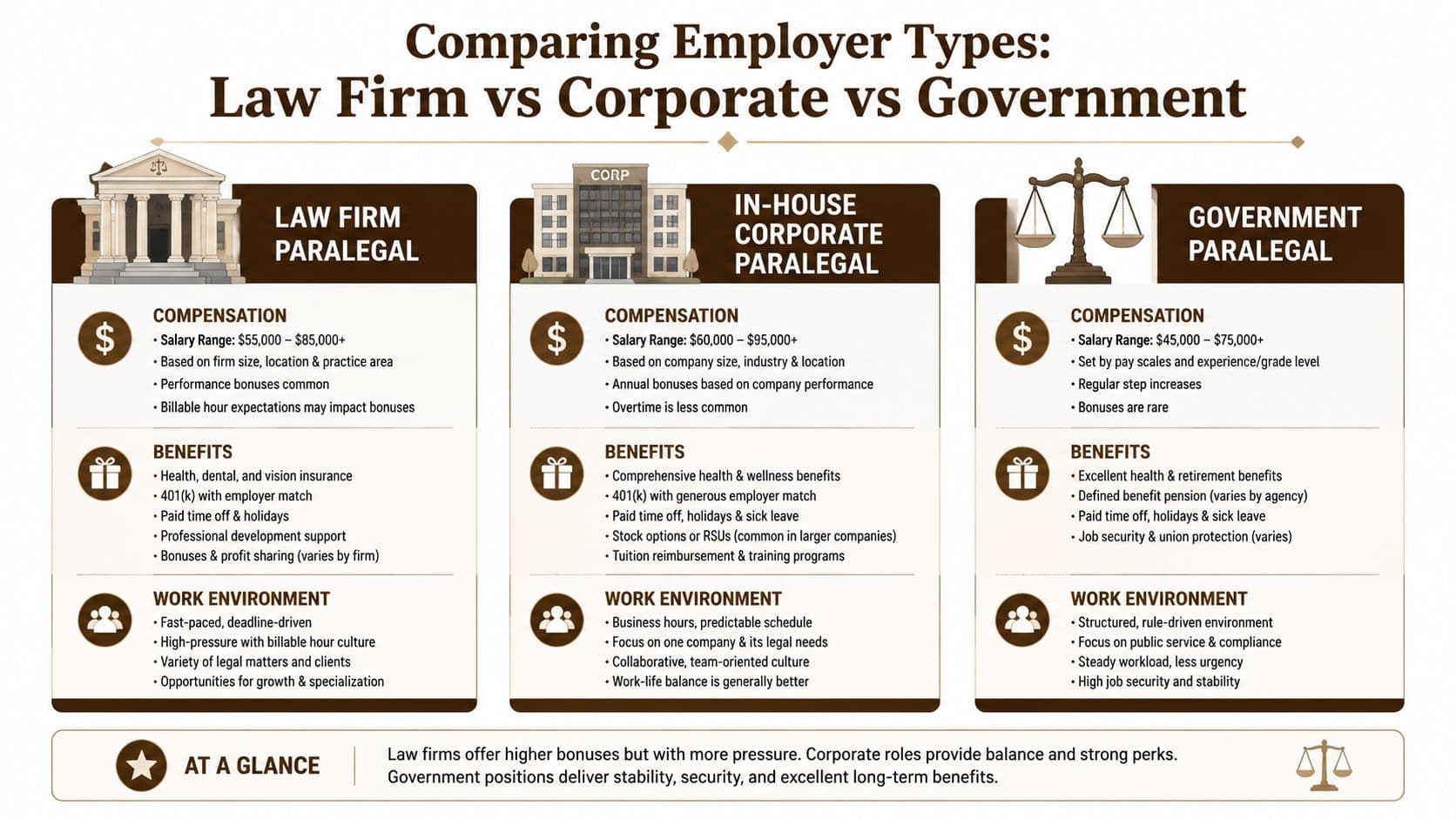
Employer type changes the compensation equation. A law firm usually pays for throughput and deadline control. A corporate legal department tends to pay for consistency, judgment, and support across business functions. Government roles usually trade top-end salary for structure, stability, and benefits.
Law firms reward production pressure
Law firms tend to price paralegals around billable support, turnaround speed, and practice-area complexity. In litigation-heavy offices, the paralegal who can organize discovery, draft pleadings, and keep a docket moving is tied directly to attorney productivity. That is why the same title can carry very different value in a small firm compared with a busy multi-office practice.
For hiring managers, the implication is straightforward. If the role sits close to client deadlines, document volume, or court-driven timing, pay has to reflect the cost of delay and the value of reduced attorney review. For candidates, the strongest bargaining position usually comes from showing that you can operate at that pace with limited oversight.
Corporate teams pay for internal reliability
In-house paralegals often support contracts, compliance, legal ops, and recurring business needs. Employers in that setting may value polish, discretion, and steady process management more than raw volume. Compensation often reflects that broader internal utility, especially when the paralegal helps attorneys handle work that would otherwise slow down legal review.
That distinction matters because corporate teams usually compare a paralegal against other internal resources, not only against outside firms. A candidate who can manage cross-functional requests, maintain clean records, and keep legal work organized across departments can justify a stronger offer even if the role does not have the same billable pressure as a litigation seat.
Government offers a different trade-off
Government positions usually appeal to candidates who want predictability, established procedures, and a clearer separation between work and after-hours demands. The base salary may not lead the market, but the total value can still be compelling for someone who prioritizes stability and benefits.
That trade-off also affects hiring strategy. Public-sector employers may not match private-firm pay, so they have to sell certainty, process clarity, and long-term fit. Candidates who compare offers only on base pay can miss the value of a role that produces a more controlled workload and a steadier schedule.
Texas salary distribution shows a middle 50% salary band of $44,700 to $63,800 Texas salary distribution. That range is useful because it shows how much employer type can shift the offer before benefits are counted. A candidate comparing paths should treat compensation as a package, not a single number.
Beyond the Base Salary Understanding Total Compensation
Texas gives candidates one immediate advantage that should stay in the compensation conversation, no state income tax. That does not change the posted salary, but it does change what remains in the employee's pocket after payroll is processed. For paralegals comparing Texas offers with coastal legal markets, that difference can make a modest base salary look stronger on an after-tax basis.
Benefits carry the rest of the equation. Health insurance, retirement contributions, paid time off, and continuing education support all affect the actual value of a role. A paralegal with a slightly lower base salary but better benefits and less payroll friction may come out ahead over the full year. Employers that understand that dynamic can compete more effectively without pushing base pay beyond what the role supports.
Some Texas salary sources also place a Paralegal I average at $68,319. That figure suggests employers may need to price early-career or structured roles with care if they want to attract candidates who can contribute quickly rather than spend a long stretch learning from scratch. For hiring managers, the signal is clear. Compensation has to reflect both the work being assigned and the level of independence expected from day one.
Hiring takeaway: if base salary is only average, the rest of the package has to do more of the work. Candidates notice tuition support, certification reimbursement, predictable schedules, and the kind of stability that reduces turnover risk.
Base pay should always be reviewed alongside benefits and local tax context. A Texas offer that looks ordinary on paper can still be competitive when the employer offers better time off, training support, and long-term stability. For firms that want help structuring an offer or comparing market options, Texas legal hiring guidance can be a practical starting point.
Practical Salary Negotiation Strategies for Texas Paralegals

The strongest negotiation starts before the interview ends. If you know the Texas range, you can talk about compensation as a market question instead of a personal request. That shifts the discussion from what you hope to get to what the role is worth.
Start by tying your ask to measurable fit. If you've done litigation support, contract review, or probate coordination, say so in the language the employer already uses. A good line is, “Given the complexity of the docket and my experience handling [relevant task], I'd like to discuss a package that reflects that scope.” That sounds more grounded than a flat number, and it keeps the discussion on value.
When salary history comes up, keep the answer disciplined. You don't need to overexplain your past pay, and you shouldn't let an old figure anchor the new one. If the recruiter presses, you can say, “I'm focused on the market rate for this role and the full responsibilities of the position.” That keeps control of the conversation without sounding evasive.
Use the offer stage to compare more than one lever. If the base salary isn't where you want it, ask about certification reimbursement, hybrid flexibility, title changes, or a shorter review cycle. Those items can matter a lot in Texas, especially when the employer already has room to compete on taxes and overall cost of living.
For candidates who want help framing the market or positioning a counteroffer, the right recruiting partner can sharpen the pitch and reduce guesswork. A direct way to start that conversation is through this contact page.
The offer discussion should stay calm and specific. If you ask for more, give the reason, then pause. Silence works better than overexplaining.
Navigating the Texas Market Insights for Candidates and Employers
Texas paralegal compensation rewards specificity. Candidates who can explain their practice area, metro, and level of specialization usually negotiate from a stronger position than candidates relying on a statewide average. Employers that benchmark against the wrong comparison set often underprice the role and then face a longer search.
Candidates get the best results by focusing on where demand meets fit. Litigation, personal injury, commercial work, and probate all show up often in Texas practice patterns, which helps explain why some paralegals command stronger offers when their background matches a busy desk. The practical point is simple, a paralegal with the right experience can use that background more effectively when targeting the right city and employer type.
Employers should treat the base salary as one part of the decision, not the whole market test. If a role is specialized, or if the office expects the paralegal to work with real autonomy, compensation should move in that direction. A generic benchmark can miss the market entirely, especially in larger Texas metros, where competition for experienced legal support remains tight. If you want a more structured way to compare candidates, roles, and internal pay bands, the team at Five Star Placements focuses on legal hiring and support staffing.
The strongest Texas offers reflect how broad the market really is. Candidates who understand that can ask for a package that fits their value. Hiring managers who understand it can build offers that attract the right people faster and keep them longer.
Need help filling a legal role?
Five Star Placements partners with law firms and legal departments nationwide.
Schedule a Call