
How Long to Fill Up a Pool: Real Timelines
October 21, 2026 · 13 min read · Five Star Placements
Table of contents
Filling a typical 20,000-gallon residential pool at a measured 10 GPM takes about 33 hours of uninterrupted flow. To verify your own timeline, time how long your hose takes to fill a bucket with a known volume, then use that measured flow rate instead of a generic estimate.
You might already have the hose stretched across the yard, with plans to swim once the water reaches the right level. Before you turn on the tap, grab a stopwatch, check the bucket's capacity, and find your pool's documented water volume. Those measurements will give you a more useful answer than a neighbor's experience with a different setup.
Table of Contents
- The Core Math That Sets Your Pool Fill Time
- Measuring Your Own Flow Rate With a Bucket
- How Pool Size and Shape Change the Timeline
- Real-World Factors That Slow the Math Down
- Choosing the Fastest Way to Deliver Water
- Prep Work Before the Water Starts Running
- Common Questions Pool Owners Ask Mid-Fill
The Core Math That Sets Your Pool Fill Time
Pool volume ÷ flow rate = filling time. The important part is keeping the units consistent: gallons divided by gallons per minute gives you minutes.
Gallons per minute, usually shortened to GPM, describes how much water leaves the hose during a minute of operation. It isn't the same as water pressure. For your estimate, you need the amount of water arriving at the pool, not whether the stream feels strong.
The relationship is easier to follow when you separate the inputs from the answer.
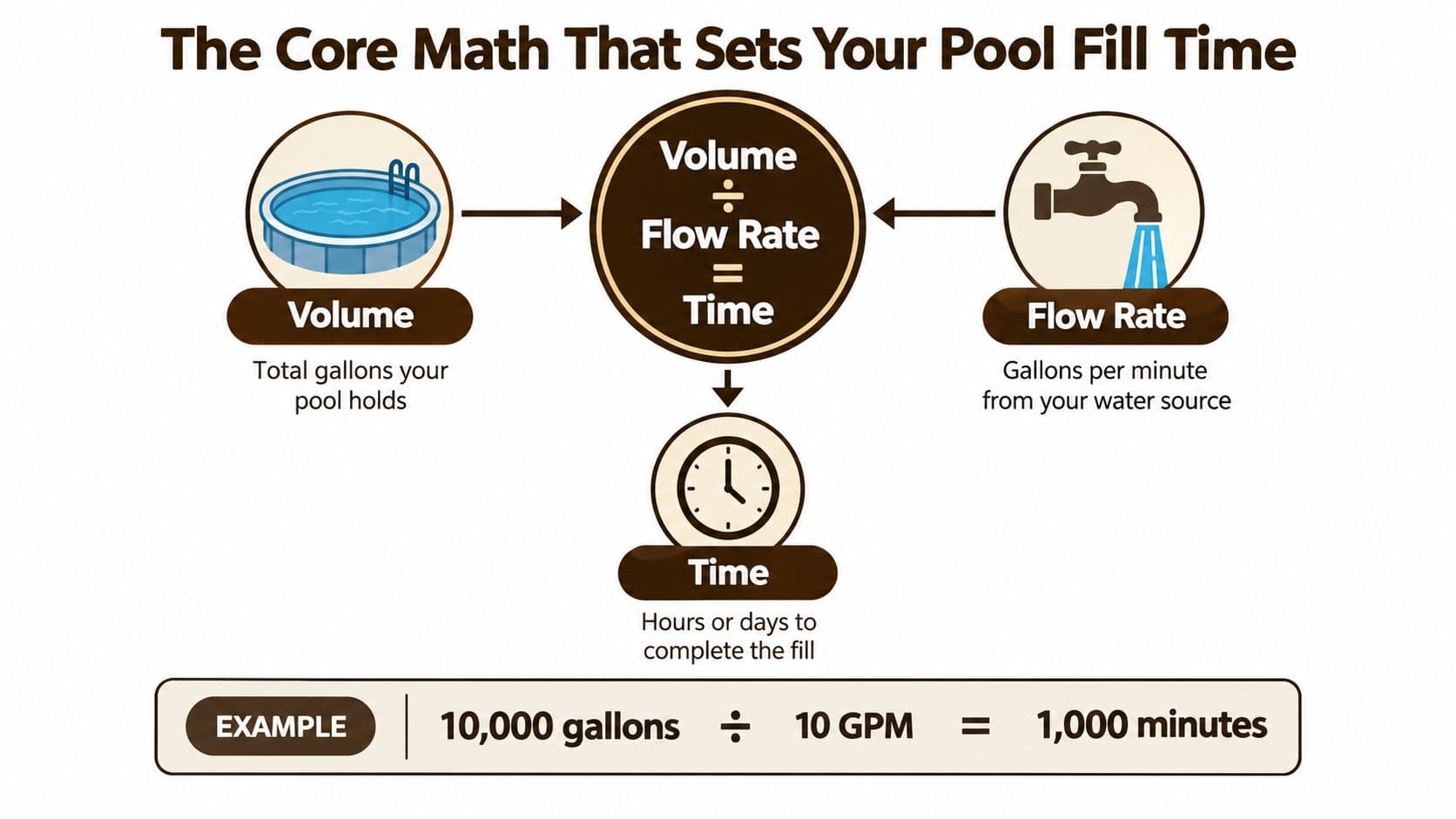
Follow the units through the calculation
For the residential example, 20,000 gallons ÷ 10 GPM = 2,000 minutes, or approximately 33.3 hours; at 5 GPM, that becomes 4,000 minutes, or 66.7 hours, while 15 GPM reduces it to approximately 22.2 hours. For perspective, conventional household faucets have historically been associated with approximately 2.2 GPM, and WaterSense-labeled faucets have a maximum of 1.5 GPM under test conditions, benchmarks discussed in EPA faucet efficiency materials.
Treat the pool volume as the amount you need to deliver and the flow rate as your delivery speed. Dividing the former by the latter tells you how long the hose must run. You can then express that result in the time units that make scheduling easiest.
Before calculating, write down:
- Water needed: Use the volume required to reach the intended operating level, not necessarily the pool's entire capacity.
- Measured output: Use the flow through the hose and fittings you'll use.
- Operating assumptions: Decide whether the water can run continuously or whether you'll need scheduled pauses.
Separate running time from finishing time
The formula gives you active filling time under the conditions you measured. Your calendar finish time also includes interruptions and any periods when delivery slows.
If you're topping up a partly filled pool, using the full capacity will overestimate the job. If you're filling an empty pool, guessing its capacity from appearance can make your schedule unreliable before you even test the hose.
Practical rule: Write the units beside every input. If you can't identify the gallons needed and the gallons delivered per minute, you don't yet have a dependable estimate.
When someone tells you how long to fill up a pool, ask what volume and measured output produced that answer. Without those inputs, their timeline is just a comparison, not a plan for your yard.
Measuring Your Own Flow Rate With a Bucket
Test at the delivery end of the hose, with the setup arranged as it will be during the fill. A measurement taken directly at the faucet won't necessarily represent what comes out after water travels through your hose and attachments.
You need a bucket with a clearly marked capacity, a phone stopwatch, and somewhere to record the result. Use a marked fill line rather than guessing where the bucket looks full.
Run a repeatable bucket test
- Arrange the hose: Lay it along the intended route and attach any fittings that will remain in use.
- Start a steady stream: Open the faucet to the position you intend to use, then let the output settle before measuring.
- Time the collection: Direct the stream into the empty bucket and stop timing when the water reaches the known-volume mark.
- Calculate the output: Divide the collected gallons by the elapsed time expressed in minutes.
- Repeat the measurement: Empty the bucket and test again. Keep the results rather than discarding a slower reading.
If your stopwatch displays seconds, convert the elapsed time to minutes before dividing. Don't divide gallons by seconds and label the answer GPM. That unit mismatch can make a plausible-looking estimate completely wrong.
Measured Flow Rate Bands by Water Source
| Water source | Typical GPM range | Best test method |
|---|---|---|
| Outdoor faucet with garden hose | No universal range assumed | Time a known-volume bucket at the hose outlet |
| Indoor faucet | Fixture-dependent, not a substitute for hose output | Measure at the outlet actually supplying the water |
| Authorized high-capacity connection | Obtain the approved delivery range | Request metered flow information from the operator |
| Bulk water delivery | Provider- and setup-dependent | Confirm discharge rate and delivery schedule |
The faucet benchmarks noted earlier are useful context, but they aren't a rating for your outdoor hose. Don't substitute an indoor fixture specification for a measurement you can make yourself.
Measure the water that reaches the pool, not the water you assume the faucet supplies.
Record the hose arrangement alongside your result. If you change the hose, move to another faucet, or remove an attachment, test again rather than carrying the old measurement forward.
When readings vary, keep that variation visible in your schedule. A slower repeatable result is a safer planning input than the strongest brief burst you happen to observe.
How Pool Size and Shape Change the Timeline
A pool's visible footprint doesn't tell you its water volume. Depth matters, and a shallow lounging area doesn't hold the same amount of water as an equally large deep section.
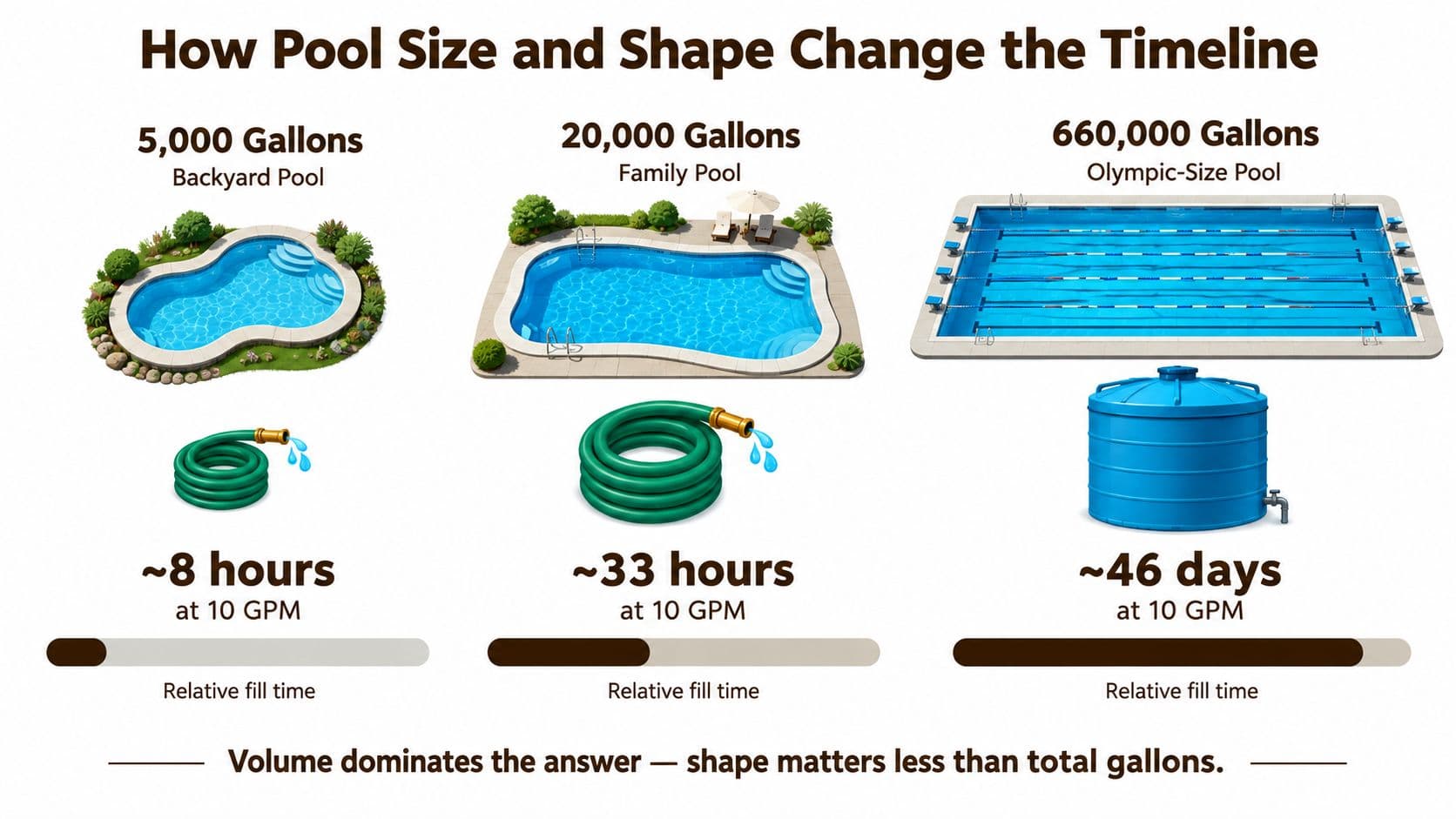
This comparison illustrates why total gallons deserve more attention than whether a pool looks small, medium, or large.
Use the intended water level
Start with the builder's documentation, manufacturer's specifications, or a reliable volume calculation for your particular pool. Check that the stated capacity corresponds to the intended waterline rather than the shell's maximum depth.
For a simple rectangular space, length, width, and average water depth establish its volume. Keep those measurements in consistent units. If you calculate in cubic feet, convert the result to gallons before combining it with a GPM measurement.
Free-form pools need more care. Curved walls, sloping floors, steps, and benches make a calculation based on maximum length, maximum width, and deepest point a poor substitute for the actual water space.
- Sloping floors: Account for the changing depth rather than treating the entire floor as the deep end.
- Irregular outlines: Break the footprint into manageable shapes instead of including empty space outside the walls.
- Built-in features: Use documentation that accounts for substantial steps, seating, and other displaced water.
Put residential volume in perspective
An Olympic-size pool measuring 50 meters long by 25 meters wide, with a nominal minimum depth of 2 meters, represents approximately 660,000 U.S. gallons; filling that volume takes about 7.3 hours at 1,500 GPM, 110 hours at 100 GPM, or 45.8 days at 10 GPM, and a 20,000-gallon residential pool holds about 3% as much water, according to the geometry and calculations associated with Olympic-size swimming pool specifications.
Those examples illustrate why supply capacity and pool volume must be considered together. A large pool with an engineered water supply can finish sooner than a smaller pool supplied through a restricted household setup.
For an additional visual reference, use the video below alongside your own pool measurements.
Your practical goal isn't an impressive-looking capacity estimate. It's a volume figure accurate enough to schedule the fill, check progress, and avoid mistaking a normal rise in water level for a delivery problem.
Real-World Factors That Slow the Math Down
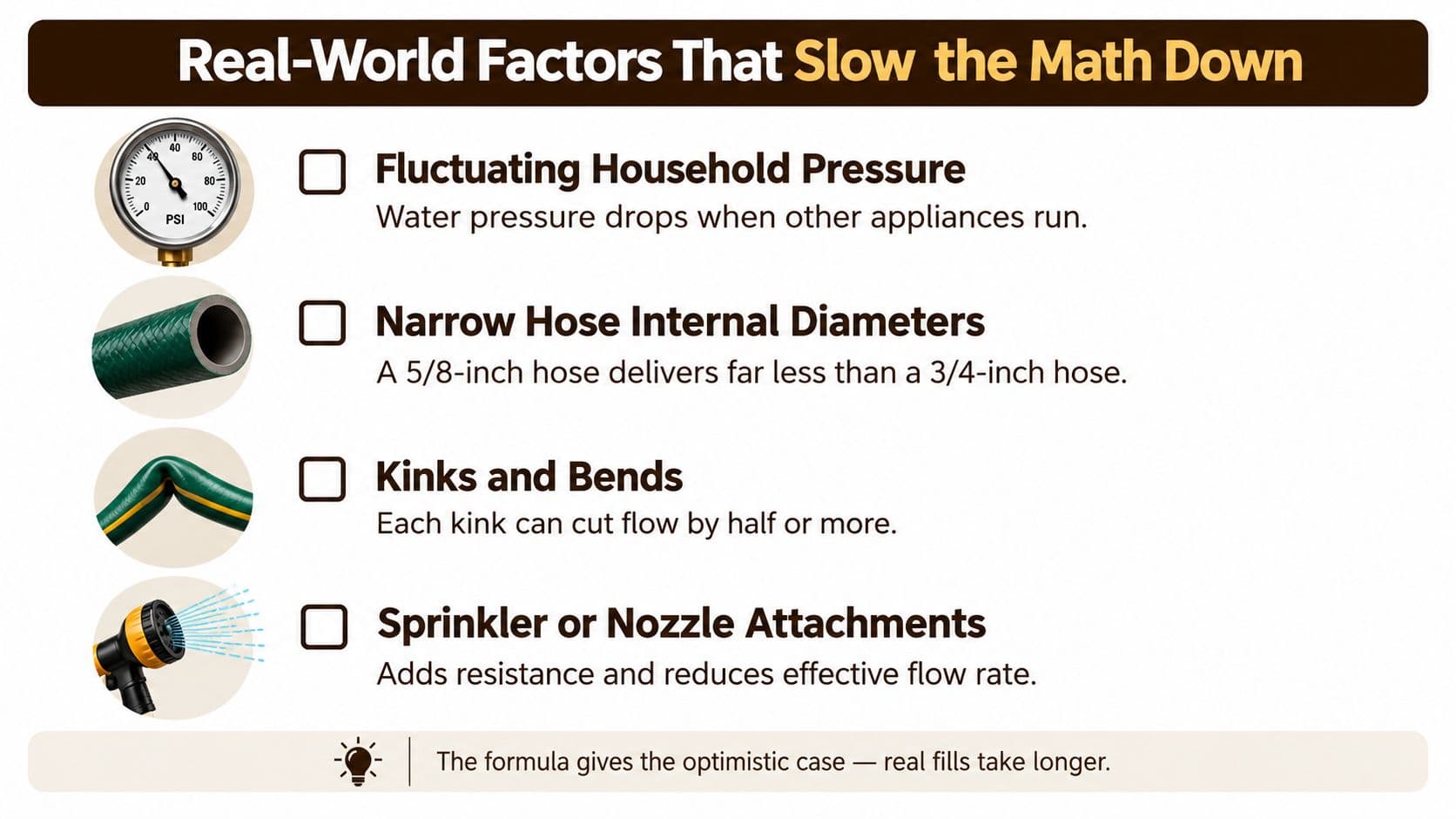
A bucket test captures your setup under the conditions present during the test. Household pressure can fluctuate, and simultaneous water use can reduce delivery. Hose internal diameter and plumbing restrictions also affect the result.
The illustration identifies useful places to inspect. Treat any specific performance figures in it as illustrative, not as measurements of your equipment.
Audit the complete delivery path
Walk from the faucet to the pool before committing to a long fill. Look for anything that makes the operating setup different from the one you tested.
- Changing household demand: Note whether showers, laundry, or other substantial water use coincide with weaker output.
- Restricted hose routing: Inspect tight bends, flattened sections, and places where someone might step on or drive over the hose.
- Unnecessary attachments: Check whether a nozzle, splitter, or fitting is required. Measure again after changing the arrangement.
- Changing valve position: Make sure everyone in the household knows which faucet is supplying the pool.
- Planned interruptions: Write down when the hose must be shut off instead of assuming uninterrupted operation.
Don't assign a universal time penalty to a kink or fitting. The useful question is how much your measured output changes when you correct the setup.
If you suspect a restriction, change the suspected item and repeat the bucket test. Changing several things together may improve delivery, but it won't tell you which change mattered.
Track water-on time separately
A slow fill and an interrupted fill aren't the same problem. Record when water starts, when it stops, and when you notice a meaningful change in output.
Scheduling check: A finish estimate based on continuous delivery needs to move whenever the hose stops or the operating conditions change.
Keep a visible reference for the water level and check that it's rising. If progress looks wrong, inspect the supply and pool rather than just adding more time to the schedule.
A repeat measurement is especially useful when the stream appears weaker than it did during setup. Use the updated output to reassess the water still needed, rather than applying the new rate to water that has already been delivered.
You don't need a complicated monitoring system. A phone note containing start times, pauses, bucket results, and observed water levels is enough to make the estimate understandable instead of mysterious.
Choosing the Fastest Way to Deliver Water
Choose a delivery method by comparing confirmed completion time, not just advertised flow. Availability, access, authorization, setup, and pauses between deliveries all belong in the decision.
The comparison below shows the main delivery options. Its example rates, loads, and prices aren't a local quote or a guarantee of what a provider can supply.
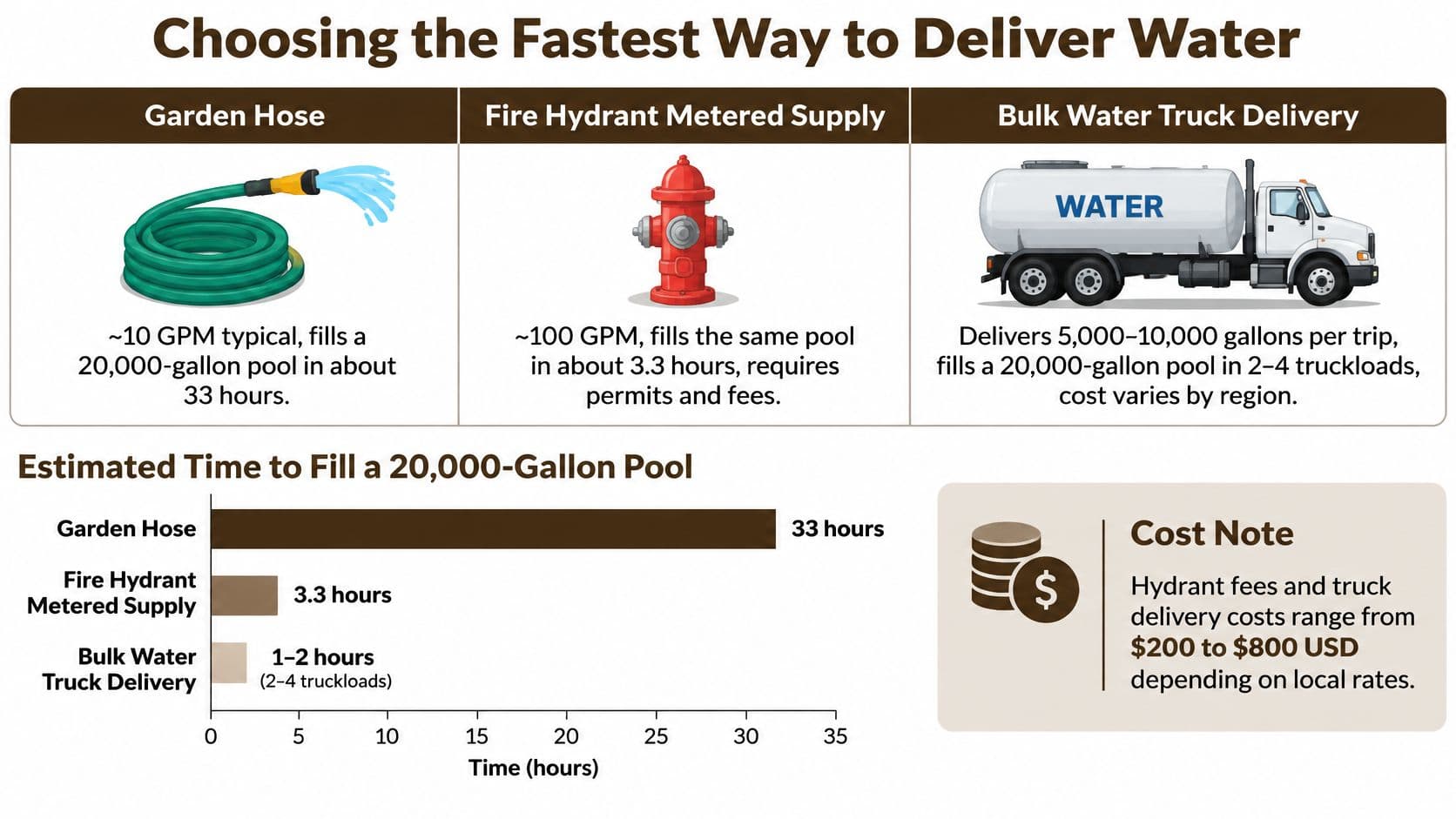
Compare the whole job
| Delivery method | What to verify | Scheduling question |
|---|---|---|
| Household hose | Measured output, utility billing, and any use restrictions | Can you accommodate the required running time? |
| Authorized hydrant supply | Utility approval, operator requirements, equipment, and charges | When can an approved connection actually operate? |
| Bulk water truck | Delivered volume, site access, discharge arrangement, and full quote | Does the completion estimate include every delivery? |
A household hose gives you direct control over the start time and lets you measure output yourself. It isn't automatically free, though. Ask your utility how the added consumption will appear on your bill and whether any pool-fill procedures apply.
Hydrant supply should begin with a conversation with the water utility, not an attempt to connect equipment. Ask whether residential pool filling is available through an authorized program and what approvals, metering, or operators would be required.
Bulk delivery needs a site-specific conversation with the provider. Describe access, the pool's location, the water volume needed, and any limits on where equipment can be positioned.
Ask for a usable completion estimate
A fast discharge rate doesn't tell you when the pool will be full if the provider must schedule separate trips. Likewise, a readily available hose may be more practical than a higher-capacity service that can't arrive when you need it.
Ask each provider to distinguish:
- Arrival and setup: When work can begin and what you must prepare.
- Active delivery: The expected output at your property.
- Completion: Whether the estimate includes all required deliveries and intervening delays.
- Total charges: Which water, transport, equipment, and service costs are included.
Don't assume adding another household hose will produce an equivalent increase in total output. If you consider that arrangement, test the combined setup while everything is operating. Choose based on measured delivery and a complete schedule, not the number of hoses in the yard.
Prep Work Before the Water Starts Running
Finish the checks that require an empty or partly filled pool before starting. Use the pool manufacturer's instructions and, for a newly finished or repaired pool, the installer's startup directions.
Don't assume every pool should be filled, paused, or commissioned in the same way. The appropriate sequence depends on the shell, finish, equipment, and work that has just been completed.
Confirm the pool is ready
- Resolve installation questions: Have the installer confirm any outstanding concerns about support, leveling, fittings, or visible damage.
- Check the required waterline: Identify the intended stopping point and make it easy to recognize.
- Complete equipment preparation: Confirm that valves, plumbing, and equipment are arranged according to the startup instructions.
- Position the hose carefully: Secure it so it won't move unexpectedly, and ask the installer how to protect the pool surface.
- Prepare testing supplies: Have the specified water-testing equipment and startup products available before you need them.
If you notice a possible leak or damaged component, get it assessed rather than assuming it will be easier to address once the pool is full. Avoid improvising a repair or draining plan without appropriate guidance.
Make the monitoring plan realistic
Choose a start time that lets you observe the beginning of the fill and check the setup afterward. Arrange who will inspect progress, who can turn off the supply, and how you'll prevent accidental overfilling.
Check local requirements before committing to the schedule. If you use a well, ask the well or pump professional what operating limits apply to your system.
Before opening the tap: Know the target waterline, the responsible person, and the approved startup procedure.
For budgeting, ask the utility which billing units and charges apply, then use your expected added consumption. Don't assume a pool fill receives a special rate or a sewer-charge adjustment.
Keep the volume estimate, bucket-test result, installer instructions, and utility information together. That gives anyone helping with the project the same practical plan.
Common Questions Pool Owners Ask Mid-Fill
Can I swim as soon as the pool is full?
Don't use a full waterline as your only readiness check. Follow the specified startup procedure, test the water, and confirm that the treatment and equipment requirements have been met before swimming.
If the pool has a new finish, ask the installer about its particular startup restrictions. Filling and being ready for swimmers are separate milestones.
What should I do if the water turns green during a delay?
Keep swimmers out and seek a water test and treatment advice appropriate to the pool. Describe the incomplete fill, the appearance of the water, and whether the circulation equipment can operate.
Don't guess chemical doses from the pool's eventual capacity while it remains partly filled. Follow product directions and qualified guidance for the water present.
Should I fill during freezing weather?
Ask the installer or service technician whether the pool and exposed equipment can be filled and commissioned safely under the expected conditions. Don't assume moving water alone makes the entire setup suitable for freezing weather.
Confirm what should happen if weather interrupts the work. That decision belongs in the plan before the hose is running.
How do I estimate ongoing water costs?
Separate the initial fill from later replacement water. Use your utility's billing method and measured consumption rather than treating the pool's full capacity as a recurring monthly requirement.
Keep a record of additions so you can distinguish routine use from an unexplained need for more water. For the fill itself, the most dependable finish estimate comes from measuring output, monitoring progress, and recording interruptions.
Five Star Placements provides permanent recruitment for attorneys, legal support professionals, partners, in-house counsel, and legal operations leaders. Just as planning a pool fill starts with knowing the actual requirements, a focused hiring search starts with defining the role and organizational fit. Visit Five Star Placements to discuss a customized search for your law firm or corporate legal department.
Need help filling a legal role?
Five Star Placements partners with law firms and legal departments nationwide.
Schedule a Call