
Legal Secretary Job Description 2026: Your Full Guide
July 11, 2026 · 19 min read · Five Star Placements

Table of contents
You're probably dealing with one of two problems right now. Either a strong legal secretary resigned and left a gap that's disrupting filings, calendars, billing, and client communication all at once, or you've been trying to fill an opening for weeks and the applicant pool keeps missing the mark.
What usually sits underneath both problems is the same issue. The legal secretary job description is outdated, too generic, or written like an internal HR form instead of a hiring tool. It lists clerical tasks, says “must be organized,” and leaves top candidates with no clear sense of scope, standards, or room to grow. The people you want to hire read that and move on.
A good job description screens in qualified applicants. A great one also signals the level of the practice, the complexity of the desk, and what success looks like in the role. That matters more now because the legal secretary role no longer fits the old template of typing, phones, and scheduling. Firms that write to the old model tend to attract the old model.
Table of Contents
- Why Your Old Job Description Is Costing You Talent
- The Modern Legal Secretary Role Summary
- Core Duties and Responsibilities
- Required Skills and Key Qualifications
- Salary Benchmarks and Compensation
- How to Write a Compelling Job Posting
- Screening Checklist and Interview Questions
- Onboarding and Setting Performance Metrics
- Frequently Asked Questions
Why Your Old Job Description Is Costing You Talent
A managing partner usually notices the problem late. It starts as inconvenience. Then one missed handoff turns into a late filing scare, an attorney starts doing their own calendar cleanup, and clients begin hearing “I'll need to get back to you” more often than they should.
Then the firm posts a role using the same legal secretary job description it has used for years.
The posting says the candidate will answer phones, prepare correspondence, maintain files, and support attorneys as needed. That language attracts applicants who can perform office support. It does not reliably attract the legal support professional who can manage competing court deadlines, protect attorney time, handle sensitive client interactions, and catch formatting or filing issues before they become expensive.
Practical rule: Top legal support talent reads a job description as a proxy for how the firm operates. If the posting is vague, they assume the workflow is vague too.
That's the hiring trade-off many firms miss. A broad posting may generate more resumes, but it often lowers the average quality of those resumes. A specific posting narrows the field, but it usually improves fit and reduces wasted interviews.
The strongest candidates also look for signs that the firm understands the role's current market reality. If your posting still treats the legal secretary as purely clerical, you'll lose candidates who want a seat in case coordination, client communication, and deadline control.
For firms that want a clearer picture of how specialized legal recruiting evaluates role fit, Five Star Placements' firm background shows the kind of practice-aligned screening that matters in legal hiring.
The Modern Legal Secretary Role Summary
The modern legal secretary isn't a general office assistant with a legal title. In a well-run firm, this person is a workflow anchor for attorneys, clients, filings, and deadlines. They keep the administrative side of legal work moving, but the role also requires procedural judgment, polish with clients, and confidence with legal documents.

What the role includes now
The role has expanded well beyond classic clerical support. The Association of Legal Administrators notes that legal secretaries now handle responsibilities that include conducting legal research, verifying quotes and citations in briefs, transcribing attorney audio files, proofreading legal documents for errors, and serving as the first point of contact for clients and external parties while maintaining professionalism and confidentiality, as described in this ALA white paper on the changing role of the legal secretary.
That combination matters. A candidate who can only “assist when asked” is different from one who can see the chain reaction created by a hearing date, a service deadline, a missing exhibit, or a client waiting for a call back. The best legal secretaries think in sequences, not isolated tasks.
What strong firms understand
Partners often say they need someone “detail-oriented and organized.” That's true, but it's not enough. The more useful definition is this: a legal secretary protects momentum.
In litigation, that means keeping filings, transcripts, binders, and calendars aligned. In trusts and estates, it often means managing client communication with unusual care. In corporate settings, it may mean formatting, scheduling, version control, and board or deal coordination. The title stays the same. The operational weight of the role changes by practice.
A strong legal secretary doesn't just support attorneys. They reduce friction across the matter lifecycle.
A legal secretary job description should reflect that reality. If it doesn't, your posting undersells the position and misstates what the desk demands.
Core Duties and Responsibilities
A useful legal secretary job description should organize duties by function, not by random bullet accumulation. That makes it easier for candidates to understand the desk and easier for your firm to evaluate fit.
Administrative support that keeps attorneys productive
This category still matters. It just shouldn't be the whole story.
- Calendar control: Maintain attorney calendars for meetings, hearings, court dates, filing deadlines, and internal case milestones.
- Communication flow: Manage incoming calls, emails, mail, and message routing so attorneys aren't buried in avoidable interruptions.
- Scheduling logistics: Coordinate client meetings, conference calls, travel, and hearing-related logistics.
- Billing and expenses: Enter billable time when required, submit expense reports, and support clean handoffs to accounting.
- File maintenance: Keep electronic and physical files orderly so attorneys can retrieve what they need without delay.
This work sounds simple on paper. In practice, it isn't. A legal secretary often has to decide what needs immediate attorney attention, what can wait, and what should be solved before it reaches the lawyer's desk.
Legal documentation and filing responsibilities
Generic job descriptions usually fall short. Legal support work is document-heavy, deadline-driven, and rule-sensitive.
According to Indeed's legal secretary hiring guide, the role can include substantive litigation support such as transcribing lawyers' audio files and written notes, indexing and updating pleadings and discovery binders, and preparing court statements, forms, minutes of court proceedings, affidavits, wills, and briefs from dictation.
A practical duties list often includes:
- Document preparation: Draft, revise, proofread, and format correspondence, pleadings, motions, subpoenas, affidavits, wills, briefs, and related materials at attorney direction.
- E-filing and submission: File documents with courts and agencies in the required format and within required deadlines.
- Version control: Manage edits across draft rounds so attorneys aren't working from outdated documents.
- Exhibit assembly: Prepare filing sets, hearing binders, discovery binders, and supporting materials.
- Quality review: Check names, dates, captions, citations, attachments, signature blocks, and formatting before anything goes out.
Client and matter coordination
This category often separates average support staff from top-tier legal secretaries.
- Client contact management: Serve as an initial point of contact for clients, with discretion and professionalism.
- Status coordination: Help track outstanding documents, signatures, responses, and scheduling items.
- Vendor and court contact: Communicate with court personnel, reporters, experts, and outside vendors as needed.
- Confidential information handling: Manage sensitive material carefully and consistently.
- Trial or hearing support: Coordinate logistics, material readiness, and last-minute changes under pressure.
If a duty has legal consequences when done poorly, it belongs in the job description with clear language.
A weak posting says “provide administrative support.” A strong one names the filing, document, deadline, and communication responsibilities that define the role.
Required Skills and Key Qualifications
The best legal secretary job descriptions don't just list qualifications. They show which skills are essential for the desk you're filling and why those skills matter in your environment.
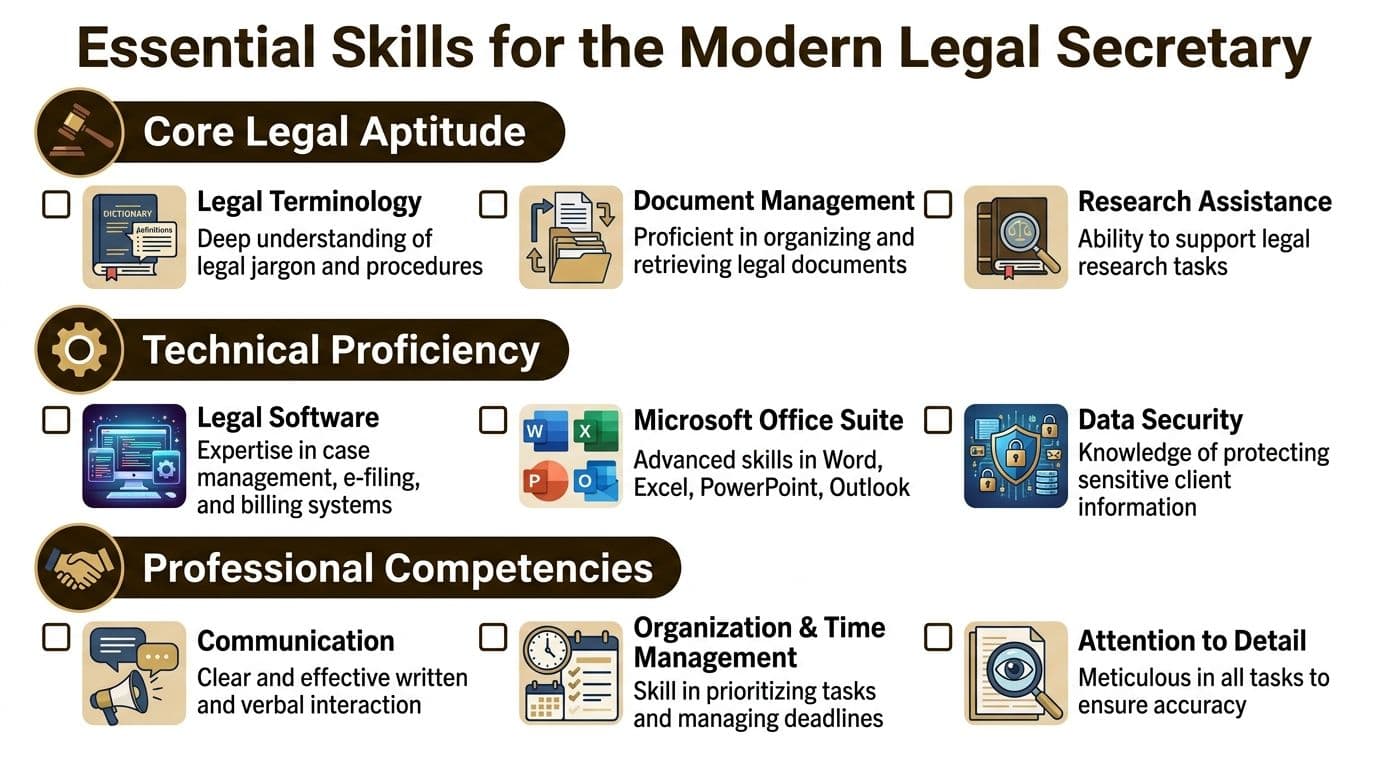
Technical skills that are hard to fake
Some competencies become obvious only after a candidate is hired. That's why your posting should call them out directly.
A senior legal secretary role may require certified competency in docketing and deadline management across multiple jurisdictions, a minimum of 3+ years of experience in a law firm or professional services environment, proficiency in Microsoft Office, particularly Outlook and Word, and a working knowledge of specialized terminology, policies, procedures, and formatting styles for the assigned practice group, as outlined in this legal secretary job description from a law firm.
The technical qualifications worth specifying usually include:
- Docketing and calendar management: Especially for litigation and any role supporting deadline-sensitive practices.
- Microsoft Office proficiency: Word and Outlook are baseline tools in most firms. Candidates should be comfortable with document formatting, redlines, scheduling, and email management.
- E-filing familiarity: If the role includes court or agency filings, say so plainly.
- Billing system comfort: Not every desk owns time entry, but many roles touch it.
- Document production discipline: Formatting legal documents isn't the same as formatting general business correspondence.
Legal knowledge that reduces training drag
A firm can train for internal process. It's harder to train quickly for legal judgment around terminology, court conventions, or practice-specific workflow.
Look for candidates who show they understand:
- Legal terminology
- Practice-area vocabulary
- Court and procedural expectations
- Matter file structure
- Formatting standards for the work product your attorneys use daily
The more specialized the practice, the more dangerous it is to write a generic qualification line such as “legal experience preferred.” If your secretary needs to support probate administration, insurance defense, plaintiff PI, or multi-jurisdiction litigation, name that context.
Professional traits that determine long-term success
The best hires usually stand out less on charisma and more on reliability.
A strong legal secretary should show:
| Competency | Why it matters |
|---|---|
| Attention to detail | Small document or date errors can create legal risk |
| Discretion | Client and firm information must stay confidential |
| Priority judgment | Attorneys rarely hand work over in perfect sequence |
| Composure under pressure | Deadlines shift and urgent requests collide |
| Professional communication | Clients and outside parties often judge the firm through this role |
What doesn't work is stuffing a posting with every imaginable trait. “Team player, self-starter, multitasker, detail-oriented, excellent communicator” tells candidates almost nothing. Tie each qualification to the actual work of the desk.
Salary Benchmarks and Compensation
Compensation is where many firms either lose strong candidates early or waste time with misaligned expectations. If the role is demanding, deadline-sensitive, and practice-specific, the salary discussion has to reflect that reality.
According to All Criminal Justice Schools' summary of U.S. Bureau of Labor Statistics 2024 Occupational Employment Statistics, the median national annual salary for legal secretaries is $54,140. The same source states that the range extends from approximately $48,280 on the lower end to $175,501 for highly experienced professionals in senior roles or major metropolitan areas.
Why the range is so wide
That spread doesn't mean the market is inconsistent. It means the title covers very different jobs.
A legal secretary supporting one attorney in a lower-complexity practice may handle scheduling, correspondence, and routine document work. A senior legal secretary in a large market may be managing multi-attorney calendars, coordinating filings across jurisdictions, handling billing, preparing complex materials, and acting as a central point of control for a high-pressure desk.
Compensation usually moves based on a few practical factors:
- Geographic market: Major metros generally command higher pay.
- Practice area intensity: Litigation-heavy and deadline-driven desks often justify stronger compensation.
- Attorney ratio: Supporting multiple lawyers increases complexity.
- Autonomy level: Candidates who require little hand-holding are more valuable.
- Institutional knowledge: Secretaries who already understand your practice area shorten ramp time.
A planning table for salary discussions
The table below is best used as a hiring framework, not a data table. It helps firms think through why one legal secretary role should pay differently than another.
| Factor | Boutique/Small Firm (1-20 Attorneys) | Mid-Size Firm (21-100 Attorneys) | Large Firm (101+ Attorneys) |
|---|---|---|---|
| General support role | Often broader duties across office operations | More defined desk structure | More specialized support lane |
| Litigation support demands | Can swing sharply based on active matters | Often tied to assigned practice groups | Usually more formalized and deadline-heavy |
| Client-facing expectations | Frequently high-touch | Balanced between attorney and team workflow | Often polished and process-driven |
| Systems exposure | Varies by firm | Usually more standardized | Commonly requires comfort with multiple internal systems |
| Pay positioning | Depends heavily on local market and partner expectations | Often calibrated by experience and practice fit | Usually influenced by complexity, scale, and city |
Don't treat compensation as salary only
Candidates evaluate the whole package. A firm that can't lead the market on base salary may still compete if it offers stable hours, respectful attorney management, hybrid flexibility where appropriate, strong benefits, and a role with defined scope.
The fastest way to lose a top candidate is to present a demanding, high-accountability desk as if it were interchangeable administrative support.
Be candid about expectations. If overtime, evening availability, or filing crunches are part of the role, say so early. That honesty helps with both acceptance and retention.
How to Write a Compelling Job Posting
Most law firms write legal secretary postings as if they're documenting a vacancy for internal records. That approach fills space, not seats. The market reads a job post as an invitation and a filter at the same time.
A compelling posting does three things well. It tells the candidate what the desk involves, what kind of firm environment they're entering, and why a strong legal secretary would want the role.
For additional hiring perspectives and legal recruiting insights, firms often benefit from following a specialized resource library like the Five Star Placements blog.
Start with a title that reflects the real desk
“Legal Secretary” is often too broad on its own. Add practice area or level when it helps the right candidates recognize fit.
Examples:
- Legal Secretary for Commercial Litigation
- Senior Legal Secretary for Trusts and Estates
- Plaintiff Personal Injury Legal Secretary
- Legal Secretary Supporting Managing Partner
Those titles work because they communicate context. A candidate can self-select before applying.
Sell the role before listing demands
The opening paragraph should answer a simple question. Why would a capable legal secretary leave their current role for this one?
Bad opening: We are seeking a motivated legal secretary to join our fast-paced law firm.
Better opening: Our firm is hiring a legal secretary to support a busy litigation practice with active court calendars, high document volume, and direct client contact. This role suits someone who's comfortable owning deadlines, keeping attorneys organized, and maintaining polished communication under pressure.
The difference is clarity.
Write duties around impact
A weak duties list reads like task debris. A strong one shows how the work supports attorneys and matters.
Compare these:
- Weak: Answer phones and maintain files.
- Better: Manage client communications, maintain organized matter files, and ensure attorneys receive time-sensitive information promptly.
- Weak: Prepare legal documents.
- Better: Draft, format, proofread, and finalize pleadings, correspondence, and filing materials in line with court and firm standards.
A sample structure that works
Use a posting skeleton like this:
| Section | What to include |
|---|---|
| Role summary | Practice area, attorney support scope, pace, client exposure |
| Key responsibilities | The actual recurring work of the desk |
| Required experience | Practice-specific background, systems, level of independence |
| Preferred qualifications | Nice-to-have items that shouldn't block strong candidates |
| Work environment | In-office, hybrid, multi-attorney support, peak periods |
| Compensation and benefits | Clear range if your firm shares it, plus notable benefits |
What to leave out
Cut anything that creates noise without helping candidates assess fit.
Avoid:
- Laundry-list filler: Endless bullets that blend together
- Inflated adjectives: “Rockstar,” “ninja,” and similar language usually weaken credibility
- Contradictory requirements: Entry-level pay with senior-level demands
- Vague growth promises: If advancement is possible, describe how
Candidates don't need a firm to sound exciting. They need it to sound competent, clear, and worth joining.
A great legal secretary job description doesn't try to impress everyone. It attracts the people who can succeed on that specific desk.
Screening Checklist and Interview Questions
Once the posting is live, the next risk is inconsistency in screening. One interviewer focuses on personality. Another focuses on software. A third assumes any legal office background is enough. That's how firms miss strong candidates and move weak ones forward.
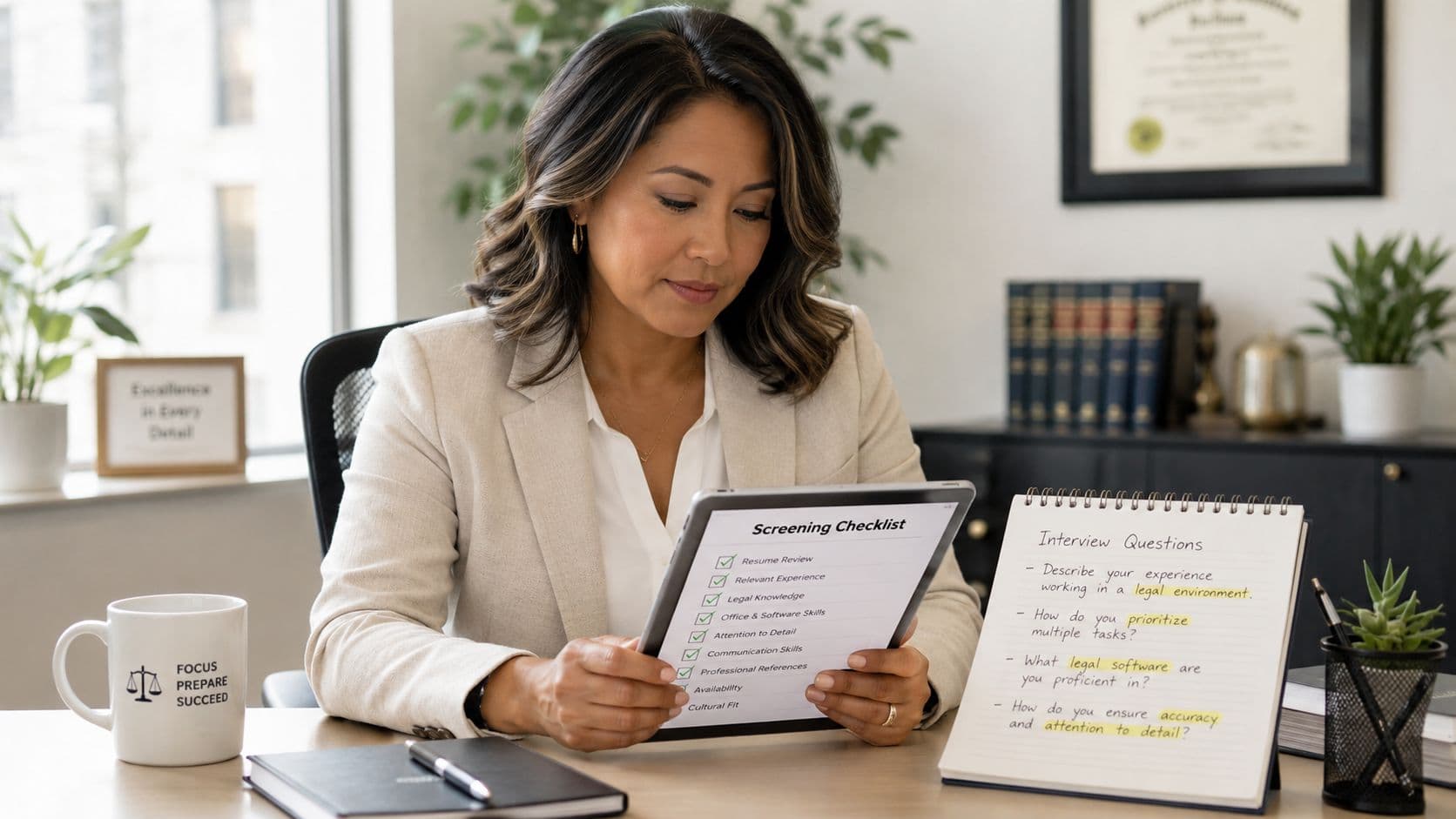
Resume screening checklist
Start with a practical screen before the first call.
- Relevant law firm experience: Look for direct support experience in a legal setting, not just general administrative work.
- Practice match: Prior experience in the same or a similar practice area usually shortens ramp time.
- Document-heavy background: The resume should suggest comfort with pleadings, correspondence, file management, or filing workflow.
- Calendar and deadline ownership: Candidates should show they've managed schedules, deadlines, or attorney coordination.
- Tenure pattern: Frequent short stays aren't always disqualifying, but they deserve inquiry.
- Software clues: Look for Word, Outlook, billing tools, case management tools, or e-filing references.
- Client-facing exposure: Strong roles often require polished communication with clients and outside parties.
According to the earlier-cited Indeed hiring guide, legal secretaries may handle substantive support tasks such as transcribing notes, indexing pleadings and discovery binders, and preparing forms, affidavits, wills, and briefs from dictation. If your desk requires that level of support, the resume should show more than receptionist-style experience.
Interview questions that reveal judgment
Generic questions produce rehearsed answers. Ask for examples and trade-offs.
Use questions like these:
- Tell me about a time you were managing conflicting deadlines for more than one attorney. How did you decide what moved first?
- Describe a filing or document preparation issue you caught before it became a problem. What tipped you off?
- How do you keep a busy attorney informed without overwhelming them with every incoming issue?
- What's your process for managing a calendar that includes court dates, internal deadlines, and client meetings?
- Describe a time a client or outside party was frustrated. How did you handle the communication?
- What kinds of legal documents have you formatted or proofread regularly?
- How do you protect confidentiality in day-to-day work?
- When an attorney gives incomplete instructions on an urgent request, what do you do next?
A useful video primer on interview readiness and communication can help firms compare polished answers against substance:
What to listen for
Don't just note whether a candidate has “done the task.” Listen for how they think.
| Signal | Strong answer sounds like | Weak answer sounds like |
|---|---|---|
| Prioritization | Explains sequence, urgency, and communication | “I just multitask” |
| Accuracy | Mentions checking details, formatting, deadlines | Stays broad and generic |
| Judgment | Knows when to escalate and when to solve | Needs constant direction |
| Professionalism | Handles difficult interactions calmly | Focuses on blame or drama |
If your firm wants outside help tightening screening steps or comparing candidate quality, the most efficient move is often to contact a legal recruiting specialist before interviews start drifting.
Onboarding and Setting Performance Metrics
A good hire can still fail if the firm treats onboarding as software setup plus “shadow Susan for a few days.” Legal secretary roles are too procedural and too attorney-specific for that approach.
The new hire needs clarity on workflow, communication standards, document expectations, and escalation points. Without that, even experienced candidates can look weaker than they are.
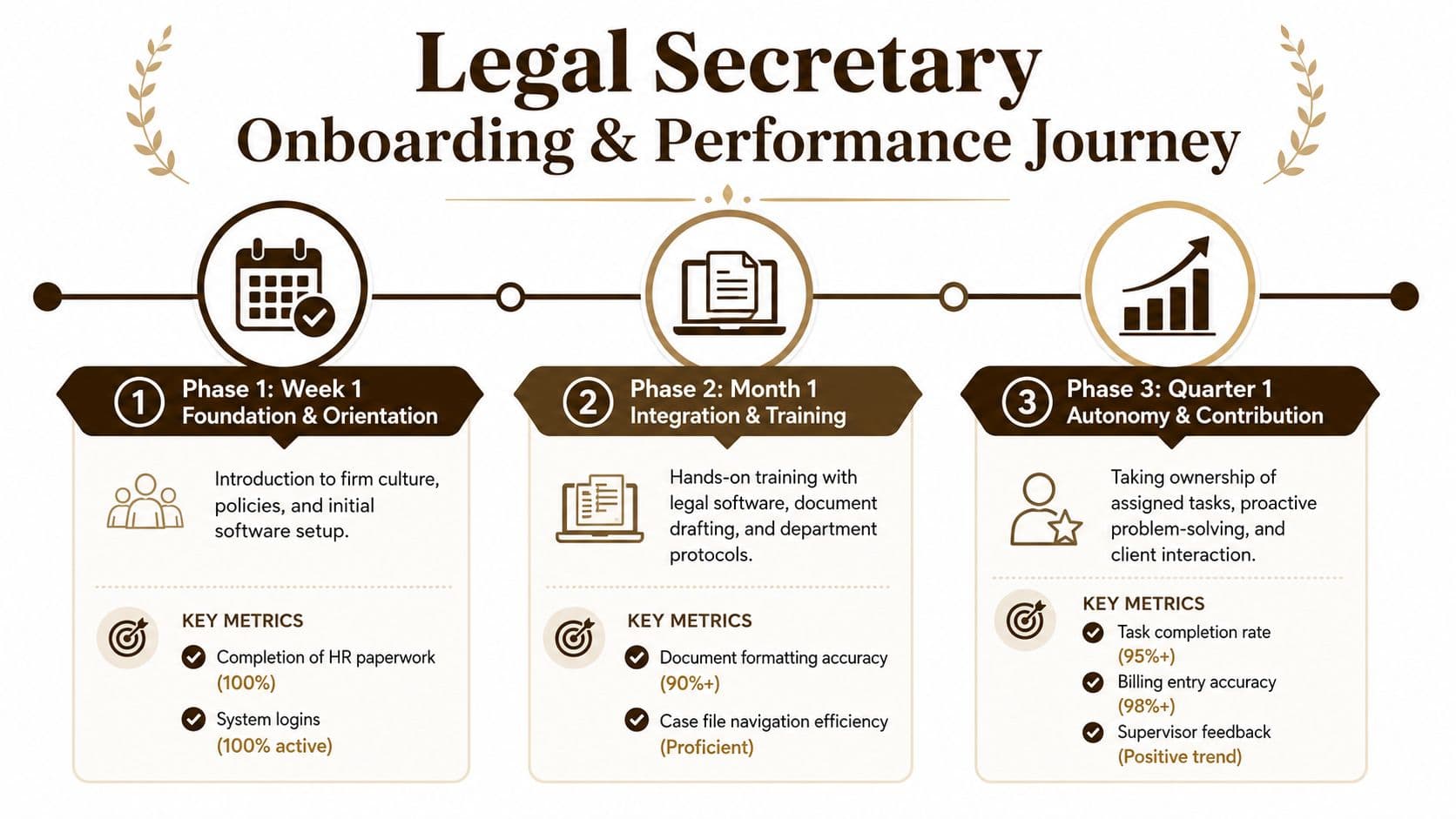
A practical 30-60-90 day structure
Use onboarding to reduce ambiguity early.
First 30 days
- System access and process training: Email, document management, billing, calendars, and filing tools.
- Matter familiarization: Key clients, active matters, attorney preferences, and recurring document types.
- Standards training: Formatting rules, naming conventions, filing workflow, and confidentiality expectations.
- Observation period: Let the new hire watch how attorneys communicate, delegate, and escalate.
Days 31 to 60
- Independent task ownership: Routine scheduling, document prep, correspondence handling, and basic deadline tracking.
- Practice-specific refinement: Learn the work style of assigned attorneys and the pressure points of the desk.
- Communication rhythm: Establish when to update attorneys, what to escalate, and what can be handled directly.
Days 61 to 90
- Full desk management: Own recurring workflow with limited oversight.
- Proactive support: Flag issues early, prepare ahead for deadlines, and reduce attorney follow-up.
- Performance review checkpoint: Confirm what's working and where additional training is needed.
The goal of onboarding isn't just familiarity. It's confident, accurate independence.
Performance metrics that actually help
A legal secretary's performance shouldn't be measured only by whether attorneys “like working with them.” That matters, but it's incomplete.
Use a blend of operational and professional metrics:
- Document accuracy: Are drafts clean, correctly formatted, and ready for attorney review?
- Deadline reliability: Are filings, scheduling tasks, and reminders handled on time?
- Calendar accuracy: Does the attorney trust the calendar?
- Responsiveness: Are messages and requests handled promptly and professionally?
- Billing and administrative accuracy: If the role touches time or expense entry, are submissions clean?
- Client service quality: Are communications polished, calm, and discreet?
A simple scorecard reviewed regularly works better than vague annual feedback. Legal support professionals perform best when the firm defines success in observable terms.
Frequently Asked Questions
Is a legal secretary still mainly an administrative role
Not in the way many older job descriptions suggest.
The role still includes core administrative work, but in many firms it also involves deadline management, document quality control, client communication, filing coordination, and practice-specific workflow support. The closer your firm gets to high-volume, high-stakes, or deadline-sensitive work, the less useful the old clerical definition becomes.
What's the difference between a legal secretary and a paralegal now
The traditional answer focused on education and formal scope. That distinction still matters in many settings, but it doesn't fully explain how legal teams operate now.
As discussed in Lakewood's analysis of legal secretaries, legal assistants, and paralegals, a key unresolved question is how the legal secretary role differs from a paralegal role in the era of AI automation. The article notes that AI tools are automating parts of document drafting and research that once strengthened the paralegal distinction, while pushing legal secretaries into higher-level case coordination and client liaison functions.
That means the practical line is getting blurrier in some firms. A legal secretary may still not hold a paralegal credential, but the day-to-day work can include complex coordination and procedural support that goes beyond the old stereotype.
Should a job description mention AI tools
Only if the role uses them.
Don't add trend language for show. If your legal secretary will work with AI-assisted drafting, workflow, or document review tools, mention that in a practical way. Candidates want to know whether your systems are current and whether they'll be expected to adapt.
What's the biggest mistake firms make when hiring for this role
They write for availability instead of fit.
A broad, underspecified posting may bring in more applicants, but it usually makes the hiring process slower and weaker. The best legal secretary job description is specific about workload, practice context, standards, and communication demands.
Five Star Placements helps law firms and legal departments hire attorneys, legal support staff, and legal operations talent with practice-specific screening and permanent placement support. If you need help hiring a legal secretary who can handle the desk you're filling, learn more at Five Star Placements.
Need help filling a legal role?
Five Star Placements partners with law firms and legal departments nationwide.
Schedule a Call