
Intake Specialist Jobs: Hire & Get Hired in 2026
July 16, 2026 · 16 min read · Five Star Placements

Table of Contents
You're probably on one side of the same bottleneck.
If you're a candidate, you've seen intake specialist jobs that look deceptively simple on paper, then turn into a blur of phones, follow-up, software, and emotionally charged conversations. You want to know what firms value, what gets you hired, and whether this role can lead somewhere better.
If you're hiring, you may already know the pain. Good leads come in. Some are urgent. Some are confused. Some are angry. Some are a fit. Some aren't. The person handling that first contact can steady the conversation, gather the right facts, and move the matter forward. Or they can lose trust in the opening minutes and create cleanup work for everyone else.
That's why this role deserves more respect than it usually gets. In many firms, the intake specialist is the first voice a prospective client hears, the first filter on case quality, and the first person who tests whether the firm's systems work under pressure.
Table of Contents
- Why the Intake Specialist Is a Law Firm's MVP
- A Day in the Life of a Legal Intake Specialist
- Essential Skills and Qualifications for Success
- Your Guide to Landing an Intake Specialist Job
- How to Hire an Elite Intake Specialist
- Intake Specialist Salary and Career Path in 2026
- Find Your Next Role or Your Next Hire
Why the Intake Specialist Is a Law Firm's MVP
A prospective client calls after a car crash, an arrest, a custody dispute, or a termination they believe was unlawful. They're rattled. They don't know the process. They don't care who owns which task internally. They care whether someone listens, sounds competent, and gives them a clear next step.
That call rarely starts with a lawyer.
It starts with the intake specialist, and that first exchange does more than collect contact information. It tells the caller whether the firm is organized, whether the staff is trained, and whether their matter will be handled with care. I've seen firms spend heavily on marketing, only to undermine the investment with weak intake. I've also seen leaner firms outperform larger competitors because the intake desk was disciplined, warm, and fast.
The intake specialist isn't just answering the phone. They're shaping whether a qualified prospect ever becomes a client.
The best hiring managers understand this role as a business function, not a reception function. A strong intake specialist protects attorney time, screens out poor fits without alienating people, and captures the facts the legal team needs to make a smart decision. That combination is rare enough that firms feel it immediately when the role is vacant or poorly filled.
For candidates, that's the opportunity. These aren't dead-end administrative jobs unless the firm treats them that way. In a healthy office, intake can become the proving ground for case management, operations, client relations, and team leadership.
What makes the role different from generic front desk work
A legal intake specialist works with stakes that are higher than a standard customer service desk.
- The caller may be under stress: They may cry, vent, interrupt, or leave out important facts.
- The firm needs usable information: Names, timelines, opposing parties, incident details, and scheduling availability all matter.
- Scope has to stay clean: The intake specialist must never drift into legal advice.
- Bad handoffs are expensive: If the notes are messy or incomplete, the attorney starts cold and the client notices.
That's why firms that hire well for intake usually hire better across the board. They've learned to value judgment early.
A Day in the Life of a Legal Intake Specialist
Most legal intake days revolve around the same path. A lead comes in, the specialist qualifies it, documents it, and moves it to the right next step without losing momentum or creating risk.
A visual summary helps.
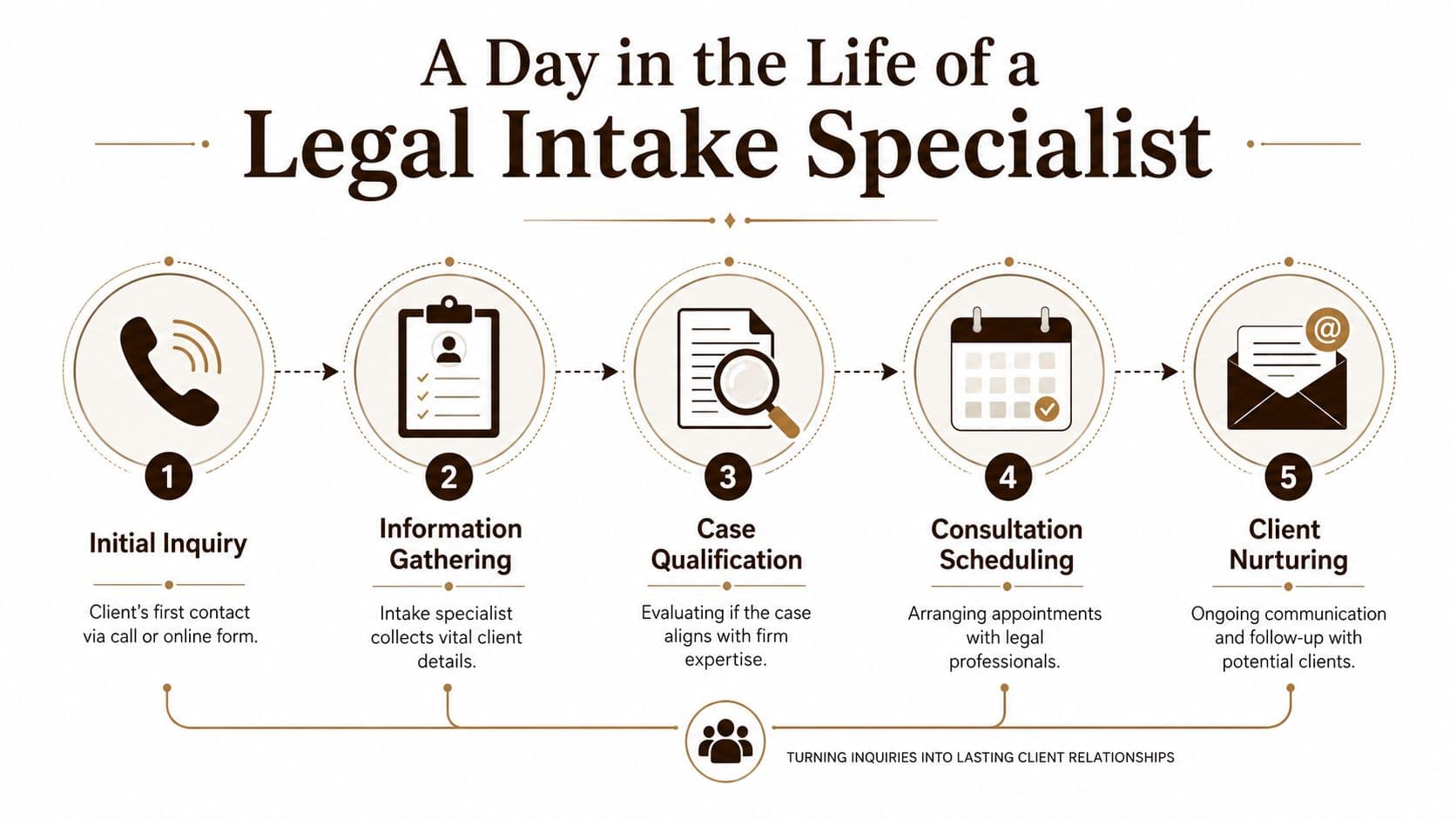
Where the day usually starts
Leads come from more than one direction. Phone calls are still central, but many firms also receive contact forms, chat submissions, referral emails, and internal transfers. The intake specialist has to work across channels without letting details scatter.
The first task is simple in theory and demanding in practice. Slow the caller down enough to gather facts, but don't make the conversation feel scripted or cold.
Client Screening
Good screening isn't interrogation. It's a controlled conversation that identifies whether the matter fits the firm's practice areas, geography, urgency, and internal criteria.
A typical opening includes basic contact information, the reason for the call, and a short timeline of what happened. In a personal injury setting, that may mean incident date, treatment status, and insurance details. In family law, it may mean jurisdiction, pending hearings, and whether the opposing party already has counsel.
Later in the day, many specialists are still working the leads that didn't convert on first contact. They're returning missed calls, clarifying details, or nudging a prospect to confirm a consultation. Follow-up is where mediocre intake breaks down. Firms often focus on the first call and overlook what happens when the prospect says, “Can you call me back this afternoon?”
What happens after the first call
Once the basics are captured, the specialist usually moves into the operational part of the job.
Conflict Checks
Before a consultation is booked, the firm needs enough identifying information to screen for conflicts and route the matter safely.
That information has to be entered cleanly into the firm's system. Depending on the office, that could be Clio Grow, Lawmatics, MyCase, Filevine, Salesforce, or a custom case management setup. Hiring managers make a common mistake in this area. They over-focus on whether a candidate has used their exact software before. What matters more is whether the person understands structured data entry, note discipline, and the importance of complete records.
After documentation comes scheduling. The intake specialist coordinates attorney calendars, sets expectations with the caller, confirms what documents to bring or send, and makes sure no one shows up confused. The best specialists also flag weak spots before the consult. If a caller sounds hesitant, disorganized, or unreachable, they note that for the attorney without editorializing.
This part of the workflow is often easier to understand after seeing it discussed in context.
The handoff that separates good from average
The final handoff should feel smooth to the client. Internally, it should answer three questions:
- Is this matter a fit
- What do we know so far
- What needs clarification at consult
If the intake specialist can do that consistently, they make attorneys more efficient and clients more confident.
Essential Skills and Qualifications for Success
The strongest intake specialists combine service instincts with operational discipline. That mix is why some candidates look excellent in an interview, then struggle in the role. They can talk well, but they can't organize details under pressure. Others are meticulous in software but too rigid on the phone to build rapport.
This role rewards balance.
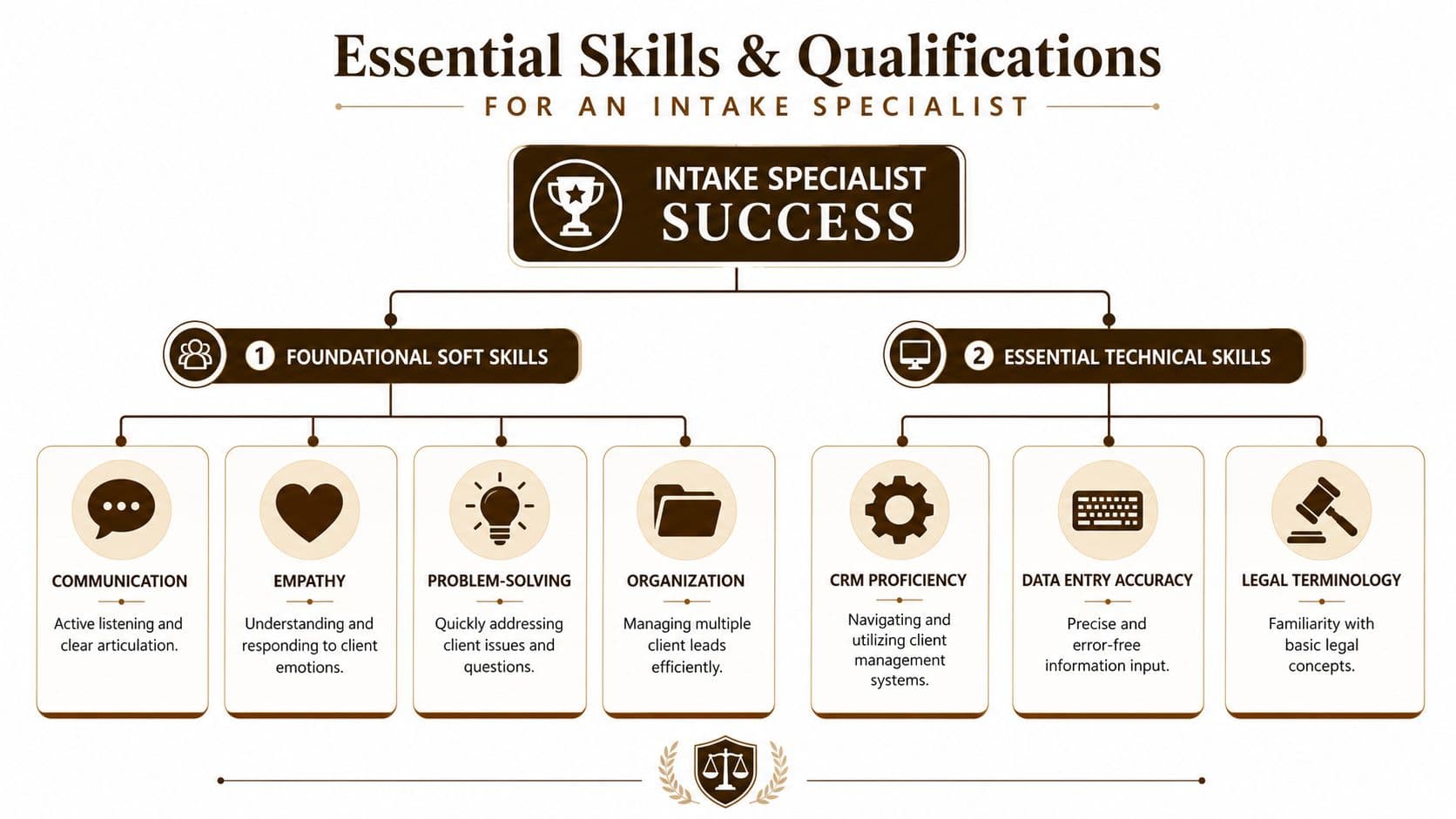
Must have soft skills
Communication comes first, but not in the vague way job ads usually mean it. In intake, good communication means asking direct questions without sounding abrupt, redirecting a talkative caller without sounding dismissive, and explaining next steps in plain English.
Empathy matters because many callers are stressed or embarrassed. Empathy doesn't mean turning the call into counseling. It means acknowledging emotion while keeping the intake moving. A strong specialist can say, in effect, “I hear that this is urgent, and I'm going to get the information we need so we can move quickly.”
Composure is what keeps a difficult call from becoming a messy file. Some callers are angry. Some want immediate legal answers. Some refuse to provide basic facts. The specialist has to stay calm and keep boundaries intact.
Essential technical proficiencies
The technical side of intake is teachable, but firms still need a baseline.
- CRM and case management fluency: Candidates should be comfortable learning platforms like Clio Grow, Lawmatics, MyCase, Filevine, or Salesforce.
- Data entry accuracy: Names, dates, opposing parties, and incident details must be entered consistently. Sloppy intake creates downstream problems.
- Calendar coordination: The role often involves attorney calendars, reminders, intake forms, and consultation logistics.
- Basic legal vocabulary: Not legal analysis. Basic terminology, common practice-area language, and procedural awareness.
A hiring manager shouldn't reject a candidate because they haven't used one exact platform before. A candidate also shouldn't assume “I'm a fast learner” is enough. Be ready to show how you've learned systems, maintained records, and handled sensitive information in prior roles.
Practical rule: Hire for judgment and train on platform details. It's much easier to teach software navigation than phone maturity.
Next level professional traits
The difference between competent and excellent usually shows up in traits that don't fit neatly into a checklist.
One is pattern recognition. Experienced specialists hear the same kinds of issues repeatedly and learn where confusion, conflict problems, or scheduling failures tend to happen. Another is ownership. They don't just log tasks. They notice when a hot lead hasn't been contacted, when an attorney note is missing context, or when a consultation was booked without enough qualifying information.
A third is scope discipline. Great intake specialists know the line between helpful and improper. They don't guess. They don't improvise legal advice. They escalate when they should.
That restraint protects the firm and builds trust internally.
Your Guide to Landing an Intake Specialist Job
Candidates often undersell themselves for intake specialist jobs because they assume firms only want direct legal experience. That's not how the best hiring decisions are made. Legal experience helps, but many strong intake hires come from medical scheduling, high-level customer service, insurance support, hospitality, admissions, front office operations, and call-heavy administrative roles.
What matters is whether you can prove relevance.
Translate your background into intake language
Start with your resume. Most resumes for this role fail because they list duties instead of outcomes and context.
Here's the kind of weak bullet I see all the time:
- Answered phones and scheduled appointments.
That tells me almost nothing. A stronger version sounds like this:
- Managed inbound client calls, gathered required information, scheduled appointments across multiple calendars, and documented next steps accurately in a CRM.
If you've worked in customer-facing roles, convert your experience into the language of intake.
- Instead of generic service: Show that you handled sensitive conversations, upset customers, or complex scheduling.
- Instead of admin support: Show that you maintained detailed records, coordinated handoffs, and protected confidentiality.
- Instead of sales language: Show that you qualified leads, followed up consistently, and moved prospects toward a defined next step.
You can find more hiring-side perspective in the Five Star Placements legal recruiting blog, especially if you want to understand how firms frame legal support roles.
What firms look for in application materials
A resume should make three things easy to spot:
- You can handle phones professionally
- You can document accurately
- You can stay organized in a fast-moving environment
A cover letter should be short and specific. Don't write about your lifelong passion for law unless you can make it believable. A better approach is to explain why your background fits the mechanics of the role. If you've handled emotional callers, multi-step scheduling, sensitive records, or high-volume communications, say that plainly.
Prepare for the interview like the job already matters
Interviews for intake specialist jobs usually go wrong when candidates stay too abstract. They say they're empathetic, detail-oriented, and good under pressure. Every candidate says that.
Bring examples.
- An upset caller: Explain how you listened, clarified the issue, and guided the conversation without escalating it.
- A documentation-heavy task: Describe how you kept records clean when things moved quickly.
- A scheduling challenge: Show how you balanced urgency, availability, and follow-through.
- A scope boundary: Share a time you knew something was outside your role and escalated it correctly.
When a firm interviews you for intake, they're not just listening to your answers. They're listening to how you sound under mild pressure.
Before the interview, research the firm with a checklist, not just a quick homepage skim.
- Practice areas: Know what kinds of matters they handle.
- Client base: Consumer-facing firms and business-facing firms need different intake styles.
- Office structure: Look for whether they appear attorney-centric, team-driven, or highly process-oriented.
- Technology hints: Job ads often reveal whether they use CRMs, call routing, or structured workflows.
- Tone: Read reviews, website copy, and attorney bios. Some firms want polished warmth. Others value speed and directness.
If you walk in knowing the firm's work and speaking clearly about workflow, you'll stand out quickly.
How to Hire an Elite Intake Specialist
Too many firms hire intake as if they're filling a support seat at the edge of the business. That mindset creates expensive turnover. If you want a strong hire, you need to treat the role as a client acquisition and risk-control function.
That changes everything from the job ad to the interview process.

Write the role like it matters
Weak job descriptions attract weak-fit applicants. If your posting reads like “answer phones, schedule consultations, perform other duties as assigned,” you'll get candidates who see the role as interchangeable office work.
Stronger postings define the actual mission. Explain that the person will manage first contact with prospective clients, screen matters using firm criteria, document intake thoroughly, support conflict workflows, and coordinate clean handoffs to attorneys or case teams.
Also be honest about the environment.
- If calls are emotional, say so
- If the pace is relentless, say so
- If scripts exist, explain how tightly they're used
- If the role includes evening or weekend coverage, put it in writing
Candidates don't quit because a role is demanding. They quit because the role they accepted wasn't the role they got.
The team behind Five Star Placements works in legal hiring across support and attorney functions, and one lesson holds across the board: clear scope improves fit.
Interview for judgment not charm
Charm can fool a hiring team. Intake requires warmth, but warmth without structure creates bad files, vague notes, and missed issues. Your interview process should test how a candidate thinks in real situations.
Use scenario questions that force trade-offs.
- A caller is frantic and wants legal advice immediately. How do you respond while staying within scope
- You're speaking with a prospective client who gives a long, disorganized story and keeps skipping dates and names. How do you regain control of the intake
- A caller refuses to provide identifying information but wants to know whether the firm can take the matter. What do you do next
- An attorney's calendar is full, but the matter sounds urgent and time-sensitive. How would you handle the scheduling and internal escalation
- You notice that a consultation was booked with incomplete notes and no clear conflict information. What would you do before the attorney takes the meeting
Listen for more than politeness. Good candidates will talk about structure, clarification, documentation, escalation, and boundaries. Weak candidates drift into reassurance without process.
A polished interview doesn't matter if the candidate can't run a controlled intake call.
Onboarding decides whether the hire sticks
Firms often blame the employee when intake turnover happens, but the onboarding is usually part of the problem. New specialists need more than a login and a script. They need to understand what makes a good lead, what disqualifies a matter, when to escalate, how to document edge cases, and where scope ends.
A workable onboarding plan usually includes:
- Shadowing live calls: Let the new hire hear how experienced staff manage different caller types.
- Script training with flexibility: Scripts matter, but rigid reading sounds robotic. Train the purpose behind each question.
- System walkthroughs: Show exactly where notes go, how tasks are assigned, and how consultations are confirmed.
- Feedback loops: Review early calls and notes quickly, while habits are still forming.
The firms that do this well don't just fill intake roles. They build reliable front-end teams.
Intake Specialist Salary and Career Path in 2026
Compensation is one of the first questions candidates ask and one of the most mishandled topics in hiring. There's no single clean number that fits every intake specialist job. Pay shifts based on practice area, market, schedule demands, software expectations, whether the role includes lead qualification or only scheduling, and how much responsibility sits at the intake desk.
Without verified market-wide data, the most honest approach is to treat salary as a range shaped by role design, not title alone.
How compensation usually gets shaped
Firms tend to pay more when the role asks for more than basic call handling. If the intake specialist is expected to screen for fit, manage detailed records, coordinate with attorneys directly, handle emotionally charged calls, and own follow-up, that role should be priced above a simple receptionist model.
A practical way to think about compensation is by comparing scope.
| Experience Level | Boutique/Small Firm (1-10 Attorneys) | Mid-Size Firm (11-50 Attorneys) | Large Firm (50+ Attorneys) |
|---|---|---|---|
| Entry-Level | Varies based on training provided, call volume, and whether the role is mostly scheduling or true intake | Often higher when structured systems and broader responsibilities are in place | Usually tied to process complexity, shift expectations, and internal support layers |
| 3-5 Years | Often rewards independence and cross-training in intake, case support, or office operations | Commonly reflects stronger screening judgment and system ownership | May include specialized workflows, formal performance review structures, and team coordination |
| Senior/Manager | Typically depends on whether the person supervises staff or improves process | Often expands into team leadership, reporting, and workflow management | Frequently tied to management scope, multi-office coverage, and training responsibility |
That table won't give a candidate a specific number, but it does show what both sides should be evaluating. Title alone won't tell you much. Scope will.
A practical career ladder
One reason intake specialist jobs attract ambitious candidates is that the role sits close to multiple growth paths inside a law firm.
Common next steps include:
- Intake Manager: For specialists who can coach others, refine scripts, and own workflows.
- Case Manager: A natural move for people who like client contact and ongoing coordination after sign-up.
- Paralegal track: Especially where the firm supports further training and the person wants deeper legal work.
- Firm Administrator or Operations support: For specialists who show strength in systems, scheduling, reporting, and process design.
For candidates, the right question isn't just “What does this role pay now?” It's “What does this role lead to here?” A firm that can't answer that may still be worth joining, but you should go in with clear eyes.
For employers, career path clarity matters because strong intake people usually don't want to stay static forever. If you want them to stay, show them the lane.
Find Your Next Role or Your Next Hire
The market for intake specialist jobs rewards precision. Public job boards cast a wide net, but they also create noise. Candidates waste time applying into vague postings. Firms waste time sorting through people who can interview well but don't understand the pace, boundaries, or judgment the role requires.
That's why better outcomes usually come from tighter targeting.
Candidates should look beyond title alone. Read postings for scope, software, practice area, call volume, and reporting structure. Ask how intake is measured. Ask who owns training. Ask whether the role is viewed as the front end of client acquisition or just overflow admin work.
Hiring managers should do the same kind of sorting in reverse. Don't overvalue direct legal experience if the candidate lacks composure or note discipline. Don't dismiss transferable backgrounds too quickly. Some of the best legal intake hires come from adjacent environments where calm communication, documentation, and follow-through were already essential.
A specialized legal recruiter can narrow that gap because they know what success looks like before the resume hits your inbox. For firms, that means fewer interviews with poor-fit candidates. For job seekers, it often means access to better-matched openings and more candid guidance about what a firm is really looking for.
Here's the firm site if you want a direct sense of the market they work in.
If you're ready to move, the smartest next step is usually a focused one. Candidates should pursue roles that match their actual strengths, not every posting with “intake” in the title. Employers should build a hiring process that tests real intake judgment, then support the hire with training that reflects the stakes of the job. For direct help on either side, reach out through Five Star Placements contact options.
Five Star Placements helps law firms hire legal support professionals, attorneys, operations leaders, and intake talent with a practical, search-driven approach. If you're hiring for an intake role or exploring your next move in legal support, connect with Five Star Placements for targeted guidance and direct placement support.
Need help filling a legal role?
Five Star Placements partners with law firms and legal departments nationwide.
Schedule a Call