
Boutique Law Firm Recruiting Playbook for Growth
August 14, 2026 · 11 min read · Five Star Placements

Table of contents
Your phone lights up with another partner asking why the associate seat is still open, while the practice group keeps losing hours to coverage gaps and the strongest candidates keep disappearing into faster-moving firms. In a boutique, that pressure doesn't feel abstract. It shows up in missed handoffs, stretched teams, and a hiring process that can't afford to wander.
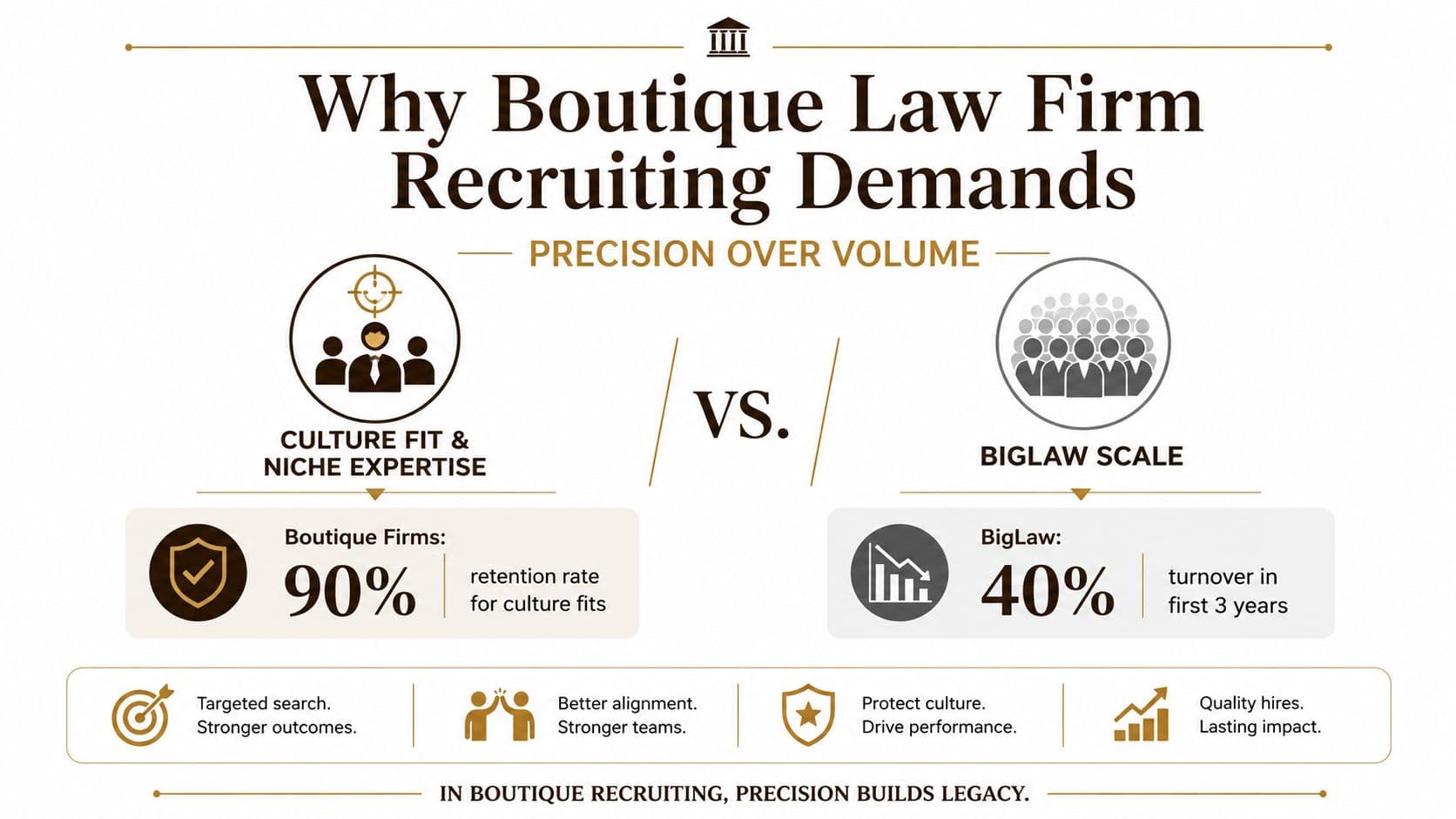
That's why boutique law firm recruiting has to be treated as precision hiring, not a BigLaw volume exercise. The firms that do it well aren't trying to review the most resumes. They're trying to identify the handful of people who can do the work, fit the culture, and stay long enough to matter.
Table of Contents
- Why Boutique Law Firm Recruiting Demands Precision Over Volume
- Defining Your Hiring Needs and Crafting a Role Brief That Attracts Fit
- Targeted Sourcing That Builds a Repeatable Talent Pipeline
- Screening and Interview Frameworks That Reveal Culture Fit and Billable Readiness
- Onboarding and Retention Strategies That Protect Your Hiring Investment
- How to Use Metrics and When to Engage a Contingency Legal Recruiter
Why Boutique Law Firm Recruiting Demands Precision Over Volume
A boutique hire usually starts with a very practical question, not a branding exercise. Who can walk in, handle the right matters, and keep the practice moving without creating extra supervision? In that environment, a flood of generic candidates is more of a liability than a strength.
The market has already shifted toward smaller firms. In BCG Attorney Search's 2019 State of the American Lateral Law Firm Legal Market Report, the share of placements in mainstream corporate and litigation practice areas outside the Am Law 200 rose from 39.61% in 2017 to 43.81% in 2018, and interviews rose from 39.16% to 44.33% over the same period (BCG Attorney Search report). The report also says the “lion's share” of placement and interview activity had shifted away from the largest firms and toward boutiques and small-to-midsized firms by 2018.
That matters because it changes what candidates expect. They are not just comparing logos, they're comparing practice quality, responsiveness, and whether the firm can show them a real path inside a narrower platform. A boutique that knows exactly what it needs can move faster and sound more credible than a larger platform that is still debating the role.
Practical rule: If you can't describe the role in a way that a serious lateral would understand in one conversation, you're not ready to source.
Boutique firms also lose more from every vacancy. One empty seat can mean delayed client work, partner distraction, and more pressure on the next hire to be flawless. That is why process discipline matters as much as candidate quality, and why firms like Five Star Placements position their screening around fit instead of raw volume.
Defining Your Hiring Needs and Crafting a Role Brief That Attracts Fit
A strong role brief starts with internal alignment, not a job posting. Partners often think they need “a strong litigator” or “a corporate generalist,” but those labels don't tell a recruiter what to find or a candidate why the move is worth making. The sharper the brief, the less time you spend undoing bad assumptions later.
Start with the work, not the title
List the matters the hire will touch, the clients they'll serve, and the pain points they'll relieve. Then separate must-have experience from nice-to-have exposure. If the firm needs someone who can step into a niche practice with minimal ramp, say that plainly.
Budget conversations belong in the brief too. Boutique compensation often has to reflect business realities, but candidates need to understand the upside in autonomy, responsibility, and visibility. If you hide the trade-off behind vague language, serious candidates assume the firm is being evasive.
Write for the candidate you want, not the one you'll settle for
Generic job descriptions push away the people you want. Phrases like “fast-paced environment” and “competitive salary” don't sell a boutique platform. Specific language does, especially when it describes direct access to partners, matter ownership, or a path into a growth practice.
A clean role brief also protects the partners from themselves. When everyone signs off on the scope before the search begins, you don't get a late-stage veto because someone suddenly wanted a different profile.
The market is tighter than many firms want to admit. Reuters reported in August 2026 that law firms with 500 or more lawyers hired 7.5% fewer entry-level associates from the Class of 2025 than the year before, about 540 fewer graduates, and that it was the first decline in BigLaw entry-level hiring since 2014 (Reuters). That doesn't just affect large firms, it raises the bar everywhere. A boutique that knows its role, its needs, and its pitch can still move decisively while others are hesitating.
Targeted Sourcing That Builds a Repeatable Talent Pipeline
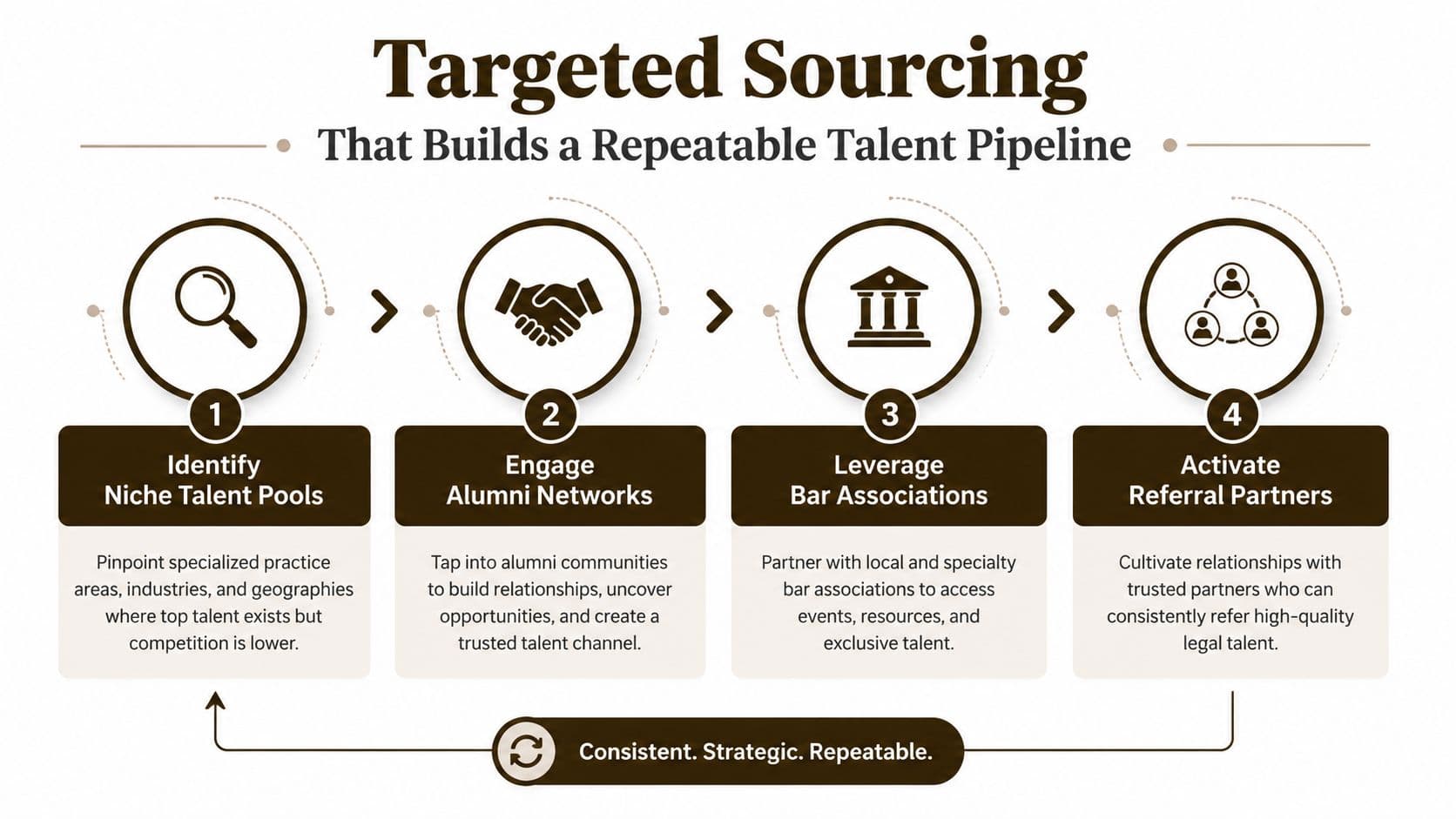
Boutique sourcing works best when it behaves like relationship management, not broadcasting. Many of the best candidates never respond to a posted opening because they're not shopping resumes on public boards. They move when a trusted person reaches out with a clear, credible opportunity.
Build the list before you build the search
Start with the actual talent pools, not the job title. For a trusts and estates seat, that means attorneys in nearby firms, local bar circles, and alumni networks where the work is visible and reputation travels quickly. For healthcare, construction, or another niche, the pool is usually narrower, which is exactly why broad posting rarely solves the problem.
Use trusted channels in the right order
The point isn't to spray outreach across every channel at once. It's to use a sequence that preserves credibility and keeps the market from feeling saturated.
- Lead with known networks: Alumni groups, local bar associations, and prior colleague relationships usually surface the best referrals first.
- Use recruiters where trust already exists: Boutique and midsized firms often rely on a small set of trusted recruiters instead of advertising widely, which is why outreach has to feel selective, not mass-market (Atticus Recruiting).
- Keep the message specific: Say what kind of matters the role handles, what kind of autonomy exists, and why the move is relevant now.
- Track who responds and why: If certain practice groups or markets produce stronger candidates, feed that back into the next search instead of starting from zero.
The biggest mistake is acting like every opening needs a public announcement. It doesn't. A stealth search, or even a quiet one, can preserve negotiation power and avoid triggering noise among candidates who are already employed.
One useful way to think about a boutique pipeline is as a long-memory system. The people who aren't ready this quarter may be ready next quarter, if you've built enough trust to stay in the conversation. That's why the best search teams keep a disciplined contact log and treat referrals as an asset, not a one-off favor.
For a practical example of how firms think about recruiter-fit and market coverage, the Five Star Placements blog is worth reviewing for how hiring teams frame role intake and outreach.
Screening and Interview Frameworks That Reveal Culture Fit and Billable Readiness
A résumé can tell you where someone has worked. It cannot tell you whether that lawyer will hold up under client pressure, meet deadlines without constant supervision, or work well inside a small partner group. Boutique recruiting has to answer those questions early, because one weak hire is felt immediately.
Use a short, disciplined workflow
For boutique and lateral law-firm recruiting, a 6 to 12 week process is the right shape. Use 1 to 2 weeks for stakeholder alignment and role definition, 3 to 5 weeks for sourcing and screening, and 2 to 4 weeks for interviews, evaluation, and offer negotiation (Global Legal Market). That timeline keeps the search moving and stops the process from drifting while partners debate the brief.
Keep the interview slate tight. Firms that limit the process to four to five rounds and maintain a structured communication cadence are reported to reach 94% one-year retention, compared with a 54% industry average for lateral partner hires. The point is not that more interviews create loyalty. A controlled process forces better judgment, keeps candidates engaged, and reduces the dead time that makes strong lawyers lose interest.
Screen for portable value before you get attached
Billable readiness is more than confidence in a conversation. It means knowing whether the attorney can contribute at the level the firm needs. Reference work, matter-level performance questions, and conflicts review do that work better than instinct alone.
Practical rule: Check whether the candidate's experience is real, portable, and relevant before final approval. That is where boutique firms save weeks and avoid bad fits.
A good boutique screen usually includes these pieces:
- Structured behavioral questions: Ask how they handled a difficult client, a compressed deadline, or a team conflict.
- Work samples or matter walk-throughs: Use real examples to test judgment, not just polish.
- Client-handling discussion: Find out how they communicate when the answer is uncertain.
- Lateral Partner Questionnaire and conflicts review: Use the LPQ stack to assess portable value and fit before the offer stage.
- Colleague and adversary references: Those checks often reveal how the candidate performs under pressure.
Reuters reported that 30% to 40% of laterals leave within five years, and that many never reach the revenue numbers they projected when they joined a new firm (Reuters). That is why the interview process cannot reward charisma alone. It has to pressure-test durability.
A boutique partner should leave the process able to answer one question clearly. Can this person do the work, with this team, at this pace, without creating more risk than they solve? If the answer is unclear, the search is not ready to close.
Onboarding and Retention Strategies That Protect Your Hiring Investment
A hire only matters if the person stays and produces. Boutique firms understand that immediately, because every departure lands hard on a small team. Onboarding is part of recruiting, not the end of it.
Laterals do not always stay long enough to pay back the move, as noted earlier. Some also fall short of the business case they presented during hiring. That is why the work starts after the offer letter, when the firm has to turn a good decision into a durable one.
Make the first 90 days count
The opening months need structure. Client transitions should have a clear owner, internal introductions should happen early, and the new hire needs real work quickly enough to feel useful. Waiting for them to sort it out on their own is a luxury smaller firms usually do not have.
Expectations should be concrete as well. If a lateral is expected to contribute to business development, spell out what that looks like in this firm, with these partners, on these matter types. If the role has limited originations at first, say that plainly too. Ambiguity is where disappointment starts.
Keep the levers practical, not theatrical
Boutiques keep people when the day-to-day setup works.
- Autonomy: Let the hire own meaningful matters instead of treating them like a junior helper.
- Responsive support: Paralegals, assistants, and legal ops support can shape the experience quickly.
- Transparent growth paths: A candidate should know what success looks like in six months and twelve months.
- Flexible comp conversations: A pay mismatch does not disappear on its own, and it gets harder to fix once it is ignored.
The firms that lose people fastest usually miss the same signals. The new hire is underused, cut off from the practice, or surprised by how the work flows. Once that gap opens, loyalty weakens. If the person cannot see a path to useful contribution, the job starts to feel temporary.
A strong onboarding process also gives the team a shared language for feedback. That makes it easier to address flight risk early, before disengagement turns into resignation. In a boutique, retention is not a separate project. It is the return on the hiring process.
How to Use Metrics and When to Engage a Contingency Legal Recruiter
If the search is not being measured, it is being guessed at. Boutique firms do not need a dashboard full of vanity metrics. They need a small set of numbers that show whether the process is disciplined and whether the hire is likely to hold up.
Track time-to-fill, shortlist quality, offer acceptance, and one-year retention. Add a check on whether the candidate brought the experience they claimed, especially for laterals making portable business claims. Those metrics show whether the firm is moving with enough speed and enough discipline to make a sound hire.
Use post-hire review to improve the next search
After the hire starts, ask three things. Where did the search slow down, which candidates got the strongest partner support, and what questions surfaced the key issues too late? That review helps a boutique get smarter from one opening to the next instead of repeating the same errors.
A contingency recruiter makes sense when the internal team is already stretched, the role is sensitive, or the market requires access to passive candidates you will not reach through postings alone. It also works well when you want outside screening without taking on upfront search fees. For firms that need a direct intake path, the Five Star Placements contact page is the simplest place to start the conversation.
Use the recruiter as an extension of your team and set clear expectations from the start. Give them the role brief, the deal-breakers, the must-hit timeline, and the concerns that usually surface late in the process. Then expect them to screen for fit, keep communication tight, and tell you quickly when the market is pushing back.
The firms that get the most from contingency recruiting are not the ones asking for more names. They are the ones asking for better signal. That fits boutique law firm recruiting, because the goal is not filling seats. It is building a practice that can carry more work without breaking the people already inside it.
Need help filling a legal role?
Five Star Placements partners with law firms and legal departments nationwide.
Schedule a Call